
Emerging Indian Cinema Talent: The Next Generation of Stars and Filmmakers
Written by RVLNSV PRASAD
Independent Writer & Researcher
Published: August 30, 2026
Last Updated: August 30, 2026
Reading time: 12–15 minutes
Introduction
The next important name in Indian cinema may not come from the traditional route to stardom.
An actor might be discovered through an independent film. A director might first attract attention at a festival. A writer might develop a career through streaming. A cinematographer, editor, or VFX artist might become influential without ever appearing on screen.
That is why emerging Indian cinema talent is a bigger subject than a list of young actors.
Indian cinema is becoming more interconnected across languages, platforms, and production systems. The International Film Festival of India’s Creative Minds of Tomorrow program has developed into a structured platform for emerging filmmakers, writers, editors, animators, and other artists, with the 2025 program recognizing talent across multiple filmmaking disciplines.
The industry is also creating new routes for writers. In July 2026, Netflix announced its NextGen India Writers’ Program to identify and develop a new generation of Indian storytelling voices.
So who deserves attention?
There is no reliable way to predict who will become an icon. Fame can disappear quickly, while a relatively unknown creator can produce one piece of work that changes a career.
A better approach is to look for evidence of potential: distinctive work, strong craft, recognition, creative risk, audience connection, and promising opportunities ahead.
This article uses those factors to examine the people and systems that could shape the next chapter of Indian cinema.
Key Takeaways
- Future cinema icons are not defined by age alone. A stronger indicator is a distinctive body of work and the ability to develop creatively.
- Emerging talent is coming from many parts of India, not just the largest Hindi-language production centers. IFFI‘s talent programs deliberately draw participants from across the country.
- Actors are finding different routes to recognition, including independent films, regional cinema, streaming, and festival discoveries.
- Directors and writers may be just as important as future stars, because strong storytelling often creates the performers and films audiences remember.
- IFFI‘s Creative Minds of Tomorrow provides institutional evidence of India’s emerging talent pipeline, covering numerous filmmaking crafts rather than acting alone.
- Streaming is creating additional opportunities for new writers and creators, including through Netflix‘s 2026 NextGen India Writers’ Program.
- Regional cinema is central to the future of Indian cinema, with talent increasingly moving across language and industry boundaries.
- No emerging artist should be described as a guaranteed future superstar. The most responsible approach is to identify talent worth watching and explain the evidence behind that assessment.
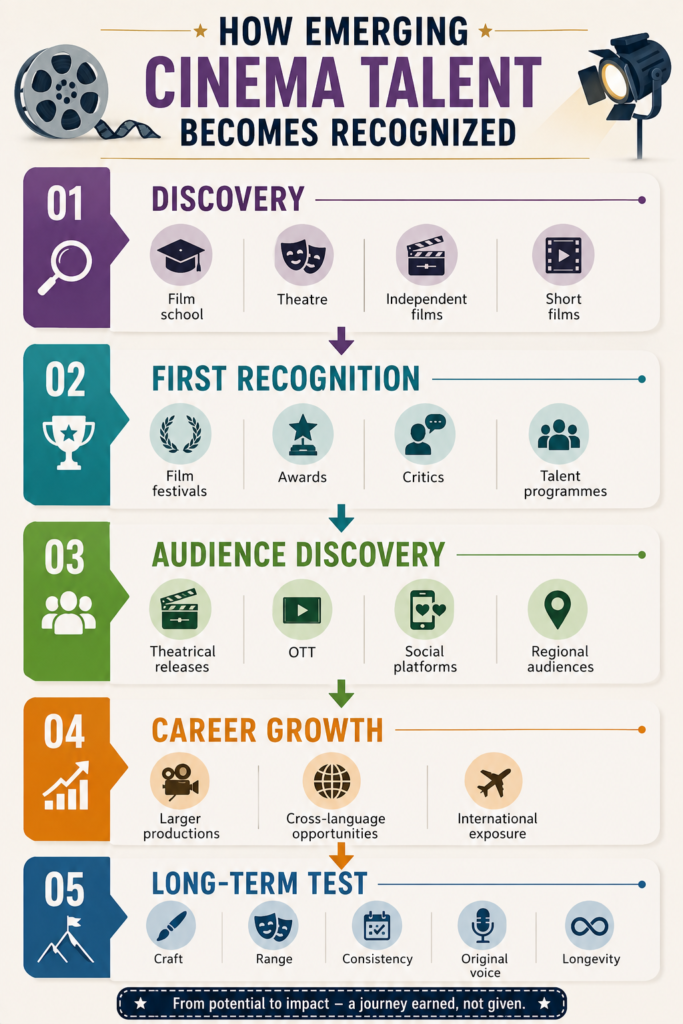
What Makes Emerging Talent Worth Watching?
Being young, popular on social media, or attached to a successful film is not enough to establish a long-term career.
A more useful evaluation looks at several factors.
Distinctive work
Does the actor or filmmaker already have something recognizably their own?
A memorable performance or unusual directorial voice can be more meaningful than a large follower count.
Craft
Talent becomes sustainable when it is supported by skill.
For actors, that might involve emotional control, dialogue delivery, physical performance, or the ability to disappear into different characters.
For filmmakers, it can mean visual language, structure, pacing, sound design, or the ability to create memorable characters.
Creative risk
An emerging artist who repeatedly chooses safe opportunities may become successful, but an artist willing to experiment can sometimes create a more distinctive career.
Recognition
Awards and festival selections do not guarantee future success, but they can provide evidence that professional audiences have noticed the work.
The Creative Minds of Tomorrow program is one example of this structured recognition. IFFI describes CMOT as a platform for emerging filmmakers, writers, editors, animators, and artists representing the future of Indian cinema.
Its 2025 selection jury itself covered 13 crafts, including direction, scriptwriting, cinematography, editing, acting, music, costume design, animation/VFX/AR/VR, and sound.
Ability to evolve
Perhaps the most important factor is whether an artist can develop after an early success.
The film industry changes quickly. The performer who succeeds in one type of role may later need to demonstrate completely different abilities.
That is why a career should be evaluated as a journey rather than a single breakthrough.
The New Generation of Indian Actors
The phrase “future star” is often used too casually.
A better question is
Which performers have already shown enough work to make their next stage worth following?
Recent institutional programs provide one useful source of evidence.
The 2025 Creative Minds of Tomorrow program recognized Arpit Raj as Best Actor and Sajumi Hamalkar as Best Actress. The same program also recognized directors, writers, and cinematographers, demonstrating how emerging talent can be identified across an entire production rather than through celebrity status alone.
That is significant because short-film recognition can reveal abilities that commercial casting does not always expose.
A new actor may not yet have a major box-office film.
But a strong performance in a festival or short-film environment can demonstrate timing, emotional control, and character work.
Arpit Raj: Recognition Through a New-Talent Platform
Arpit Raj’s selection as Best Actor in the 2025 Creative Minds of Tomorrow competition is a concrete example of institutional recognition at an early stage. The official Press Information Bureau record identifies him as the Best Actor for The Paper Sky, which won Best Film.
That does not make him a guaranteed future star.
It does, however, give readers a reason to watch what he does next.
This is the distinction between prediction and evidence.
Sajumi Hamalkar: Another Emerging Performance to Watch
Sajumi Hamalkar was recognized as Best Actress for The Spit Show in the same 2025 program, while the film received the runner-up award.
Her recognition also illustrates why emerging-talent coverage should not focus exclusively on people who have already accumulated mainstream publicity.
A festival or institutional program can sometimes provide an earlier signal.
The next step is whether that promise develops into sustained screen work.
Why Regional Cinema Matters
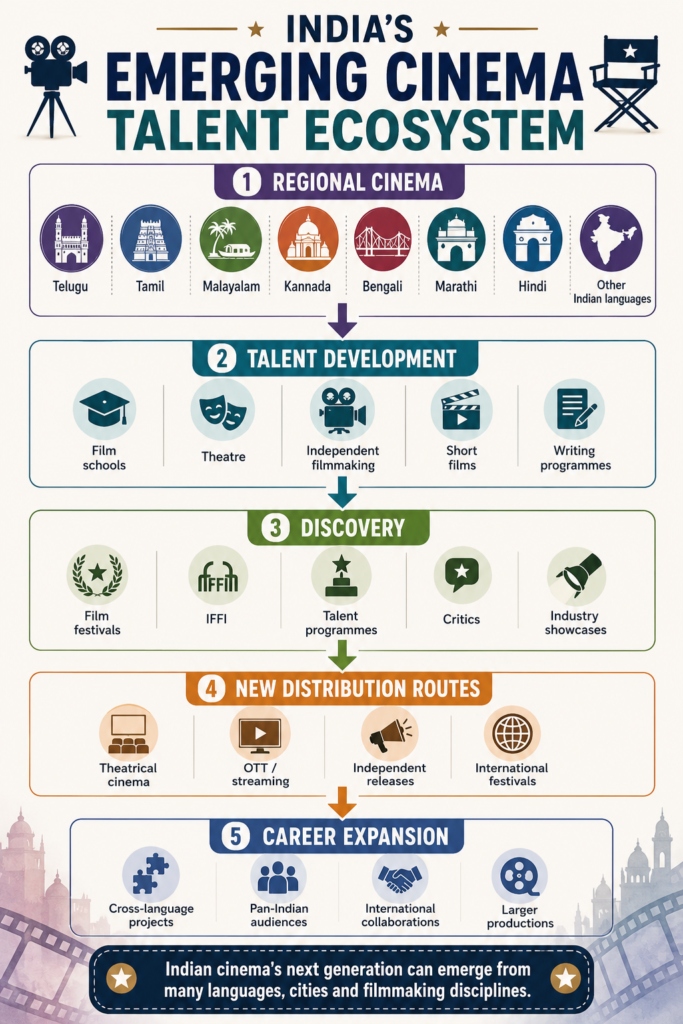
Indian cinema is not a single industry.
It is a network of film cultures operating in different languages, markets, and creative traditions.
Telugu, Tamil, Malayalam, Kannada, Bengali, Marathi, Hindi, and other industries have their own stars, directors, writers, and production ecosystems.
That diversity matters when considering future talent.
An actor who becomes known in one regional industry may later receive opportunities in another. A filmmaker can gain festival recognition before entering a larger commercial production. A story created for a regional audience can eventually travel much further through subtitles, dubbing, and streaming.
IFFI’s talent initiatives reflect this geographic diversity. The festival describes CMOT as a platform for young creative talent and has expanded the initiative across numerous filmmaking disciplines.
The broader lesson is important: the next significant Indian cinema talent does not have to emerge from one traditional film center.
Emerging Directors Could Shape the Next Decade
Actors are the most visible part of cinema, but directors often determine the artistic identity of an entire project.
The 2025 Creative Minds of Tomorrow awards provide a useful example.
Raghu Arav received Best Director for The Paper Sky, which also won Best Film. Vishwas K won Best Script for The Spit Show, while Ramiz Naveeth received Best Director of Photography. These results are documented by the Press Information Bureau.
These awards matter because filmmaking is collaborative.
A director needs actors.
Actors need strong scripts.
Scripts need visual interpretation.
The cinematographer, editor, sound team, and other craftspeople turn an idea into a finished film.
This is why the future of Indian cinema should not be discussed only through future actors.
The next influential filmmaker may be the person whose visual or narrative approach changes what audiences expect from an entire genre.
Chidananda S. Naik Shows How a Short Film Can Travel Far
One of the clearest recent examples of emerging Indian filmmaking talent is Chidananda S. Naik.
His Kannada short film Sunflowers Were the First Ones to Know was selected for the La Cinef section of the 2024 Cannes Film Festival. The official government record notes that it was an FTII student film and one of 18 shorts selected from 2,263 submissions from film schools worldwide.
The film subsequently won the first prize at Cannes’ La Cinef. The Press Information Bureau records Chidananda S. Naik as the student director and identifies the film as a Kannada-language project inspired by Indian folk stories and traditions.
The film later qualified for the 2025 Academy Awards in the Live Action Short Film category.
This is precisely the kind of career development that makes emerging talent worth studying.
Naik did not need to begin with a large commercial feature.
A short film rooted in Indian folklore travelled from a film school environment to Cannes and then to the Oscars qualification process.
That does not guarantee the shape of his future career.
It does demonstrate that a distinctive story can create international visibility even at an early stage.
Writers May Become the Most Important Emerging Voices
The future of cinema is often discussed through actors and directors, but writers determine what those people are given to perform.
A weak script can limit a brilliant actor.
A strong script can introduce an unknown performer to millions of people.
That is why the development of new writers deserves attention.
In July 2026, Netflix announced its NextGen India Writers’ Program. Netflix describes the program as a search for the next generation of Indian storytelling voices and says the initiative is intended to help writers develop original series concepts.
This is significant for two reasons.
First, it recognizes that new writers need structured pathways into the industry.
Second, it reflects the growing demand for stories that can work across India’s many cultural and linguistic contexts.
Netflix’s announcement also emphasizes the international reach that Indian stories now have, with stories rooted in India’s cultures, languages, and lived experiences finding audiences beyond the country.
That creates opportunities for writers who understand specific communities rather than trying to make every story feel generic.
Climate, Identity, and Social Themes Could Open New Writing Careers
Emerging writers do not have to imitate established commercial formulas.
In April 2026, Netflix and PLUC launched India’s first Climate Scriptwriting Lab. The program is designed to engage 60 emerging writers across Delhi-NCR, Mumbai, Hyderabad, and Guwahati over eight months, supporting them in developing feature-film and short-fiction scripts.
The importance of such initiatives goes beyond climate storytelling.
It shows how a contemporary subject can become a creative opportunity when writers are given support to transform real-world issues into accessible screen stories.
Future cinema icons may therefore emerge from unexpected subjects.
A writer does not necessarily become important because they imitate the biggest film of the year.
They may become important because they find a compelling way to tell a story that other filmmakers have overlooked.
Film Festivals Are Still Career Launchpads
The rise of streaming has not made film festivals irrelevant.
If anything, festivals can provide a different kind of visibility.
A festival selection can place a new filmmaker in front of:
- critics
- programmers
- producers
- distributors
- actors
- international audiences
- other filmmakers
IFFI’s current CMOT program describes itself as a platform connecting emerging creative talent with global industry leaders, filmmakers, and producers.
The program has also demonstrated that emerging artists can be recognized for specific crafts rather than only for directing.
In 2025, its awards included acting, direction, scriptwriting, and cinematography.
That is important for people searching for future Indian cinema talent.
The next influential creator might not be the person whose face is already familiar.
It might be the cinematographer whose visual language becomes recognizable, the editor who changes a genre’s rhythm, or the writer whose scripts begin attracting major directors.
Streaming Is Changing the Route to Recognition
The traditional path to stardom often involved a theatrical film, a production house, a major cast, and eventually audience recognition.
That route still exists.
But streaming has added alternatives.
A performer can now build recognition through a series.
A writer can have a project discovered by a streaming development team.
A director can establish a reputation through a limited series or independent feature.
Netflix’s NextGen India Writers’ Program provides concrete evidence of this broader talent pipeline. The company says the program is intended to identify new voices and help them develop original series concepts.
But streaming should not be romanticized.
A digital release does not automatically create a lasting career.
The same principles still matter:
good writing, strong performances, memorable direction, and the ability to keep improving.
Women Are Essential to the Next Generation of Indian Cinema
A realistic discussion of emerging Indian cinema talent must include women not simply as performers but across the entire filmmaking process.
Actors, directors, writers, cinematographers, editors, producers, and technicians all contribute to the future of the industry.
IFFI has explicitly expanded CMOT across multiple filmmaking crafts, including acting, direction, writing, cinematography, editing, and technical disciplines.
This matters because talent development should be evaluated across the whole filmmaking ecosystem.
The future of Indian cinema will be stronger when women have opportunities not only to perform in stories but also to decide which stories get made and how they are told.
Technology Is Expanding the Creative Toolbox
Technology is changing filmmaking, but it should not be confused with creativity itself.
Virtual production, affordable cameras, digital editing, VFX, animation, and AI-assisted tools can reduce some production barriers.
IFFI’s CMOT selection structure itself recognizes emerging talent in animation, VFX, augmented reality, and virtual reality, alongside traditional crafts.
The 2025 IFFI ecosystem also incorporated technology-focused creative activity, reflecting the increasing interaction between filmmaking and new production tools.
These developments matter because future filmmakers may not work inside the same boundaries as earlier generations.
However, technology does not automatically create good cinema.
A sophisticated visual-effects system cannot compensate for an unconvincing character.
An AI tool cannot replace judgment about what a story needs.
The strongest emerging creators will probably be those who use technology in service of storytelling, rather than treating technology itself as the story.
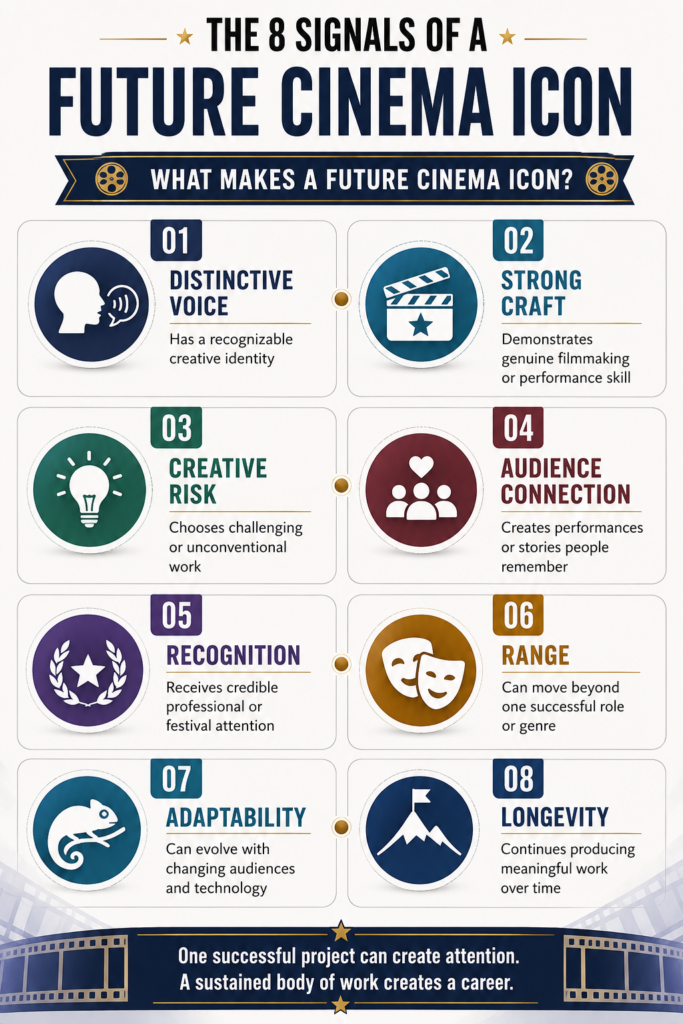
What Separates a Rising Talent From a Future Icon?
This is the most important question in the entire discussion.
A future icon needs more than one successful project.
A distinctive voice
The work should feel like it came from a particular person rather than from an interchangeable production system.
Strong craft
Talent has to be supported by continuous improvement.
Range
An actor who can perform only one character type may become successful, but range can create longevity.
Smart choices
The projects an artist refuses can sometimes be as important as the projects they accept.
Audience connection
Critical recognition matters, but cinema ultimately reaches people.
Collaboration
Filmmaking is not an individual sport. The ability to work with writers, directors, cinematographers, and performers is part of building a career.
Adaptability
Platforms, audience habits, and production technology change.
An artist who cannot evolve may struggle even after an early breakthrough.
Longevity
This is the hardest test.
A future icon is not someone who becomes famous once.
It is someone whose work continues to matter.
The Challenges Emerging Artists Still Face
The new pathways into cinema create opportunities, but they do not remove the industry’s difficulties.
Emerging creators still face:
- financial pressure
- inconsistent employment
- competition for attention
- limited access to producers
- typecasting
- dependence on social media visibility
- uneven distribution opportunities
- pressure to reproduce an early success
- difficulty sustaining independent projects
There is also a danger in judging talent too quickly.
An actor who has one viral performance may not yet have a career.
A director who wins a festival prize still needs opportunities to make a second film.
A writer with one successful series must demonstrate that the first success was not an isolated event.
That is why this article uses the phrase “worth watching,” rather than declaring anyone a guaranteed future icon.
What Indian Cinema Could Look Like by 2035
The next decade is likely to make the boundaries between India’s film industries even less rigid.
A Telugu actor may appear in a Hindi production.
A Malayalam filmmaker may attract a national audience through streaming.
A Kannada short film may travel internationally through festivals.
A writer in a smaller city may develop a series for a global platform.
Technology will make some aspects of production more accessible, while festivals and talent programs will continue to identify creators.
There may also be greater collaboration between film, streaming, gaming, animation, and other visual-media industries.
The strongest change, however, may be cultural rather than technological.
Audiences are becoming more comfortable discovering stories without needing a familiar star’s name on the poster.
That creates room for newcomers.
But it also creates greater competition.
The future icon will therefore need something difficult to manufacture:
a body of work people remember.
Why Emerging Indian Cinema Talent Deserves Attention Now
The most interesting thing about India’s next generation is not that there are more young people trying to enter the industry.
It is that there are more routes through which talent can be discovered.
IFFI’s Creative Minds of Tomorrow provides an institutional pathway.
Film schools provide another.
Festivals create international visibility, as demonstrated by Chidananda S. Naik’s Cannes success.
Streaming platforms are developing writers and creators through initiatives such as Netflix’s NextGen India Writers’ Program.
Independent filmmaking provides space for experimentation.
Regional industries continue to generate performers and filmmakers with distinct cultural identities.
The result is an ecosystem in which the next major artist can emerge from several different directions.
That does not mean everyone selected by a talent program will become famous.
It means the discovery process itself is becoming broader.
And that is worth paying attention to.
Frequently Asked Questions
Who are emerging Indian cinema talents?
Emerging Indian cinema talent includes actors, directors, writers, cinematographers, editors, musicians, and other creators who are beginning to gain recognition through films, festivals, streaming projects, talent programs, or independent work.
What makes someone a future star of Indian cinema?
A future star needs more than popularity. Distinctive performances, strong craft, audience connection, good project choices, adaptability, and sustained work are stronger indicators of long-term potential.
Why are film festivals important for emerging filmmakers?
Festivals can provide recognition, professional connections, critical attention, and opportunities to meet producers and distributors. IFFI’s CMOT program specifically aims to connect emerging creators with industry leaders and other filmmaking professionals.
Is OTT helping new Indian actors and writers?
Streaming has created additional routes for performers and writers, although success is not guaranteed. Netflix’s 2026 NextGen India Writers’ Program is one example of a structured initiative aimed at developing new Indian writing talent.
Why is regional cinema important to India’s future?
Regional industries contain their own creative traditions, audiences, and talent pools. As films travel through subtitles, dubbing, festivals, and streaming, artists can increasingly reach audiences outside their original language market.
Can a short film launch an international career?
It can create significant visibility, although it cannot guarantee a long-term career. Chidananda S. Naik’s Sunflowers Were the First Ones to Know is a strong recent example: the student film won Cannes’ La Cinef award and later qualified for the Oscars’ Live Action Short Film category.
Will AI replace filmmakers?
AI is likely to change some filmmaking processes, but technology does not remove the need for creative judgment, storytelling, performance, and collaboration. IFFI’s CMOT structure already recognizes emerging work in technology-linked disciplines, including animation, VFX, AR, and VR.
Can anyone be called a future cinema icon?
Not responsibly with certainty. “Future icon” is a prediction. A better editorial approach is to identify emerging artists whose existing work provides credible reasons to watch their careers.
Conclusion
The next icons of Indian cinema may not arrive through one predictable route.
Some will emerge through mainstream films. Others may begin with a short film, a festival selection, a streaming series, a film school project, or a distinctive script.
That is why emerging Indian cinema talent should be viewed as an ecosystem rather than a celebrity list.
The evidence already points toward a wider talent pipeline. IFFI’s Creative Minds of Tomorrow is identifying young creators across numerous filmmaking crafts. Netflix is developing new writing talent through its NextGen India Writers’ Program. Chidananda S. Naik’s Cannes and Oscars journey demonstrates the international possibilities available to a distinctive short film.
But none of these pathways guarantees stardom.
The real test will be what these artists create next.
A future icon is ultimately not created by a prediction, a social media following, or a single award.
It is created by work that continues to give audiences a reason to remember the person who made it.
Sources and Further Reading
Primary and official sources
- International Film Festival of India—Creative Minds of Tomorrow—Official information about the program and its emerging-talent mission.
- IFFI — Creative Minds of Tomorrow 2025 Jury — Official list of the filmmaking disciplines covered by the 2025 selection jury.
- PIB—Creative Minds of Tomorrow 2025 Results—Official record of the Best Film, Director, Script, DOP, Actor and Actress awards.
- PIB—Chidananda S. Naik at Cannes—Official record of the La Cinef award for Sunflowers Were the First Ones to Know.
- PIB—Sunflowers Were the First Ones to Know* and the Oscars — Official record of the film qualifying for the 2025 Academy Awards’ Live Action Short Film category.
- Netflix—NextGen India Writers’ Program—Official announcement of Netflix’s July 2026 writer-development program.
- Netflix—India’s Climate Scriptwriting Lab—Official announcement of the 2026 initiative supporting 60 emerging writers.
Additional authoritative reading
- PIB—Sunflowers Were the First Ones to Know* selected for Cannes La Cinef—Official information about the film’s Cannes selection and the competition context.
- PIB—Emerging Indian cinema and Cannes recognition—Government overview of India’s 2024 Cannes achievements, including Chidananda S. Naik.
Author’s Note
Written by RVLNSV PRASAD
Independent Writer & Researcher
This article examines emerging Indian cinema talent through publicly documented work, institutional recognition, and current industry developments. “Future icon” is treated as an editorial possibility rather than a guaranteed prediction. The article was researched and updated in August 2026.
More Stories From This Blog