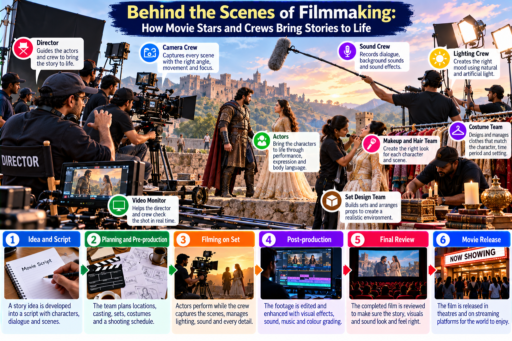
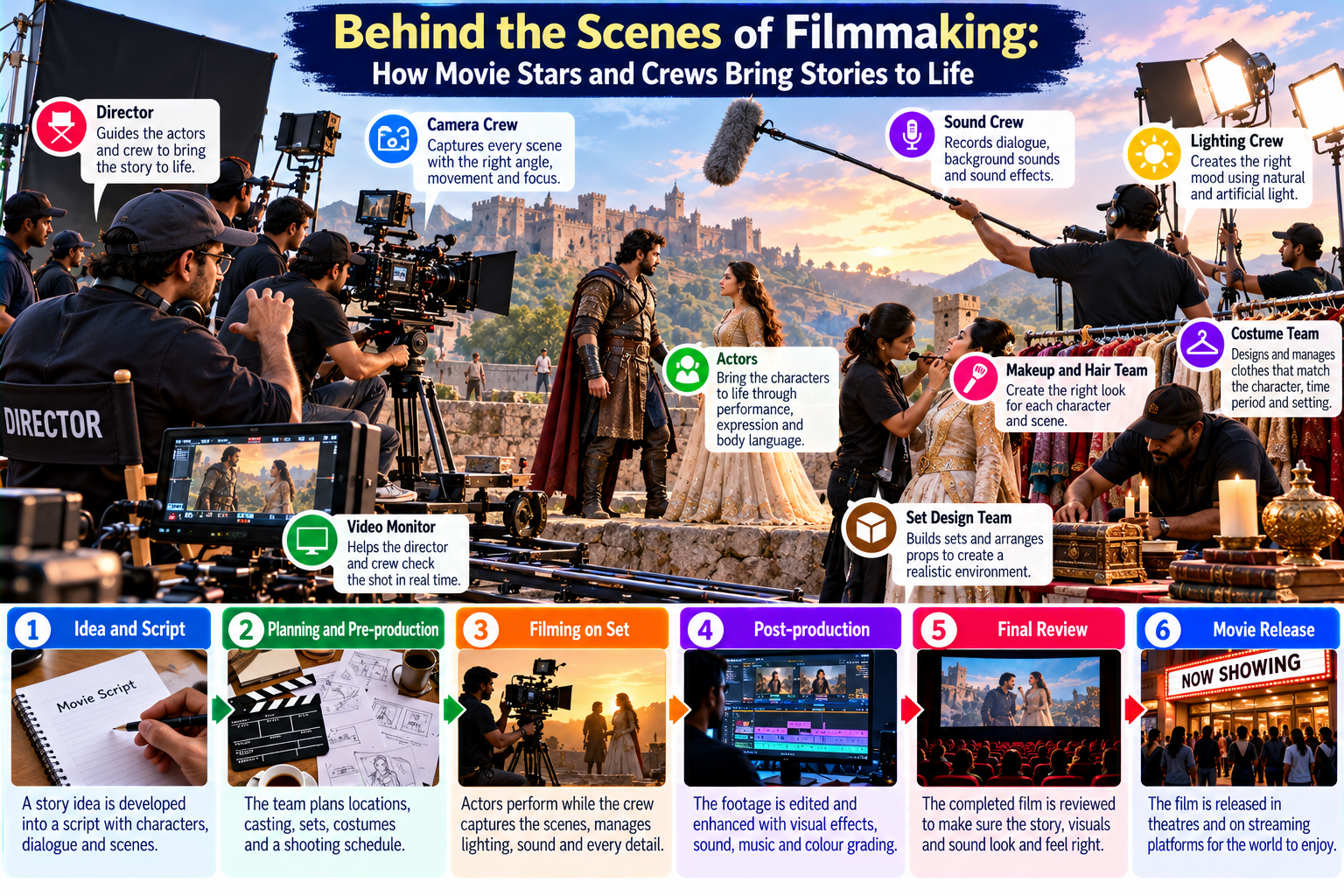

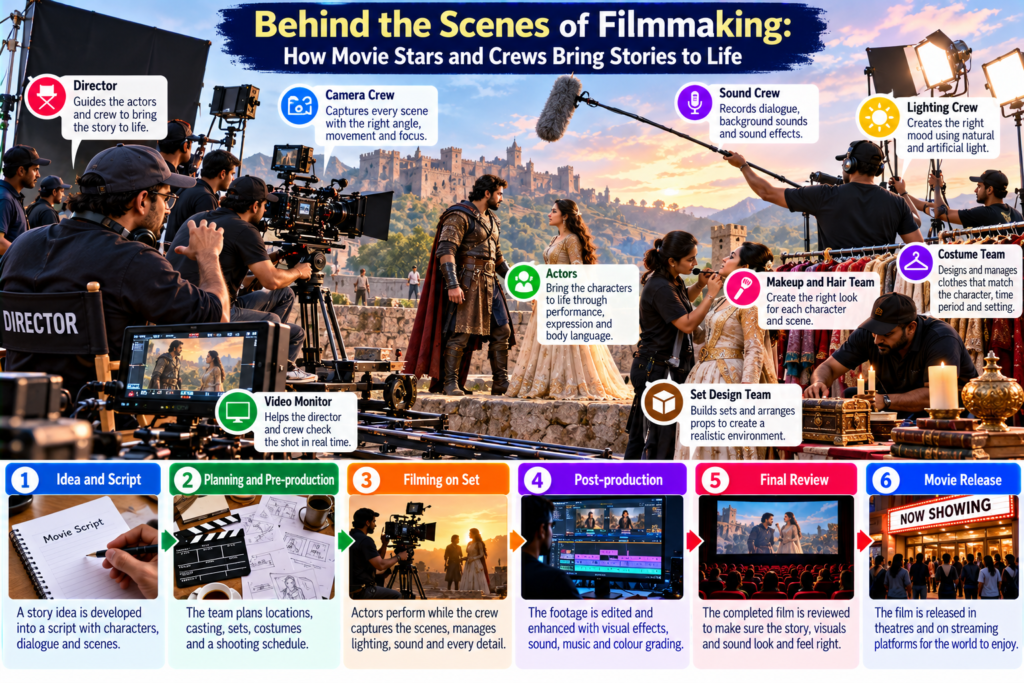
Introduction
A movie may last two hours, but creating those two hours can require months or even years of planning, preparation, filming, and editing. Audiences usually see the finished performances, impressive locations, dramatic action sequences, and beautiful visual effects. What they rarely see is the enormous amount of coordination happening outside the camera frame.
Behind the scenes of filmmaking, actors work with directors, cinematographers, stunt coordinators, costume designers, makeup artists, sound engineers, editors, and many other professionals. Each person contributes something important to the final production. Even a short conversation between two characters may require several camera setups, careful lighting, repeated performances, and detailed editing.
There is also a fascinating difference between what happens during filming and what audiences eventually see. A movie’s opening scene might be filmed near the end of production. An actor may perform in front of a green screen without seeing the imaginary world that will appear later. A single scene can combine footage recorded on different days, dialogue added in a studio, and visual effects created months after filming finishes.
This guide explores how movie stars prepare for their roles, what happens on professional movie sets, how difficult scenes are created, and how production teams turn raw footage into finished films. It also examines newer developments in virtual production and artificial intelligence that are changing parts of the filmmaking process.
Whether you enjoy Hollywood films, Bollywood productions, Tollywood cinema, or international movies, understanding these hidden processes can help you appreciate the work behind every scene.
Quick Answer: What Happens Behind the Scenes of Filmmaking?
“Behind the scenes of filmmaking” refers to all the activities that take place before, during, and after a movie is recorded. Actors prepare for their characters, directors guide performances, camera and lighting teams capture scenes, stunt professionals coordinate action, and editors combine the footage into a complete story.
The process generally includes:
-
Pre-production: Script development, casting, budgeting, location selection, and planning.
-
Production: Acting, filming, lighting, sound recording, costumes, and stunt work.
-
Post-production: Editing, sound design, music, color grading, and visual effects.
-
Distribution and promotion: Marketing, trailers, interviews, premieres, and theatrical or streaming releases.
The final movie is therefore the result of hundreds of creative and technical decisions, not simply the performances of its leading stars.
Key Takeaways
-
Movie stars often prepare for roles through script analysis, rehearsals, physical training, and character research.
-
Film scenes are frequently recorded out of story order because of location, cast availability, lighting, and production schedules.
-
Script supervisors help maintain continuity between different shots and filming days.
-
Stunt coordinators and trained performers plan action sequences with safety as a priority.
-
Green screens and virtual production allow filmmakers to create environments that may not exist physically.
-
Dialogue replacement, Foley, and sound mixing improve the audio after filming.
-
Artificial intelligence and digital replicas are creating new questions about performers’ consent and control over their likenesses.
-
A successful movie depends on collaboration between the cast and the crew.
1. How Movie Stars Prepare for Their Roles
An actor’s preparation begins long before the camera starts recording. A convincing performance requires more than memorising dialogue. Performers need to understand their characters, motivations, relationships, and emotional changes throughout the story.
The preparation process depends on the role. Playing a schoolteacher, professional athlete, historical personality, or fictional superhero can require very different skills.
Understanding the character and screenplay
Actors often read the screenplay several times to understand the character’s journey. They examine the character’s background, personality, relationships, and important decisions.
They may ask questions such as:
-
What does the character want?
-
What is preventing the character from achieving that goal?
-
How does the character respond to difficult situations?
-
What changes between the beginning and ending of the story?
-
How should the character’s behavior differ around different people?
These questions help performers make their decisions more consistent. Instead of simply delivering dialogue, they begin to understand the reasons behind each action.
Physical and voice preparation
Some roles require significant physical preparation. An actor playing a professional sportsperson might practice specific movements, while a performer portraying a historical character may study posture, speech patterns, and everyday habits.
Preparation can include:
-
Strength and flexibility training.
-
Dance or movement lessons.
-
Martial arts and supervised fight choreography.
-
Accent and pronunciation coaching.
-
Voice projection and breathing exercises.
-
Learning specialized skills required by the character.
Physical transformations should be planned with qualified professionals. Extreme dieting, excessive exercise, or unsupervised training should never be treated as a requirement for a successful performance.
Emotional preparation
Emotional scenes can be demanding because actors must communicate feelings through facial expressions, body language, voice, and timing. An actor may discuss a scene with the director, rehearse it with another performer, or work with an acting coach.
There is no single emotional preparation technique that suits everyone. Some performers prefer detailed character analysis, while others concentrate on movement, imagination, or the circumstances described in the screenplay.
2. What Happens During Pre-Production?
Pre-production is the planning stage before principal photography begins. Many important decisions are made during this period because changes become more expensive once filming is underway.
| Pre-production activity | Why it matters |
|---|---|
| Script development | Establishes the story, characters, and scenes |
| Casting | Finds performers suitable for the roles |
| Budgeting | Estimates the cost of production |
| Location scouting | Identifies suitable filming environments |
| Costume planning | Establishes the visual appearance of characters |
| Production design | Plans sets, props, and environments |
| Shooting schedule | Organizes filming days and resources |
| Safety planning | Identifies production risks and necessary controls |
Why shooting schedules matter
A movie is not necessarily filmed in the same order in which the audience watches it. Production teams often organize scenes according to location, actor availability, equipment requirements, and practical costs.
For example, imagine a story that begins in a family home, moves to a hospital, and ends at an airport. The production may film all the home scenes together, even if some belong near the end of the movie.
This arrangement reduces unnecessary location changes and helps the production use its time efficiently.
3. What Happens on a Professional Movie Set?
A professional movie set is a coordinated working environment. The actors may be the most visible people, but many departments work together to create each shot.
Important film production crew roles
| Crew member | Main responsibility |
|---|---|
| Director | Guides the creative interpretation of the story |
| Producer | Oversees production resources and major decisions |
| Assistant director | Coordinates the shooting schedule and set operations |
| Cinematographer | Develops the visual approach and camera work |
| Production designer | Creates the visual environment of the movie |
| Costume designer | Develops clothing and character appearance |
| Makeup artist | Creates the required makeup and character looks |
| Sound recordist | Captures dialogue and production sound |
| Stunt coordinator | Plans and supervises stunt activity |
| Script supervisor | Tracks continuity and scene coverage |
| Editor | Assembles footage into the finished story |
The work of a script supervisor is especially interesting because audiences rarely notice it. According to ScreenSkills’ explanation of the script supervisor role, this professional monitors dialogue, actions, costumes, props, camera details, and other continuity information. The records help editors combine footage that may have been filmed on different days.
Why actors sometimes spend hours waiting
Filming involves more than performing in front of a camera. Actors may need to wait while lighting is adjusted, equipment is repositioned, costumes are checked, or a location is prepared.
A scene might also be delayed because of background noise, weather conditions, technical problems, or changes in the shooting schedule.
This waiting time is not necessarily wasted. Production teams use it to prepare the next setup and ensure the scene can be recorded properly.
4. How Directors Guide Actors During Filming
The director is responsible for shaping the film’s creative vision. Directors work with actors to establish the emotional tone of scenes while also coordinating with cinematographers, designers, editors, and other departments.
A director might ask an actor to change the pace of a conversation, reduce a facial expression, adjust their position, or deliver a line with a different emotional intention.
Why the same scene may be filmed several times
A director may record multiple takes because each performance offers a slightly different result. One take may contain a particularly convincing expression, while another may have better dialogue delivery or timing.
The director and editor can later review the available footage and decide which performances work best together.
However, more takes do not automatically produce a better performance. The objective is to capture the material needed to tell the story clearly and effectively.
5. How Makeup and Costumes Transform Movie Stars
Makeup and costume departments help actors become believable characters. Their work can be simple or highly specialized, depending on the production.
A contemporary romantic comedy may require natural-looking makeup and everyday clothing. A historical drama, fantasy film, or science-fiction production could require elaborate costumes, prosthetic materials, wigs, and detailed character designs.
Makeup and prosthetic effects
Makeup artists may create bruises, scars, aging effects, unusual skin textures, or other visual details. Prosthetic artists can build physical pieces that change the appearance of an actor.
The process may involve several stages:
-
Studying the character and production design.
-
Preparing the required makeup or prosthetic materials.
-
Applying and blending the materials.
-
Checking the appearance under the actual filming lights.
-
Photographing the completed look for continuity.
-
Removing the materials safely after filming.
A character’s appearance must remain consistent when scenes are filmed over several days. Makeup teams therefore keep reference photographs and detailed records.
Why costumes need continuity checks
Clothing is part of the story. A character may begin a scene wearing a clean shirt and finish it with visible dirt or damage. The costume department must track those changes carefully.
A small difference in clothing can become noticeable when two shots are edited together. This is one reason costume teams document character appearances throughout production.
6. How Camera and Lighting Teams Create Movie Scenes
The camera does not simply record whatever happens in front of it. Cinematographers and camera operators make decisions about framing, movement, focus, lenses, and composition.
A close-up may help the audience notice a character’s emotional reaction. A wide shot can establish the environment and show how characters relate to one another.
Why lighting changes the appearance of a scene
Lighting influences the mood, atmosphere, and visual depth of a movie. A brightly lit room may feel welcoming, while carefully controlled shadows can create tension or mystery.
Lighting teams consider:
-
The direction and intensity of light.
-
Natural daylight and weather conditions.
-
The color temperature of different light sources.
-
Shadows on actors’ faces and backgrounds.
-
Reflections from costumes and set materials.
-
Consistency between camera angles.
A scene filmed from several positions must look visually consistent when edited. This requires communication between the cinematographer, lighting team, director, and other departments.
7. How Movie Stunts and Action Scenes Are Filmed Safely
Action sequences can involve falls, vehicle movements, fights, fire effects, wire work, and other controlled physical activities. Their apparent realism depends on careful planning rather than simply asking actors to take risks.
Stunt coordinators work with performers and production departments to design action that fits the story while considering the hazards involved.
How a stunt sequence is prepared
A typical planning process may include:
-
Reviewing the screenplay and identifying the physical actions.
-
Assessing the risks and selecting suitable techniques.
-
Assigning appropriately trained stunt professionals.
-
Checking equipment, props, costumes, and the filming environment.
-
Rehearsing movements and communication cues.
-
Confirming emergency arrangements before filming.
-
Reviewing and resetting the sequence between takes.
The SAG-AFTRA stunt safety resources explain the importance of performer protection. Its stunt coordinator standards also emphasize safety coordination with other departments.
For additional practical guidance, the Ontario film and television stunt plan guidelines describe planning meetings, rehearsals, hazard controls, communication, and equipment checks.
Actors and stunt doubles
Some actors perform selected physical actions after appropriate preparation. Other sequences are assigned to professional stunt performers.
A stunt double may be chosen because of physical similarity, movement skills, or specialist experience. The final scene can combine footage of the lead actor, stunt performer, camera movement, editing, and visual effects.
The important point is that performing a dangerous stunt is not proof of acting ability. Proper planning and professional expertise should take priority.
8. How Green Screens and Visual Effects Create Imaginary Worlds
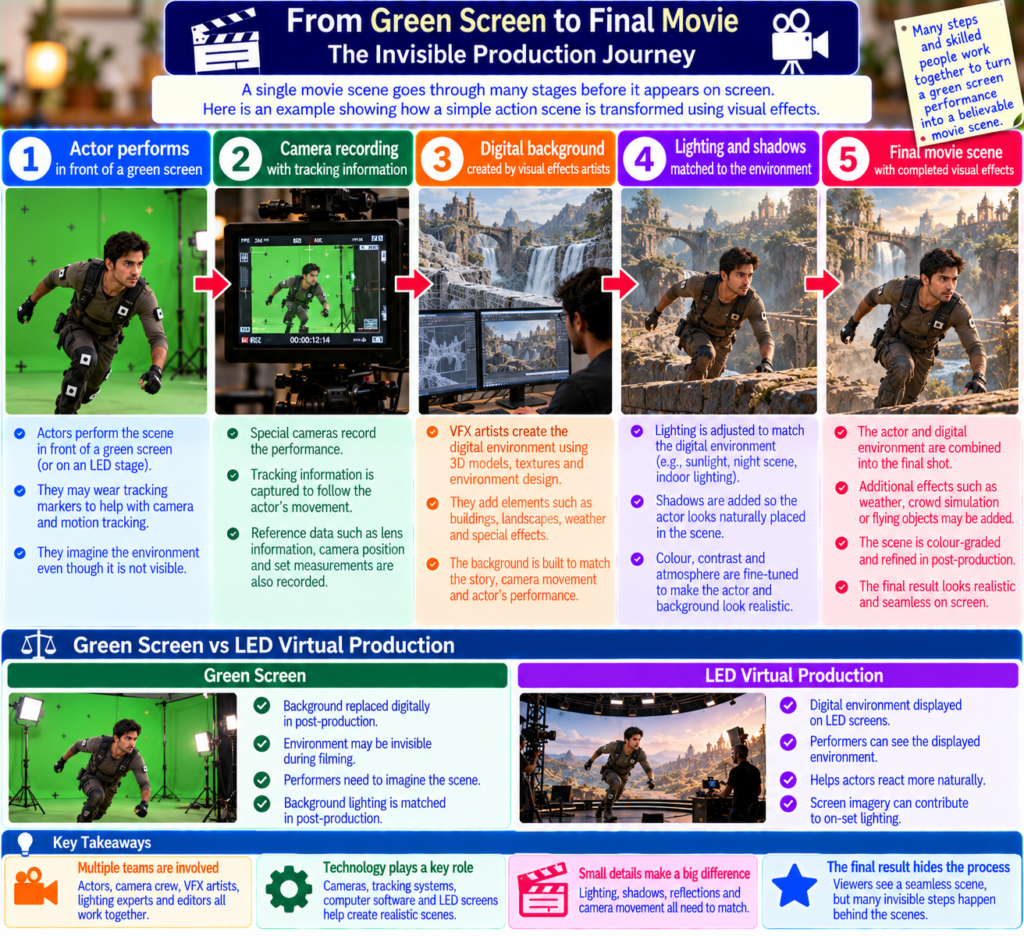
Some movie environments are difficult or impossible to film in real life. A production may need a futuristic city, an imaginary creature, an enormous explosion, or a landscape that does not exist.
Visual effects teams help create these images using digital tools and carefully prepared footage.
How green-screen filming works
A green screen provides a background that can be digitally replaced during post-production. The actor performs in front of the screen while the camera records the action.
Later, visual effects artists isolate the actor and combine the footage with a digital environment.
The actor may need to imagine objects, creatures, or surroundings that are not physically present during filming. Directors and visual effects teams use reference images, stand-ins, lighting cues, and other techniques to help performers understand the scene.
Virtual production: A changing filmmaking technique
Virtual production can combine physical sets, digital environments, camera tracking, and large LED displays. Instead of relying entirely on a green screen, filmmakers can sometimes display a computer-generated environment around the performers.
This can help actors and directors see more of the intended surroundings while filming. It may also allow the cinematography team to work with interactive backgrounds and lighting.
An interesting recent example is Industrial Light & Magic’s February 2026 report on StageCraft virtual production. It describes how virtual production technology was used to create Olympic promotional footage featuring digitally produced environments.
Virtual production is not a replacement for every traditional filmmaking technique. The best approach depends on the scene, budget, creative requirements, and technical resources available.
9. What Happens Between Takes? The Hidden Continuity Process
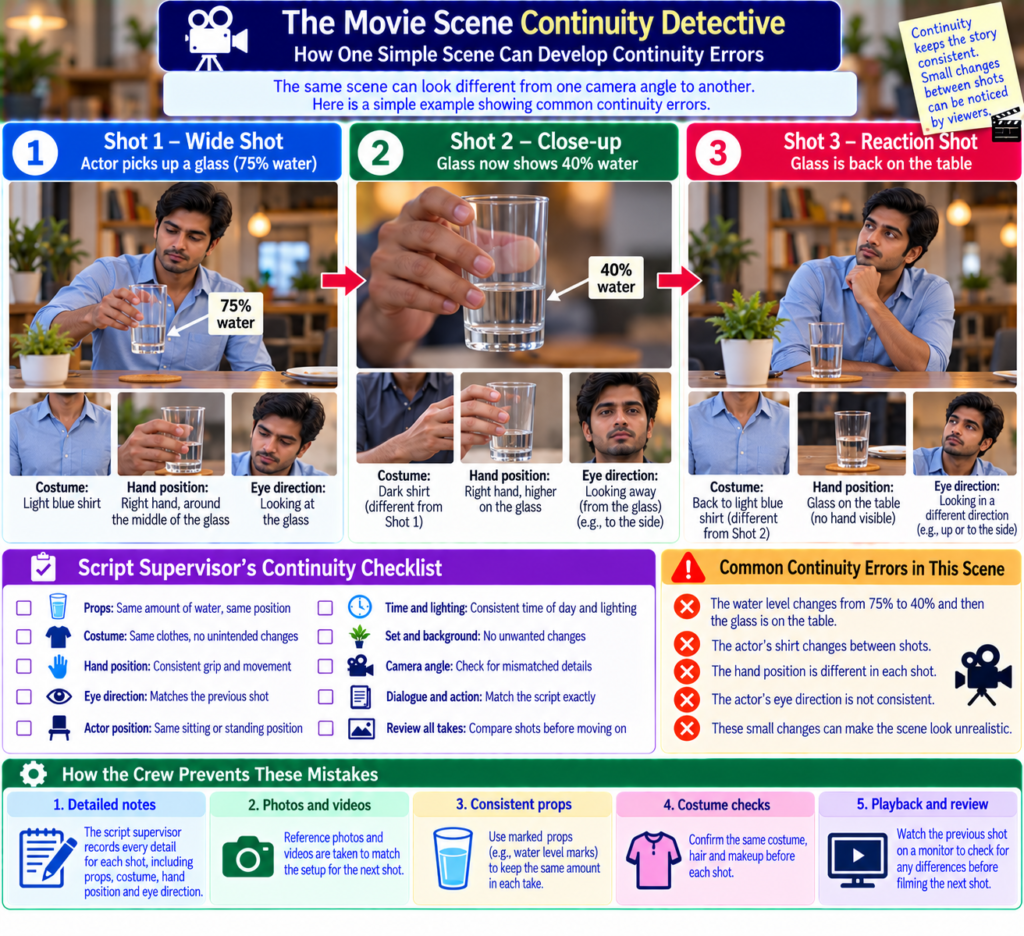
One of the most overlooked parts of filmmaking is maintaining consistency between different shots.
Imagine a scene in which an actor picks up a glass, drinks water, and places it on a table. The production may record a wide shot, a close-up, and an over-the-shoulder angle. These shots might be filmed at different times.
If the glass contains a different amount of water in each shot, viewers may notice the inconsistency when the footage is edited.
This is where continuity tracking becomes important.
The scene continuity checklist
The following practical checklist shows some of the details production teams may need to monitor.
| Continuity detail | What needs to match? |
|---|---|
| Hand position | Which hand holds an object? |
| Food and drinks | How much food or liquid remains? |
| Costume | Are clothing folds, buttons, and accessories consistent? |
| Hair and makeup | Does the character’s appearance match? |
| Body position | Is the actor standing, sitting, or leaning in the same way? |
| Dialogue | Are the words and pauses consistent? |
| Props | Are objects in the correct locations? |
| Eye line | Is the actor looking in the correct direction? |
| Background | Are visible objects and people positioned consistently? |
| Performance | Does the emotional intensity fit the neighboring shots? |
A useful example: The three-shot glass problem
Consider a simple conversation filmed using three camera angles.
-
Wide shot: The actor picks up a glass and takes a drink.
-
Close-up: The actor continues speaking while holding the glass.
-
Reaction shot: Another character responds to the conversation.
If the actor’s hand position, glass level, or timing changes unexpectedly, the editor may struggle to create a smooth sequence.
This example shows why continuity is not merely about avoiding visible mistakes. It protects the audience’s understanding of time, action, and character behavior.
For further information, see ScreenSkills’ script supervisor profile, which explains how detailed records help maintain consistency and support editing.
10. How Film Sound, Dialogue Replacement, and Foley Work
Good sound is essential to an engaging movie. However, the sound audiences hear is not always the sound recorded during filming.
A production may record dialogue on location, but wind, traffic, aircraft, equipment noise, or crowd activity can make some recordings unsuitable.
Post-production sound professionals help solve these problems.
ADR: Recording dialogue again
ADR stands for automated dialogue replacement. It involves recording dialogue again in a controlled studio environment.
An actor watches the original scene and attempts to match the timing, emotion, and delivery of the recorded performance. The new dialogue is then synchronized with the picture.
ADR may be used when:
-
The original dialogue is unclear.
-
Background noise affects the recording.
-
A line needs to be changed.
-
A scene requires additional dialogue.
-
A different language version is being produced.
Foley: Creating everyday sounds
Foley artists recreate sounds that help make scenes feel realistic. They may record footsteps, clothing movements, objects being handled, doors closing, and other small details.
For example, the sound of someone walking across gravel may be recorded separately using suitable materials in a studio.
These sounds are added during post-production to support the picture.
Why background sound matters
Sound designers also create atmosphere through environmental audio, music, and effects. A quiet room may need subtle background noise, while an action sequence may combine impacts, movement, mechanical sounds, and carefully balanced music.
For a useful introduction to film sound terminology, see Reframing Cinema’s guide to sound, which explains concepts including ADR, Foley, and diegetic sound.
11. How Editors Turn Raw Footage Into a Finished Movie
Once filming is complete, the production enters post-production. Editors review the recorded footage and organize it into a coherent story.
A movie may contain numerous versions of the same scene. Editors consider performance quality, timing, camera angles, emotional continuity, and the overall rhythm of the story.
What happens during film editing?
| Editing activity | Purpose |
|---|---|
| Reviewing footage | Identifies usable performances and shots |
| Selecting takes | Finds the most effective material |
| Assembling scenes | Organizes footage into a story |
| Dialogue editing | Improves the clarity and timing of speech |
| Visual effects integration | Combines filmed and digitally created images |
| Color grading | Establishes consistent color and visual mood |
| Sound mixing | Balances dialogue, music, and effects |
| Final quality checks | Identifies technical or storytelling problems |
Why a good performance may not appear in the final movie
An actor can deliver an excellent performance that is eventually removed from the finished version. The scene may slow down the story, repeat information, or interfere with the pacing.
This does not necessarily mean the performance was poor. Editing is about choosing the material that best serves the complete film.
12. The Latest Filmmaking Developments: Virtual Production and AI
Filmmaking continues to evolve as new production tools become available. Two important developments are virtual production and the use of artificial intelligence in relation to performers’ digital identities.
Virtual production is expanding creative possibilities.
LED-based virtual production can display digital environments on large screens during filming. This gives directors, actors, and cinematographers a more immediate view of the intended setting.
Industrial Light & Magic’s 2026 StageCraft production feature offers a current example of how these techniques are being applied beyond traditional film sets.
However, virtual production requires specialized planning. Digital environments, camera tracking, lighting, and physical set elements must work together. It is not automatically cheaper or easier than location filming.
AI and digital replicas raise important questions.
Artificial intelligence is also changing conversations about how performers’ images, voices, and performances may be used.
A digital replica is a digitally created representation of a specific person’s appearance or voice. Depending on the technology and production agreement, it may be used to modify or generate material involving that performer.
This development raises important questions:
-
Has the performer agreed to the creation of the digital replica?
-
What uses have been authorized?
-
How long can the replica be retained?
-
Can it be used in another production?
-
How will the performer be compensated?
-
Who controls the material after the original production ends?
These are not simply technical questions. They concern consent, employment, privacy, and creative rights.
An important 2026 development is the new SAG-AFTRA TV/Theatrical Agreement. The agreement includes provisions addressing digital replicas and synthetic performers. SAG-AFTRA’s published explanations describe protections involving consent, notice, and the use of synthetic performers.
The union also issued a March 2026 statement concerning the digital replication of Val Kilmer. It emphasized that the use of a deceased performer’s digital replica requires appropriate consent from the estate under applicable contractual and legal requirements.
These developments show why the future of filmmaking involves more than better cameras and visual effects. The industry must also consider how new technologies affect the people whose performances make movies possible.
13. Common Mistakes People Make When Watching Behind-the-Scenes Footage
Behind-the-scenes videos can make filmmaking look simple. A short clip might show an actor performing a difficult scene, a director giving instructions, or a visual effect appearing on a monitor.
However, these clips rarely show the complete production process.
Here are several common misunderstandings.
Mistake 1: Assuming actors perform every stunt
Some performers complete selected physical actions, while trained stunt professionals handle other sequences. A finished action scene may combine both performances.
Mistake 2: Thinking movies are filmed in story order
Production schedules are usually organized around practical requirements rather than the sequence of the screenplay.
Mistake 3: Assuming everything visible on screen was physically present
Many environments, creatures, backgrounds, and effects are added digitally or combined with physical sets.
Mistake 4: Believing every line is recorded perfectly on location
Dialogue may be replaced or supplemented during post-production.
Mistake 5: Giving all the credit to leading actors
A film depends on the coordinated work of performers and many specialized crew members. Their contributions are essential even when they are not visible on screen.
Mistake 6: Assuming a long filming day always produces better footage
Production quality depends on planning, skill, communication, and suitable working conditions. More hours do not automatically create better storytelling.
14. A Reader’s Guide: How to Understand a Movie’s Behind-the-Scenes Story
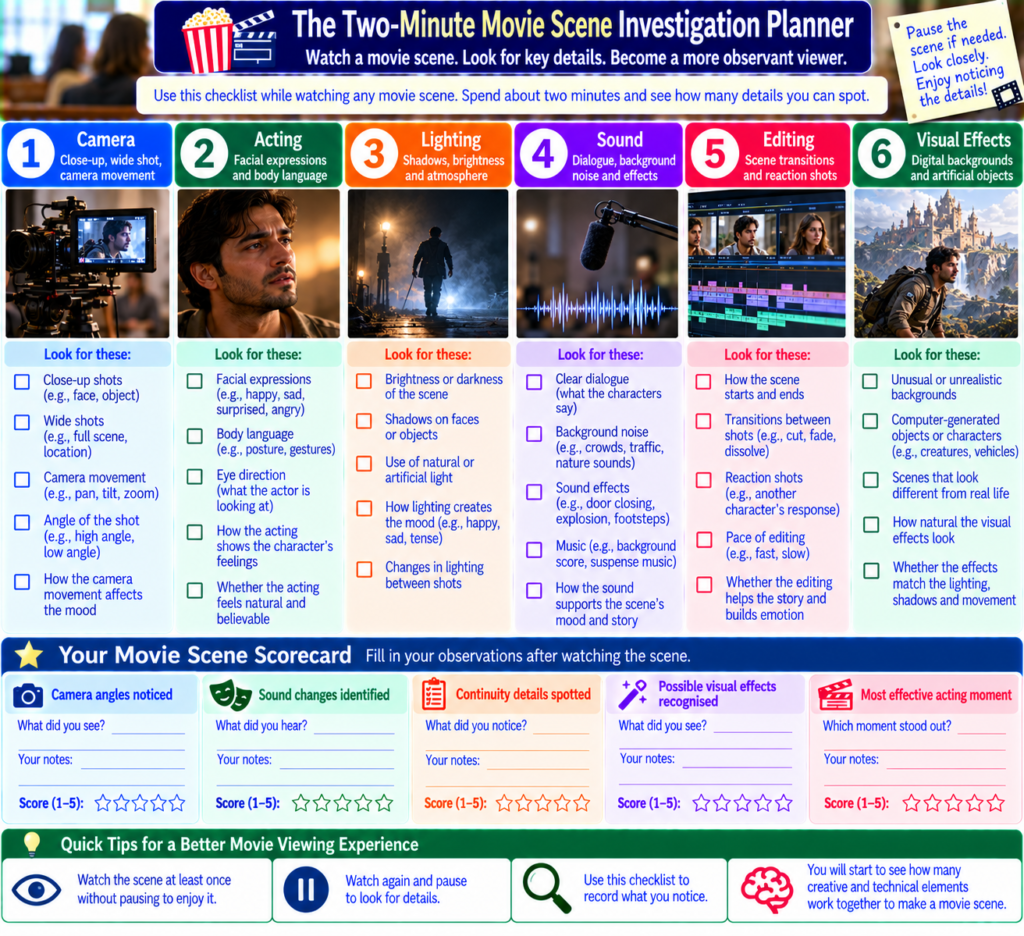
The next time you watch a film, try observing it from a production perspective. You do not need professional filmmaking experience to notice the decisions behind a scene.
| What to observe | What it may reveal |
|---|---|
| A sudden change in location | Editing or a transition between scenes |
| Different camera distances | The use of wide, medium, and close-up shots |
| Consistent clothing across scenes | Costume and continuity planning |
| An actor reacting to an unseen object | Possible visual effects or an off-camera performance cue |
| Detailed background sounds | Sound design and Foley work |
| A realistic imaginary environment | Visual effects or virtual production |
| A carefully timed action sequence | Choreography and editing |
A simple scene observation exercise
Choose a two-minute scene from a movie you enjoy. Watch it once normally, then watch it again while paying attention to the production details.
Ask yourself:
-
How many camera angles appear?
-
Does the scene move between close-ups and wide shots?
-
Are the actors looking at the correct characters or objects?
-
Does the background sound change?
-
Are there visible signs of visual effects?
-
How does the editing influence the emotional impact?
This exercise can help you understand why a seemingly simple movie scene may involve considerable planning and technical work.
15. Why Supporting Actors and Film Crews Matter
Leading performers often receive the greatest public attention, but supporting actors help create believable relationships and move the story forward.
A supporting character may provide humor, introduce a conflict, reveal information, or challenge the main character’s decisions. Without these performances, even a talented lead actor may have difficulty making the story feel complete.
The same principle applies to the technical crew. Camera assistants, lighting technicians, sound professionals, production designers, editors, and other specialists all contribute to the final result.
Filmmaking is a collaborative process. A successful production depends on people understanding their responsibilities and communicating effectively.
16. The Human Side of Working on a Film Set
Behind the glamour of movie premieres and celebrity interviews, film production can involve demanding schedules, changing locations, long periods away from home, and physically tiring work.
Actors and crew members may need to adapt to unfamiliar environments or changing weather conditions. Some productions also require night shoots, extensive travel, or repeated physical activity.
These challenges affect different people in different ways. A responsible production should consider rest, communication, suitable working conditions, and safety planning.
The International Federation of Actors’ health and safety guidance for film and television performers discusses the risks that can arise in studio and location environments. It also highlights the importance of recognizing hazards and taking appropriate precautions.
Understanding this human side makes it easier to appreciate the effort involved in creating a finished movie.
Conclusion: The Real Work Behind Every Movie
Behind the scenes of filmmaking, the work is much bigger than what audiences see on the screen. Actors study their characters, directors shape performances, camera teams create the visual language, and production crews coordinate countless details. Stunt professionals, makeup artists, sound designers, editors, and visual effects specialists all contribute to the final experience.
A short scene may involve several filming setups, repeated performances, continuity checks, additional sound recording, and digital effects. What looks effortless to an audience can represent hours of preparation and collaboration.
New technologies such as virtual production and AI-generated digital replicas are also changing how some films are created. These developments bring exciting creative opportunities, but they also make consent, safety, and responsible production practices increasingly important.
The next time you watch a movie, look beyond the leading performances. Notice the camera work, sound, lighting, costumes, editing, and supporting characters. Every detail helps build the story.
The real magic of cinema is not created by one star or one camera. It comes from the combined creativity, skill, and dedication of everyone working behind the scenes.
Frequently Asked Questions About Behind the Scenes of Filmmaking
1. What does “behind the scenes of filmmaking” mean?
It refers to the planning, preparation, filming, technical work, and post-production activities that audiences do not normally see. These include actor rehearsals, camera work, lighting, costumes, stunts, sound recording, editing, and visual effects.
2. How do actors prepare for movie roles?
Actors may study the screenplay, research the character, practice dialogue, attend rehearsals, and work with acting coaches. Some roles also require movement training, voice coaching, or specialist physical preparation.
3. Are movies filmed in the same order as their stories?
Usually not. Production teams organize filming according to practical requirements such as location availability, actor schedules, equipment, and budget. Editors later arrange the recorded scenes into the intended story order.
4. What is a script supervisor’s job?
A script supervisor monitors continuity and records details about dialogue, costumes, props, actor movements, camera setups, and scene coverage. These records help the editor combine footage consistently.
5. Do actors perform their own stunts?
Some actors perform selected stunts after suitable preparation. More complex or dangerous actions are generally handled by trained stunt professionals under appropriate supervision.
6. What is the difference between CGI and a green screen?
A green screen is a filming technique that allows a background to be replaced digitally. CGI refers to computer-generated imagery, which can create or modify objects, characters, environments, and visual effects.
7. What is virtual production in filmmaking?
Virtual production combines digital environments with physical filming techniques. Some productions use large LED screens to display computer-generated backgrounds while actors perform in front of them.
8. Why do actors record dialogue again after filming?
Actors may record dialogue again through ADR when the original sound is unclear, background noise interferes with speech, or the production needs revised lines. The new recording is synchronized with the existing footage.
9. What does a Foley artist do?
A Foley artist recreates everyday sounds such as footsteps, clothing movements, doors closing, and objects being handled. These sounds are added during post-production to make scenes feel more realistic.
10. How long does it take to make a movie?
The time varies considerably. Development and pre-production may take months or longer, while filming and post-production depend on the movie’s budget, complexity, locations, and visual effects requirements. There is no single production timeline for every film.
11. What happens after the movie finishes filming?
The production moves into post-production. Editors assemble footage, sound professionals improve the audio, visual effects artists complete digital work, and colorists establish the final visual appearance. The completed movie then moves towards distribution and promotion.
12. How is artificial intelligence changing filmmaking?
AI-related tools can support certain production and post-production tasks. Digital replicas and synthetic performers also raise questions about consent, compensation, and control over a performer’s likeness. Industry agreements are developing to address these issues.
Author’s Note
This article was prepared to help movie enthusiasts understand the creative and technical work that takes place behind the camera. Its purpose is to explain filmmaking in accessible language, rather than suggest that every production follows exactly the same process.
The production methods described here can differ between Hollywood, Bollywood, Tollywood, independent cinema, and international film industries. The examples and references are included to help readers explore the subject further.
Editorial Insight: A More Useful Way to Appreciate Movies
One important detail that viewers often overlook is the relationship between filming and editing. A performance does not exist in isolation. Its effect depends on the camera angle, the other actor’s reaction, the timing of the cut, and the sound surrounding the moment.
For this reason, a scene should not be judged only by what the lead actor does. Its impact comes from how all the creative and technical elements work together.
This is one of the most interesting lessons behind the scenes of filmmaking: the smallest details can influence how an audience understands an entire story.
Evidence-Based Sources and Further Reading
The following professional and educational sources support the filmmaking, production-safety, continuity, sound, and technology explanations in this article.
Film Production and Script Supervision
1. ScreenSkills — Script Supervisor (Film and TV Drama). Explains continuity responsibilities, scene records, dialogue, camera details, and the relationship between filming and editing. Read the ScreenSkills guide.
2. ScreenSkills—Script Supervisor Skills. Describes the role of script supervisors in monitoring coverage, preparing breakdowns, and maintaining continuity. Explore the professional skills guide.
Film Production Safety and Stunt Coordination
3. SAG-AFTRA — Stunt and Safety Resources. Provides performer-safety information and industry resources relating to stunt work. Read SAG-AFTRA’s safety resources.
4. SAG-AFTRA — Stunt Coordinator Standards and Practices. Explains professional expectations for stunt coordinators and their safety responsibilities. Read the standards.
5. Government of Ontario — Stunt Plan Guidelines. Provides practical guidance on stunt preparation, risk assessment, communication, rehearsals, and safety arrangements. Read the film and television safety guidelines.
6. International Federation of Actors — Health and Safety Guidelines for Performers in Film and Television. Provides guidance on recognizing and managing hazards in film and television production environments. Read the performer safety guide.
Virtual Production and Film Technology
7. Industrial Light & Magic — StageCraft Virtual Production, February 2026. Provides a current production example showing how virtual production technology can create digital environments. Read the StageCraft feature.
Digital Replicas and Industry Agreements
8. SAG-AFTRA — 2026 TV/Theatrical Contracts. Explains current industry contract developments, including protections relating to digital replicas and synthetic performers. Explore the 2026 agreement.
9. SAG-AFTRA — Statement Regarding Val Kilmer Digital Replication, March 20, 2026. Discusses consent requirements relating to the digital replication of a deceased performer. Read the official statement.
Film Sound and Audio Production
10. Reframing Cinema—Sound: The Other Half of Cinema. Explains important film sound concepts, including Foley, ADR, and diegetic sound. Read the educational resource.
Similar post
More Stories From This Blog
- Future Icons of the Film Industry
- Rising Stars: Upcoming Bollywood Actors You Should Keep an Eye On
- Rising Stars in Tollywood Cinema: The Next Generation of Talent
- Behind the Scenes of Major Hollywood Productions: A Deep Dive into the Art and Craft
- Behind the Scenes of Bollywood: Exclusive Interviews with Stars and Industry Insiders
- Home