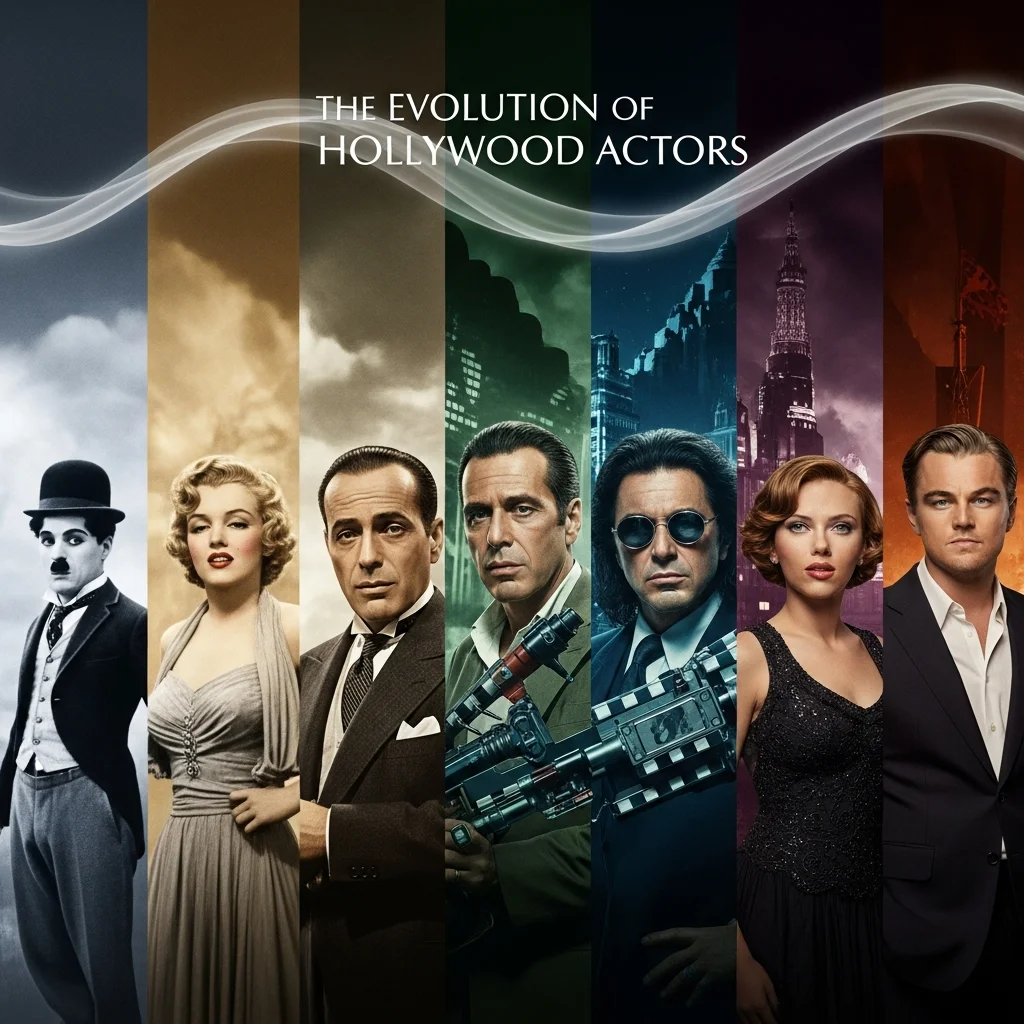

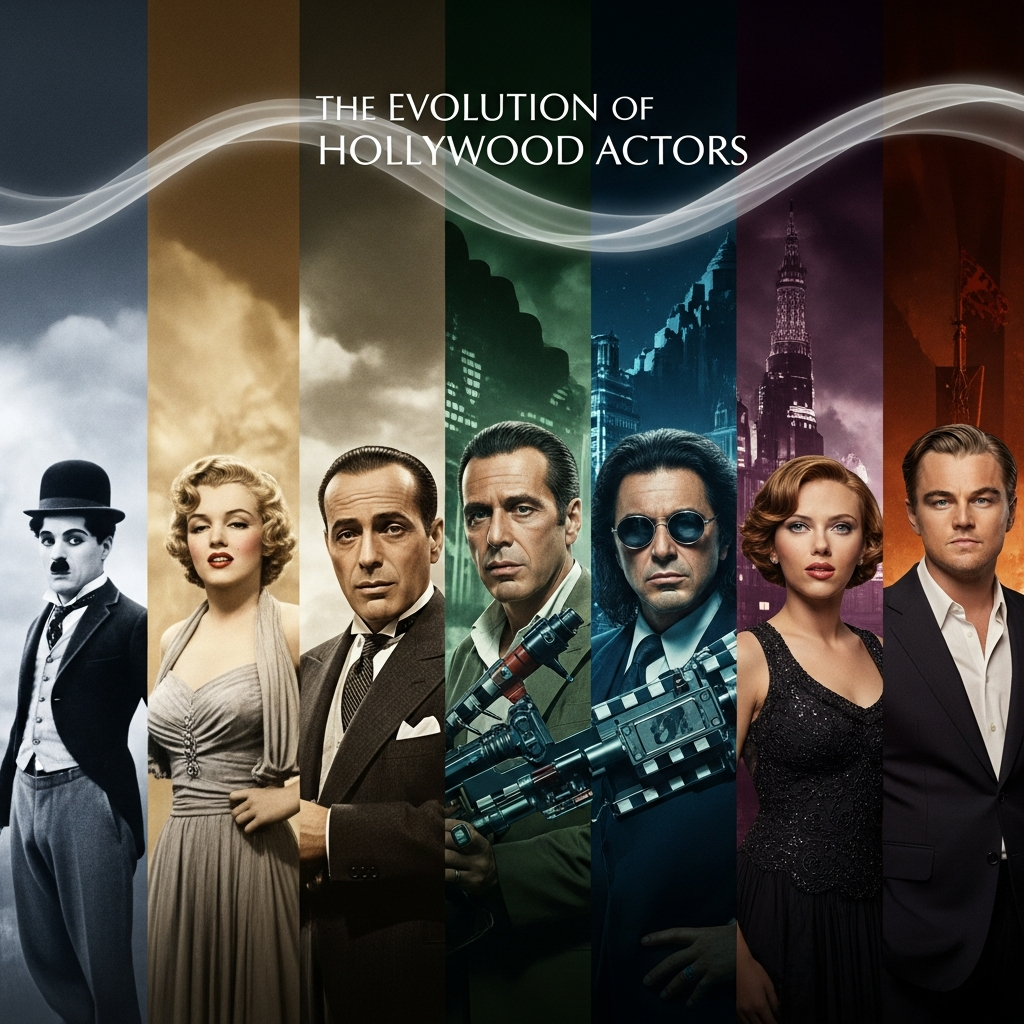
Evolution of Acting in Hollywood: From Silent Films to AI
Written by RVLNSV PRASAD
Independent Writer & Researcher
Published: Jan 28, 2025
Last Updated: August 2026 |
Reading time: 12–15 minutes
Quick Summary:
Explore how acting in Hollywood evolved from silent-film performance and the arrival of synchronized sound to the studio system, method acting, independent cinema, CGI, motion capture, streaming, virtual production, and AI.
Key Takeaways
- The evolution of acting in Hollywood was strongly influenced by changes in cameras, sound, editing, production methods, and audience expectations.
- Silent-film performers depended heavily on physical movement, facial expression, gesture, framing, and visual storytelling because recorded dialogue was unavailable.
- The arrival of synchronized sound made voice, diction, listening, pauses, accents, and conversational rhythm important parts of screen performance.
- The studio system transformed actors into carefully managed stars, connecting performance with publicity, contracts, image-making, and commercial expectations.
- Method acting brought new attention to psychological realism, but it did not invent realistic film acting; important naturalistic performances existed before the Method became influential.
- Modern actors increasingly have to understand technology, including CGI, motion capture, virtual production, and performance continuity.
- Streaming has expanded the amount and variety of screen storytelling while also increasing the importance of sustained character work across longer narratives.
- AI and digital replicas are creating new questions about consent, compensation, likeness, voice, and control over a performer’s recorded performance.
Introduction
The evolution of acting in Hollywood is more than a history of famous actors and memorable performances. It is the story of how performers continually adapted to changing cameras, sound technology, editing techniques, studio systems, acting schools, audience expectations, and digital filmmaking.
A performer in a silent film faced a very different challenge from an actor working with synchronized dialogue. A performer in the studio era worked within a tightly organized production system, while later generations gained more freedom to explore psychological realism and unconventional characters. Today, actors may perform alongside green screens, motion-capture systems, virtual-production environments, and digital effects.
The most interesting part is that acting did not simply become “more realistic” with every generation. Instead, the tools surrounding the actor changed, and performers developed new ways to communicate with audiences.
The history of Hollywood acting can therefore be understood as a continuing negotiation between human performance and filmmaking technology.
This article follows that transformation from silent cinema to sound, the studio era, method acting, independent filmmaking, digital production, streaming, and artificial intelligence. It also examines an important question: what has actually changed about acting—and what has remained fundamentally human?
A Timeline of Hollywood Acting Evolution
| Era | Major development | What changed for actors |
|---|---|---|
| Early silent cinema | Visual storytelling | Gesture, movement, and facial expression became essential. |
| Late 1920s onward | Synchronized sound | Voice, diction, and conversational performance became important. |
| Classical Hollywood | Studio system | Actors worked within contracts, publicity systems, and star personas. |
| 1940s–1960s | Method and psychological realism | Greater emphasis on inner life and naturalistic behavior |
| Later 20th century | Independent cinema and location filmmaking | More varied roles and naturalistic styles |
| Digital era | CGI and digital filmmaking | Actors increasingly performed around effects and technical markers. |
| Performance-capture era | Motion/performance capture | Physical acting could become the foundation of digital characters. |
| Streaming era | Long-form global distribution | Actors gained new opportunities for complex recurring characters. |
| AI era | Digital replicas and synthetic performances | Questions about consent, ownership, and authenticity became central. |
1. Before Hollywood: The Camera Created a New Kind of Performer
Film acting did not begin with a fully developed Hollywood style.
Early cinema inherited many ideas from theater, vaudeville, photography, popular entertainment, and other performance traditions. But the camera introduced something fundamentally different.
A theater audience normally sees an actor from a relatively fixed distance. A film camera can move closer.
It can show:
- the whole body
- a medium shot
- a face
- a hand
- a reaction
- a small movement that might be invisible from the back of a theater
This changed the relationship between performer and audience.
The camera became part of the acting environment.
An actor was no longer performing only toward an audience.
The performer was also performing for the camera.
That distinction became increasingly important as filmmakers developed more sophisticated editing and framing techniques.
The Library of Congress’s research on American silent films describes the period’s artistic language in terms that include expressive acting, moving cameras, photography, limited dialogue, and visual storytelling. It also documents how the arrival of talking pictures rapidly changed that visual tradition.
This gives us the first important lesson in Hollywood acting:
The camera did not merely record acting. It changed what acting could communicate.
2. Silent Film and the Age of Gesture
Silent-film acting is sometimes described simply as “overacting.”
That explanation is too easy.
Without synchronized dialogue, performers had to communicate information visually.
A character could not simply say:
“I am frightened.”
The actor had to make the audience understand fear through behavior.
That could involve:
- facial expressions
- posture
- gestures
- movement
- eye direction
- physical distance
- interaction with objects
- reactions to other characters
Intertitles could provide dialogue or explanation, but much of the emotional information still had to be communicated visually.
From large gesture to small reaction
Early screen performance often needed clarity because the audience had to understand what was happening.
But as film language developed, actors increasingly had opportunities to communicate through smaller details.
This produced a long-term progression:
gesture → expression → reaction → subtle reaction → micro-expression
That progression is one of the most important ways to understand the history of Hollywood acting.
The performer did not simply learn to “act less.”
The performer learned that the camera could make a smaller action visible.
3. The Camera Changed the Amount of Acting an Audience Needed to See
One of the least discussed parts of the evolution of acting in Hollywood is the importance of camera distance.
Consider two performances.
A wide shot
The audience may need to see:
- body movement
- physical relationships
- entrances and exits
- gestures
- movement across the space
A close-up
The audience may see:
- eyes
- breathing
- facial tension
- hesitation
- a small smile
- a reaction that lasts only a moment
The same emotional idea therefore requires different physical choices depending on the shot.
This is why modern screen acting cannot simply be described as “natural acting.”
It is camera-aware acting.
A good screen performer understands that a tiny reaction can become dramatically important when the camera is close.
4. From Gesture to Micro-Reaction
This leads to a useful way of understanding modern performance.
A contemporary actor may communicate an emotional change without saying anything.
A character can:
- Stop smiling
- Look away
- Take a breath
- Hesitate before answering
- Change posture
- Tighten the jaw
- Look toward another character
- remain silent when an answer is expected
These details can carry meaning because film allows the audience to see them.
What changed?
The evolution was not simply
exaggerated acting → realistic acting
It was closer to:
visible storytelling → increasingly precise visual storytelling
That distinction matters.
It prevents us from unfairly dismissing earlier actors while also explaining why modern screen performances can appear more restrained.
5. How Sound Changed Hollywood Acting
The arrival of synchronized sound created one of the biggest turning points in the history of American cinema.
The Library of Congress notes that the talking film rapidly displaced the silent feature and that early sound films often emphasized dialogue, sound, space, and a more stage-like style of presentation.
Sound did not merely allow actors to speak.
It changed the entire performance environment.
Actors now had to consider:
- diction
- volume
- accent
- pronunciation
- pauses
- vocal rhythm
- microphone technique
- conversational timing
- listening
- interruptions
A performer could no longer communicate only through visible movement.
The voice itself became part of characterization.
6. Sound Changed Listening as Much as Speaking
This is an important distinction.
When audiences hear dialogue, acting becomes a relationship between:
speaking + listening + reacting
A character’s response may begin before the character says anything.
The actor might listen with:
- surprise
- suspicion
- affection
- anger
- confusion
- fear
This means sound expanded the emotional possibilities of screen acting.
The actor was no longer only showing the audience what a character felt.
The actor could also respond to another character in real time through speech and listening.
7. Acting for the Edit
Modern screen acting has another hidden skill:
acting for editing.
A film scene may be recorded from multiple angles and performed through many takes.
The final audience may see:
- one actor speaking
- a cut to another actor
- a reaction
- a close-up
- a wider shot
- another reaction
The editor constructs the final rhythm.
Therefore, a screen performer must often maintain:
- emotional continuity
- physical continuity
- eyelines
- timing
- character intention
- reactions across multiple takes
This is different from performing a scene once in front of a theater audience.
A useful way to think about it
Film acting is partly the art of giving the editor usable emotional choices.
The actor provides the raw performance.
The camera provides framing.
The editor determines how those pieces are assembled.
This collaboration is one reason screen acting cannot be understood separately from filmmaking technology.
8. The Studio System: When the Actor Became a Product
During the classical Hollywood period, studios did much more than produce films.
They helped shape stars.
By the 1920s, Hollywood was operating under the studio system, with actors working under long-term contracts. A Library of Congress discussion of early studio contracts describes arrangements that could extend for approximately seven years.
The actor therefore became part of a larger commercial machine.
Studios could influence:
- which films an actor made
- public appearances
- publicity
- photographs
- interviews
- costumes
- screen persona
- career positioning
The star was more than a performer.
A successful actor could become a recognizable public identity.
Audiences might go to a film partly because they wanted to see that actor, not simply because they were interested in the story.
This created a tension that continues today:
actor as a person
versus
actor as brand
9. Star Persona vs. Character Transformation
Classical Hollywood often depended on recognizable star identities.
An actor might bring qualities from one movie to another:
- charm
- authority
- glamour
- toughness
- comedy
- romance
Audiences understood the persona.
Later acting traditions placed greater emphasis on disappearing into particular characters.
But these two approaches never completely replaced each other.
Even today, audiences may choose a film because they want to see a particular star.
At the same time, actors may deliberately transform themselves for individual roles.
The continuing tension
Star persona:
“Come to see this performer.”
Character transformation:
“Forget the performer and believe the character.”
Hollywood acting has continually moved between these two ideas.
10. The Rise of Method Acting
Method acting became one of the most influential developments in American acting during the mid-20th century.
But there is an important misconception to correct.
Method acting did not suddenly make Hollywood actors realistic.
Earlier performers had already demonstrated subtle and psychologically complex screen acting.
The BFI’s detailed history of the Method notes that actors such as Gary Cooper, Spencer Tracy, and Greta Garbo were examples of performers whose work could communicate rich inner life even before the Method became dominant.
The deeper change was that the Method created a new language and culture of actor training around psychological realism.
11. Stanislavski, the Group Theatre, and the Actors Studio
The roots of the American Method can be traced to the work of Konstantin Stanislavski and the Moscow Art Theatre.
Stanislavski explored how actors could create believable human behavior rather than merely reproduce external gestures.
His influence reached American theater, where practitioners developed different interpretations of his ideas.
The Group Theatre, founded in 1931 by Harold Clurman, Lee Strasberg, and Cheryl Crawford, became an important part of this development. The BFI describes how several influential American acting teachers emerged from that environment.
Later, the Actors Studio became a major center for actor training.
The Library of Congress preserves records documenting the Actors Studio’s influence during the 1950s, including attendance records containing names such as Paul Newman, Marilyn Monroe, Rod Steiger, and Eva Marie Saint.
12. Method Acting Was Not One Single Method
This is another important point that is often lost in simplified online explanations.
There was not one universally agreed “method.”
Different teachers emphasized different approaches.
The BFI’s history describes disagreements among figures, including Lee Strasberg and Stella Adler, while also emphasizing that the idea of a single fixed method is misleading.
Some approaches emphasized:
- emotional memory
- psychological preparation
- imagination
- circumstances
- physical behavior
- observation
- interaction with other actors
Therefore, saying:
“Method actors always use their personal memories”
is an oversimplification.
13. Why Method Acting Changed Hollywood
Method-influenced performances became particularly associated with actors such as
- Marlon Brando
- Montgomery Clift
- James Dean
- Paul Newman
- Marilyn Monroe
The BFI identifies the work of Clift, Brando, and Dean as particularly important in establishing the influence of the Method on American film acting.
One important effect was a stronger cultural interest in psychological interiority.
Audiences became increasingly interested in:
- contradiction
- vulnerability
- hesitation
- emotional conflict
- damaged characters
- characters who did not behave like conventional heroes
On the Waterfront, for example, is described by the BFI as a landmark of American screen acting, particularly for Brando’s performance and the film’s combination of location realism and naturalistic acting.
14. The Important Lesson: Method Acting Did Not Replace Everything Before It
Hollywood did not move from this:
bad acting → Method acting → good acting.
That would be historically inaccurate.
Different acting traditions continued to coexist.
A performer could use:
- classical technique
- theatrical discipline
- observation
- improvisation
- psychological preparation
- physical transformation
- personal experience
The best actors often combined several approaches.
This is why the evolution of acting in Hollywood should be understood as an accumulation of techniques rather than a sequence in which one style completely destroys another.
15. The Evolution of Actor Training
As the industry changed, actor preparation changed with it.
The modern actor may train in:
- voice
- movement
- dialects
- improvisation
- screen technique
- stunt work
- dance
- singing
- physical conditioning
- motion capture
- audition technique
- camera awareness
This is fundamentally different from thinking of acting as simply memorizing lines.
The modern actor is increasingly multidisciplinary.
A performer may need to understand both:
the character
and
the production environment.
That becomes particularly important in digital filmmaking.
16. Independent Cinema and the Search for Naturalism
Independent filmmaking also influenced ideas about performance.
Smaller productions could provide opportunities for:
- unusual characters
- unconventional stories
- location shooting
- less polished environments
- emerging performers
- experimental approaches
This helped broaden the range of performances audiences could encounter.
The influence moved in both directions.
Independent cinema borrowed from established acting traditions.
Mainstream Hollywood also absorbed approaches associated with independent filmmaking.
The result was not a single “independent acting style.”
It was a broader acceptance of performances that could feel less polished, less glamorous, and more observational.
17. International Cinema Changed Hollywood Acting
Hollywood did not evolve in isolation.
Filmmakers and performers around the world developed different approaches to:
- realism
- physical performance
- silence
- pacing
- improvisation
- character psychology
- social storytelling
International cinema gave Hollywood audiences and filmmakers additional examples of how performance could function.
This is especially important because the modern film industry is increasingly global.
Actors may work across:
- American productions
- European cinema
- Asian cinema
- international streaming productions
- multilingual films
The result is a more interconnected acting culture.
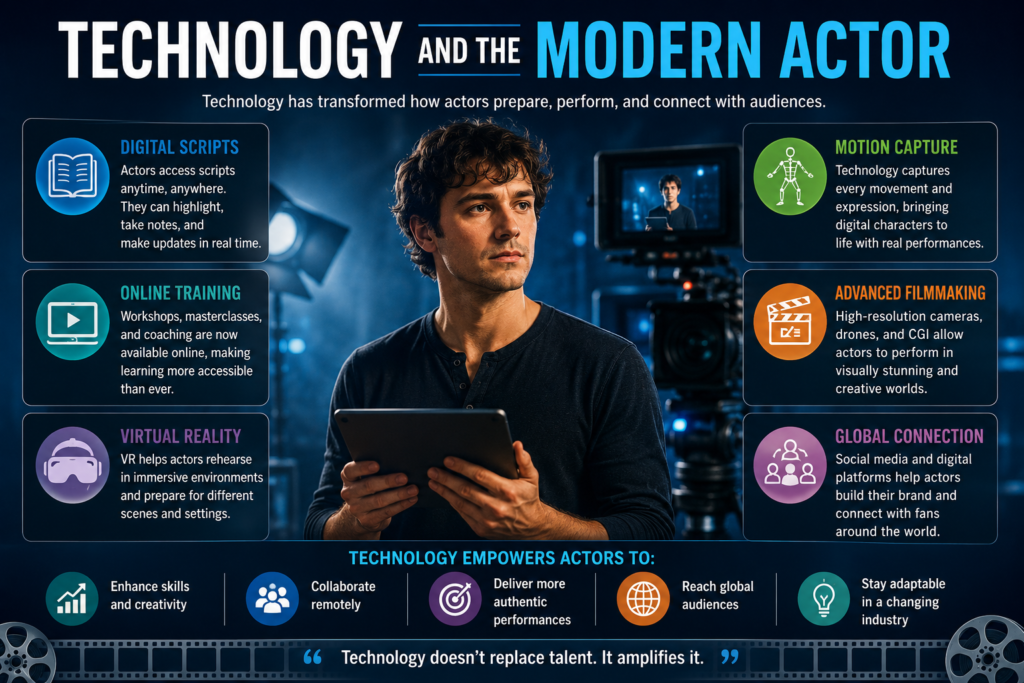
18. The Digital Actor: CGI and Performance Capture
Digital filmmaking created a new challenge.
What happens when the actor’s physical environment is partly created later?
An actor might perform:
- in front of a green screen
- with tracking markers
- beside partial physical sets
- with imaginary creatures
- with digital characters
- inside a virtual environment
This requires imagination and technical precision.
The Academy of Motion Picture Arts and Sciences describes performance capture as a collaboration combining animation, visual effects, and live performance to create digital characters.
That means performance capture should not be treated simply as “computer animation.”
There is still a performer at the center of the process.
19. Acting When the World Does Not Exist Yet
This is one of the biggest differences between traditional and digital filmmaking.
Imagine an actor playing a scene in a real room.
The performer can react to:
- walls
- furniture
- lighting
- objects
- physical distance
Now imagine the same performer acting opposite a creature that will be added later.
The actor may have to imagine:
- where the creature is
- how tall it is
- how fast it moves
- where its eyes are
- how it responds emotionally
The performance therefore becomes partly an exercise in controlled imagination.
20. Performance Continuity in Digital Filmmaking
Digital production also creates new continuity demands.
An actor may need to repeat:
- exact body positions
- eye direction
- movement speed
- hand placement
- timing
- emotional intensity
Why?
Because the visual-effects team may later build digital elements around those movements.
This means technical accuracy can become part of acting.
A modern actor therefore needs two kinds of awareness:
Character awareness
and
technical awareness.
That is a major development in the history of screen performance.
21. Virtual Production and the Changing Screen Environment
Virtual production is another step in this evolution.
Instead of always placing actors in front of a blank green screen, modern production can place performers within environments generated or displayed digitally.
This can change the actor’s relationship with:
- light
- space
- background
- eyelines
- scale
- atmosphere
The important point is not simply that the technology looks impressive.
The technology can provide actors with more visual information about the world they are supposed to inhabit.
So digital technology can sometimes make imaginary environments more tangible for the performer, rather than simply making acting harder.
22. Streaming Changed the Actor’s Job
Streaming changed the way audiences consume screen stories.
A film might be watched in a cinema.
A television series might unfold weekly.
A streaming production might be consumed over several episodes or seasons.
This creates opportunities for more sustained character development.
Actors may have to maintain a character across:
- multiple episodes
- different emotional states
- long production schedules
- changing storylines
- international audiences
The actor’s job therefore increasingly involves long-term character consistency.
23. The New Star System: From Studio Publicity to Social Media
The old studio system could strongly influence an actor’s public image.
Today, actors can communicate directly with audiences through social platforms.
That creates more control—but also more responsibility.
An actor’s public identity can now involve:
- interviews
- social media posts
- behind-the-scenes content
- promotional videos
- public appearances
- personal branding
This creates an interesting historical parallel:
Old Hollywood: Studios helped construct the star image.
Digital Hollywood: actors can participate directly in constructing their own public image.
The star system did not simply disappear.
Part of it changed platforms.
24. AI and the Rise of Digital Performers
Artificial intelligence introduces a new stage in the evolution of acting in Hollywood.
AI can potentially affect:
- voice reproduction
- facial manipulation
- digital likenesses
- dubbing
- visual transformation
- synthetic characters
- post-production
- performance generation
But the most important question is not simply:
“Will AI replace actors?”
A better question is
Who controls a performer’s digital identity and how may that identity be used?
25. Digital Replicas Are Different From Synthetic Performers
This distinction is important.
A digital replica can be designed to resemble a specific performer.
A synthetic performer may be digitally created without representing a particular recognizable actor.
SAG-AFTRA’s current materials distinguish between digital replicas and synthetic performers and emphasize protections concerning performers’ voices, likenesses, and performances.
SAG-AFTRA’s 2026 TV/Theatrical agreement materials also describe new protections concerning digital replicas, synthetic assets, biometric data, and related uses.
This demonstrates that AI is not merely a technical issue.
It is also a question of:
- consent
- compensation
- identity
- privacy
- creative control
- employment
- performance rights
26. What AI Changes—and What It Does Not
AI can alter the tools used to create a performance.
But acting involves more than producing an image that looks like a person.
Actors make choices about:
- intention
- relationships
- timing
- interpretation
- physical behavior
- emotional emphasis
- listening
- improvisation
SAG-AFTRA’s AI resources explicitly emphasize the importance of human performance while addressing protections for digital replicas and synthetic performers.
The future is therefore unlikely to be adequately described as simply
humans vs. machines.
A more useful model is
human performance + digital tools + negotiated control.
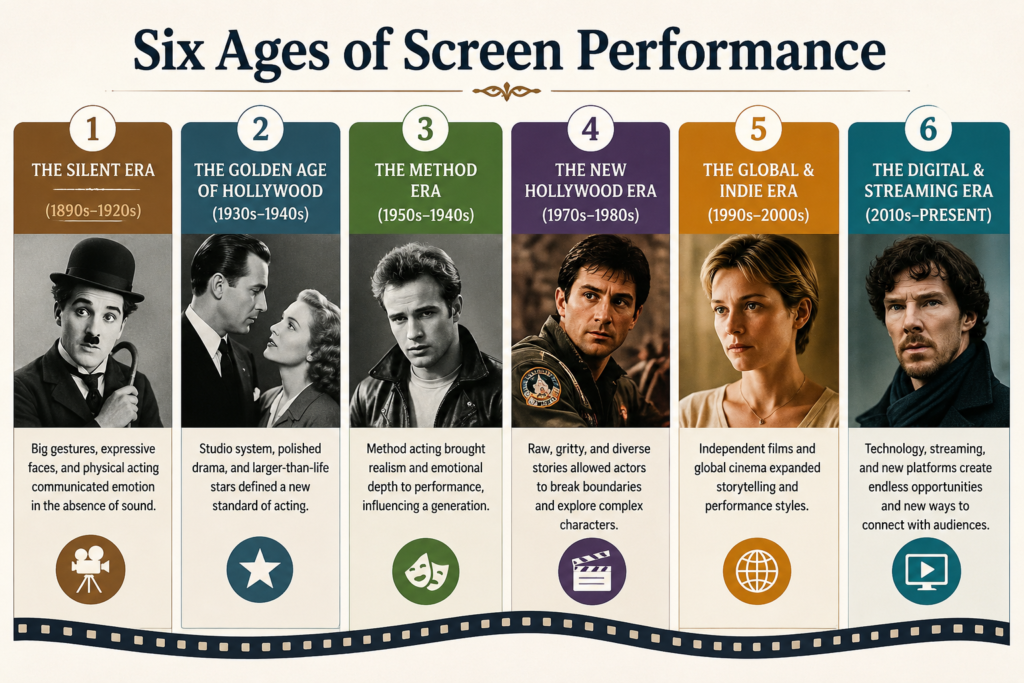
27. Six Ages of Screen Performance
The following framework provides a useful way to understand the entire history.
This is an analytical framework for this article, not an established academic classification.
1. The Gesture Age
Actors communicated through visible physical behavior.
2. The Voice Age
Sound made speech, listening, diction, and vocal rhythm central.
3. The Persona Age
The studio system connected acting with carefully managed star identities.
4. The Psychology Age
Method-influenced traditions emphasized psychological realism and complex inner life.
5. The Digital Age
CGI, motion capture, and virtual production expanded what performers could portray.
6. The Synthetic Age
AI and digital replicas are creating new questions about how performances are created, stored, reproduced, and controlled.
This framework shows that the history of acting is not simply about different acting “styles.”
It is about different performance environments.
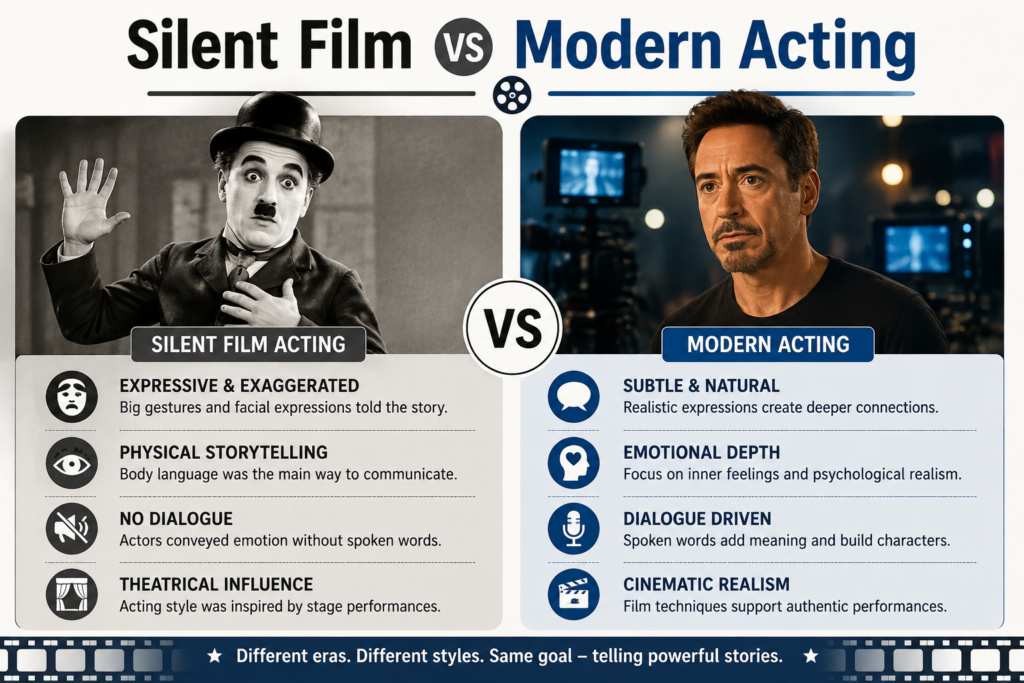
28. Silent Acting vs. Modern Acting
| Feature | Silent-film era | Modern screen acting |
|---|---|---|
| Primary communication | Visual | Visual + vocal |
| Dialogue | Intertitles | Recorded dialogue |
| Physical expression | Often more visible | Can be extremely subtle |
| Camera relationship | Developing | Highly sophisticated |
| Editing | Increasingly important | Central to performance construction |
| Technology | Film camera and photographic techniques | Digital cameras, CGI, virtual production |
| Character creation | Gesture and visual behavior | Voice, psychology, movement, and behavior |
| Technical demands | Physical continuity | Physical + digital continuity |
The key lesson is that modern acting is not necessarily “less physical.”
A performance-capture actor may need enormous physical awareness.
The difference is that the physical performance may later become part of a digital character.
29. Classical Acting vs. Method-Informed Acting
| Aspect | Classical/traditional approach | Method-influenced approach |
|---|---|---|
| Preparation | Technique and rehearsal | Psychological and experiential preparation may be emphasized. |
| Performance | Controlled external technique | Greater emphasis on internal motivation |
| Voice | Often highly trained | Varies by teacher and performer |
| Character | Built through performance choices | Often explored through psychological circumstances |
| Realism | Stylized or controlled realism | Strong emphasis on naturalistic behavior |
| Limitation | Can become overly formal | Can become overly inward if misunderstood |
Neither approach automatically produces better acting.
A skilled actor may borrow from multiple traditions.
30. Traditional Acting vs. Performance Capture
| Traditional screen acting | Performance capture |
|---|---|
| Physical performance is filmed directly. | Physical performance may be converted into digital character data. |
| A real costume may be visible. | Performers may wear specialized equipment. |
| Physical environment may be visible. | The environment may be partly digital. |
| Facial expression reaches the camera directly. | Facial movement may be captured and processed. |
| The audience sees the actor directly. | The audience may see a transformed digital character. |
| Performance remains closely tied to the actor’s appearance. | Performance can be separated from the actor’s final appearance. |
The Academy‘s discussion of performance capture highlights precisely this collaboration between live performance, animation, and visual effects.
31. What Modern Actors Can Learn From Silent-Film Performers
Silent-film actors provide a surprisingly useful lesson for today’s performers.
Lesson 1: Make emotion visible
A strong performance does not always require dialogue.
Lesson 2: Understand the camera
The same performance can look completely different in a wide shot and a close-up.
Lesson 3: Use the body
Posture and movement can communicate character before a line is spoken.
Lesson 4: Don’t depend entirely on dialogue.
A reaction can sometimes be more powerful than a speech.
Lesson 5: Adapt to the medium
The greatest performers have repeatedly adapted to technological change.
That final lesson may be the most important.
32. What Content Creators Can Learn From Great Actors
The lessons of screen acting also apply beyond movies.
Good communication requires:
- understanding the audience
- controlling attention
- choosing the right level of detail
- using timing
- communicating emotion
- adapting to the medium
A long theatrical speech is not automatically effective on a short-form video.
A dramatic film monologue is not automatically effective in an article.
The principle is the same:
The medium changes how the message should be delivered.
33. What Has Actually Stayed the Same?
After more than a century of technological change, several things remain surprisingly stable.
Actors still need to:
- understand characters
- react to other performers
- make choices
- communicate intention
- maintain concentration
- repeat performances consistently
- respond to direction
- connect with an audience
Technology can change the environment.
- It can change the camera.
- It can change the character’s appearance.
- It can change how the performance is recorded.
But the fundamental challenge remains:
How can a performer make an audience believe in a human experience?
34. Skills Hollywood Actors May Need by 2035
The future actor may need a broader skill set than previous generations.
Essential skills may include:
1. Camera awareness
Understanding framing and subtle performance.
2. Voice control
Dialogue, accents, dubbing, and voice-based digital work.
3. Physical performance
Movement, body language, and potentially performance capture.
4. Improvisation
Responding naturally when scenes change.
5. Technical literacy
Understanding green screens, virtual production, and digital capture.
6. Continuity discipline
Repeating physical and emotional choices accurately.
7. Digital identity awareness
Understanding how a voice or likeness may be digitally reproduced.
8. Collaboration
Working with directors, editors, VFX artists, animators, and technical teams.
The future performer may therefore be less like an isolated actor and more like a creative collaborator inside a larger technical system.
35. The Future of Hollywood Acting
The next stage of Hollywood acting will probably not be defined by one new technique.
Instead, several developments will overlap:
- AI
- digital replicas
- virtual production
- motion capture
- global streaming
- multilingual production
- new forms of audience interaction
The boundaries between:
acting + animation + visual effects + voice performance
may continue to become less rigid.
At the same time, audiences may place greater value on authenticity.
That creates an interesting paradox.
The more technologically sophisticated filmmaking becomes, the more audiences may want performances that feel emotionally genuine.
36. Why Human Emotion Still Matters in the AI Era
Technology can reproduce appearances.
It can manipulate voices.
It can generate images.
But audiences do not connect with a character merely because the character looks realistic.
They connect because they understand something about:
- fear
- love
- ambition
- grief
- loneliness
- hope
- conflict
- relationships
That is why the future of acting should not be framed simply as a competition between actors and machines.
The more useful question is
How will human performers use new tools without losing the qualities that make performance meaningful?
That question will probably remain important long after today’s AI systems have changed.
Frequently Asked Questions
1. What is the evolution of acting in Hollywood?
The evolution of acting in Hollywood describes how screen performance changed from the silent-film era through sound cinema, the studio system, method acting, independent filmmaking, digital effects, streaming, and AI-assisted production.
2. How did silent films change acting?
Silent films required performers to communicate primarily through visible behavior because synchronized spoken dialogue was unavailable. Facial expression, gesture, movement, and visual reactions became especially important.
3. How did sound change Hollywood acting?
Sound introduced recorded dialogue, making voice, diction, accents, pauses, listening, and conversational rhythm important parts of screen performance.
4. Did method acting invent realistic acting?
No. Naturalistic and psychologically complex performances existed before the American Method became influential. The method changed actor training and helped establish psychological realism as a major part of American acting culture.
5. Why was the Actors Studio important?
The Actors Studio became an influential workshop for professional actors, particularly after Lee Strasberg became its artistic director in 1951. Its influence helped spread method-related approaches among generations of American performers.
6. How has CGI changed acting?
CGI can require actors to perform without seeing the final character or environment. Performers may need to use imagination, precise movement, and technical awareness to interact convincingly with digital elements.
7. What is performance capture?
Performance capture records aspects of a performer’s movement and performance so they can contribute to a digitally created character. The Academy describes it as a collaboration involving live performance, animation,
and visual effects.
8. How has streaming affected actors?
Streaming has expanded the number and variety of screen productions and created opportunities for actors to develop characters across longer-form stories and internationally distributed productions.
9. What is a digital replica of an actor?
A digital replica is a digitally created representation of a specific performer’s voice, likeness, or performance. SAG-AFTRA‘s materials distinguish digital replicas from wholly synthetic performers and establish contractual protections around their use.
10. Will AI replace Hollywood actors?
There is no reliable basis for predicting that AI will completely replace actors. AI may automate or alter some aspects of performance production, but acting continues to involve interpretation, human relationships, creative choices, and performance direction.
Conclusion
The evolution of acting in Hollywood is ultimately a story of adaptation.
Silent-film performers learned to communicate through gesture and expression. Sound transformed the importance of voice and listening. The studio system connected actors to carefully constructed star identities. Method-related approaches brought new attention to psychological realism without erasing the valuable traditions that came before them.
Later, independent filmmaking broadened ideas about naturalistic performance, while digital cinema required actors to work with CGI, motion capture, and increasingly sophisticated visual-effects systems. Streaming expanded the opportunities for long-form character development and global audiences.
Now AI and digital replicas are introducing another transformation.
The central challenge, however, remains remarkably familiar.
Actors still have to make audiences believe that a character has something at stake.
The tools may change from film cameras to digital cameras, from physical sets to virtual environments, and from recorded performances to digitally assisted ones. But the most important part of performance remains the ability to communicate human intention, emotion, and experience.
That is why the history of Hollywood acting should not be viewed as a simple journey from “old-fashioned” performance to modern realism.
It is better understood as a continuous process of adaptation between performers, technology, filmmakers, and audiences.
And as Hollywood enters an increasingly digital and AI-assisted era, the most valuable actors may not simply be those who resist change or those who embrace every new technology.
They may be the performers who learn how to use new tools while preserving the human qualities that audiences have always responded to.
Author Note
About the Author—RVLNSV PRASAD
This article was written as an independent research-based overview of the history and development of screen acting. It focuses on the relationship between acting techniques, filmmaking technology, production systems, and changing audience expectations.
The article combines historical information with clearly identified analytical interpretations. Where historical or industry-specific claims are made, authoritative film, archival, and industry sources are used where appropriate.
Editorial and Fact-Checking Note
Historical film terminology can sometimes be interpreted differently by scholars, filmmakers, and acting teachers. This article therefore avoids presenting one acting tradition as the only correct approach.
In particular, Method acting should not be treated as a single uniform technique, and the arrival of Method-influenced performance should not be presented as the moment when realistic acting suddenly began. The BFI’s historical discussion provides important context for this distinction.
AI-related sections should also be updated periodically because performer agreements and digital-replica practices continue to evolve. SAG-AFTRA’s 2026 materials demonstrate that protections around digital replicas and synthetic performers are still developing.
Sources and Further Reading
- Library of Congress — The Survival of American Silent Feature Films
- BFI — Birth of the Method: The Revolution in American Acting
- Library of Congress — Actors Studio historical records
- Academy of Motion Picture Arts and Sciences — Acting and Performance Capture
- SAG-AFTRA — Artificial Intelligence Resources
- SAG-AFTRA — 2026 TV/Theatrical Contracts
More Stories From This Blog
- Unveiling the Gems: The Top Underrated Bollywood Films You Must Watch
- Behind the Scenes of Bollywood: Exclusive Interviews with Stars and Industry Insiders
- Rising Stars: Upcoming Bollywood Actors You Should Keep an Eye On
- Breakthrough Performances by New Actors: A New Era in Cinema
- Home