
Author Note
This article examines celebrity work-life balance through publicly available research, established reporting, and academic studies of celebrity culture, work-family relationships, privacy, and social media. It does not speculate about the private lives of individual celebrities or present rumors as facts.
Where a claim concerns a particular person, career, or current event, readers should consult the original source. The broader analysis in this article is intended to explain patterns and pressures that can affect public figures across different entertainment and sports careers.
Introduction
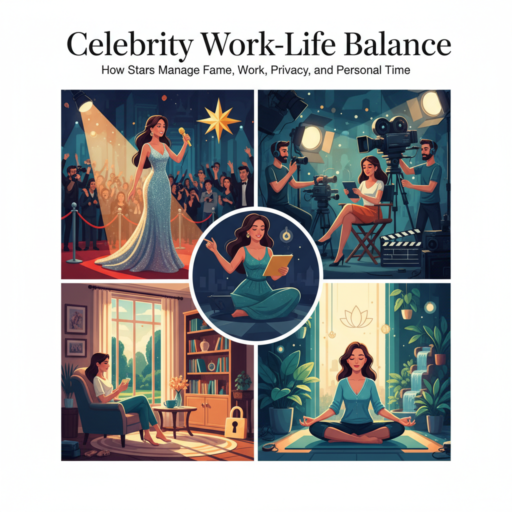
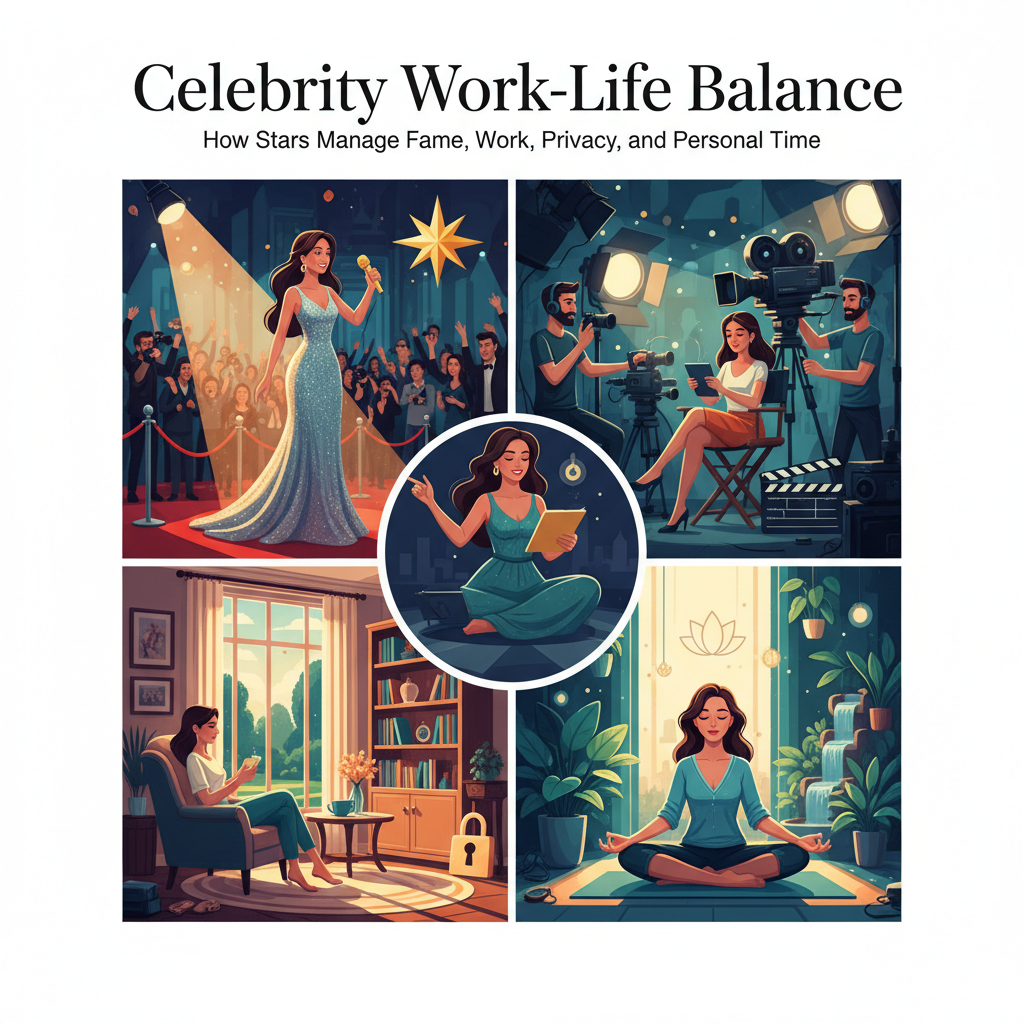
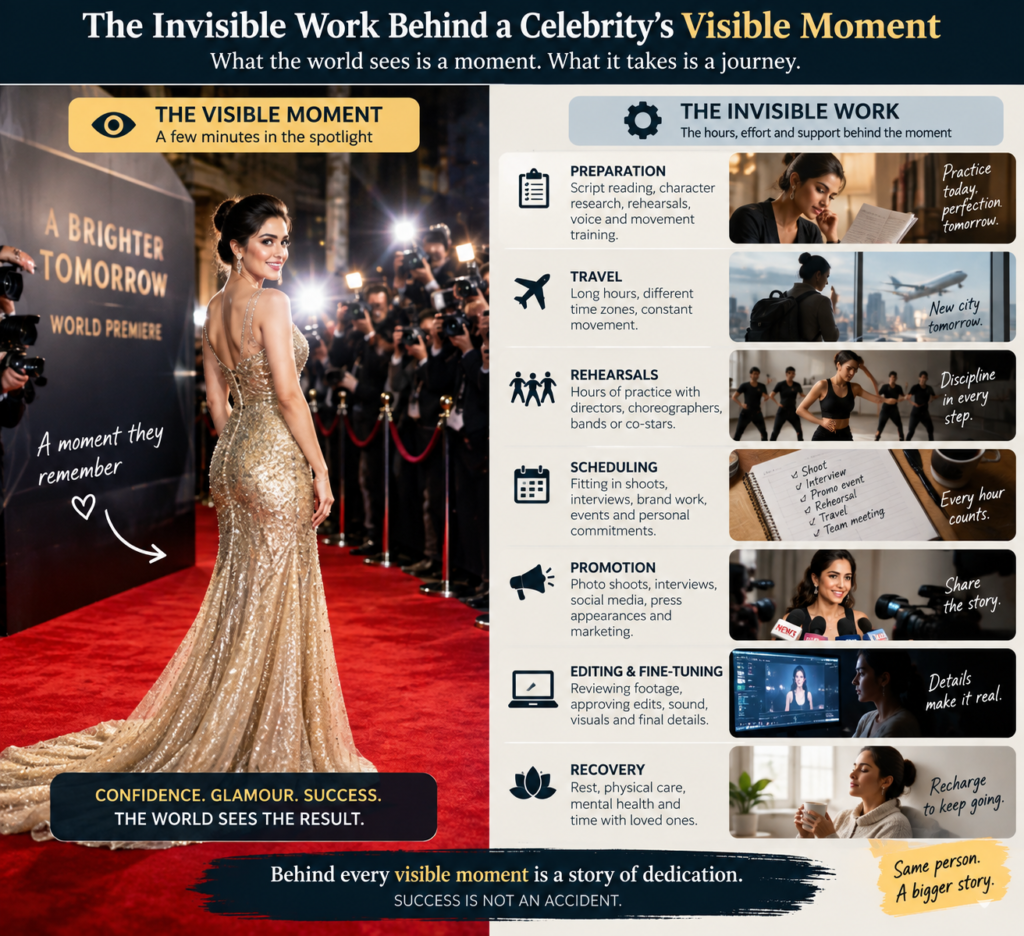
Celebrity work-life balance is often misunderstood because the public usually sees the most visible parts of a celebrity’s career: film premieres, concerts, interviews, award ceremonies, social media posts, advertising campaigns, or photographs from holidays.
What happens between those moments is much less visible.
For an actor, work may involve months of preparation followed by an intense filming schedule. A musician may move between rehearsals, recording sessions, performances, and travel. An athlete’s career can revolve around training, competition, and recovery. A social media creator may find that the platform used for personal communication is also part of the job.
That makes celebrity work life balance less about having a luxurious lifestyle and more about how limited time, professional obligations, public visibility, relationships, privacy, and recovery are managed.
Research on work-life balance generally treats the subject as more complicated than simply counting working hours. A broad review of two decades of research describes work-life balance in terms of the relationship between professional demands, family responsibilities, personal needs and the possibility of reducing conflict between those areas. Work-life balance research review (PMC)
Celebrity culture adds another layer: a person’s public identity can itself become part of the work. Academic research has examined how celebrities manage the boundary between professional and private self-presentation, particularly on social media.
This article looks at what that means in practical terms—and what ordinary readers can learn from it without assuming that every celebrity lives the same way.
Quick Answer: How Do Celebrities Balance Work and Personal Life?
Celebrities can manage demanding careers by setting boundaries, controlling commitments, protecting private time, delegating some professional tasks, choosing projects carefully, and maintaining routines that support relationships and recovery. However, there is no universal celebrity schedule. An actor filming a movie, a musician touring internationally, and an athlete preparing for competition can face very different pressures.
Celebrity work-life balance can also be complicated by public attention. Social media, interviews, publicity, and fan expectations can make the boundary between professional and personal life less clear.
The most useful lesson is not that celebrities have special routines. It is that protecting personal time often requires deliberate decisions about what to accept, what to share, and what to keep private.
What Does Celebrity Work-Life Balance Actually Mean?
The phrase sounds simple, but it involves several different kinds of time.
A celebrity’s professional life may include much more than the activity that made them famous.
An actor’s work can include auditions, rehearsals, costume fittings, filming, promotional interviews, premieres, travel, and publicity. A musician’s schedule may involve songwriting, recording, rehearsals, performances, travel, and promotional appearances. An influencer or digital creator may spend time planning, filming, editing, responding to commercial partners, and communicating with an audience.
The public may see only the finished product.
Public work versus less visible work
| Part of celebrity life | What may count as work | What the public often sees |
|---|---|---|
| Acting | Auditions, rehearsals, filming, promotion | Movies and premieres |
| Music | Writing, recording, rehearsals, touring | Concerts and music videos |
| Sports | Training, competition, travel, recovery | Matches and competitions |
| Television | Filming, rehearsals, interviews | Broadcast episodes |
| Digital creation | Planning, filming, editing, partnerships | Finished posts and videos |
This distinction matters because a celebrity’s visible working moment may represent only one part of a much larger professional process.
It also explains why a photograph showing a celebrity at a restaurant or on a beach cannot tell us whether that person is actually taking a day off. The image provides a moment, not an entire schedule.
Why Balancing Work and Personal Life Can Be Difficult for Celebrities
Ordinary jobs can certainly involve long hours and difficult schedules. Celebrity careers are not automatically harder than other occupations.
What can make some celebrity careers distinctive is the combination of unpredictable work, public visibility, and the commercialization of personal identity.
Academic research on celebrity culture describes the tension between public exposure and privacy as a central part of contemporary celebrity life. Research on celebrity privacy and image control
A performer may therefore have two boundaries to manage:
- When am I working?
- What part of my life is public?
Those questions are related but not identical.
A person can finish filming for the day and still have a promotional interview. A musician can leave the stage but continue traveling for the next performance. A public figure can spend an evening with family while still receiving messages about upcoming professional commitments.
Celebrity schedules can change in cycles.
Entertainment careers often operate around projects rather than one identical workday repeated throughout the year.
| Career period | Possible pressure | Work-life challenge |
|---|---|---|
| Early career | Auditions and opportunities | Saying yes to too many commitments |
| Breakthrough | Increased public and professional demand | Protecting personal time |
| Peak activity | Multiple projects and appearances | Controlling workload |
| Established career | Selecting projects | Maintaining boundaries |
| Career transition | New roles or business interests | Rebuilding routines |
This is a framework, not a rule. Individual careers differ substantially.
The important point is that balance can change from one period of a career to another.
A Celebrity’s “Day Off” May Not Mean What People Think
One common mistake is to divide celebrity life into “working” and “not working” as though the boundary were always obvious.
Consider an actor who is not filming.
That person may still have:
- an interview
- a script to read
- a promotional event
- a meeting
- travel
- a brand obligation
- preparation for an upcoming role
Similarly, a musician between concerts may still be traveling or rehearsing.
This is why a better way to understand celebrity work-life balance is to consider control over time, not just the number of hours worked.
Someone can have considerable financial resources and still have little control over when professional obligations arise.
How Celebrities Can Protect Personal Time
There is no single formula, but several practical boundary-setting strategies can make personal time easier to protect.
1. Choosing commitments carefully
A celebrity who accepts every possible project may create a schedule that becomes difficult to manage.
As careers develop, some public figures can have more freedom to decide which projects, partnerships, or appearances fit their priorities.
This is not always possible early in a career, when opportunities may be less predictable.
2. Creating periods with fewer professional commitments
A person may deliberately leave space between projects or reduce appearances during certain periods.
The public may interpret this as disappearing from the spotlight, but stepping back can simply be a way of controlling professional exposure.
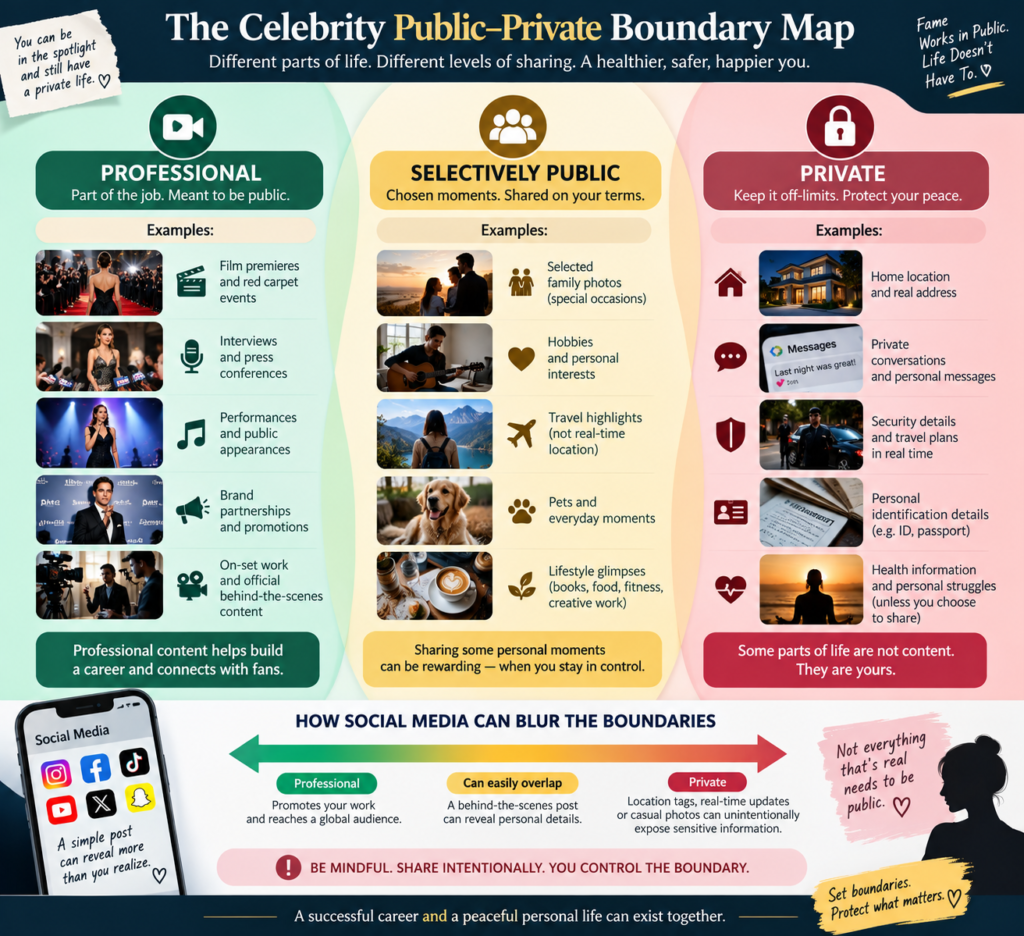
3. Separating public and private information
Not every personal activity needs to become content.
This is particularly important in the social media era, where personal photographs can easily become part of a public-facing professional identity.
Research examining more than 1,400 celebrities and hundreds of thousands of Instagram posts found that celebrities vary in how much private versus professional material they share and that the relationship between private self-presentation and popularity is not simply linear. Journal of Business Research study on celebrities and private social-media content
That finding is important because it challenges the assumption that celebrities must reveal everything to remain popular.
4. Delegating administrative work
Some public figures have professional teams that help coordinate schedules, communications, and business responsibilities.
That can reduce certain administrative demands.
But delegation does not automatically create emotional or personal balance. A manager can coordinate appointments; they cannot decide what a person values in their private life.
How Fame Changes the Boundary Between Work and Personal Life
For most people, their job title and personal identity are at least partly separate.
Celebrity culture can make that separation more difficult.
A celebrity’s name, appearance, relationships, opinions, and lifestyle can all become part of public interest. Academic research describes celebrity culture as involving a continuing negotiation between public visibility and privacy. Academic research on celebrities, privacy, and image control
That creates an unusual situation:
The person is not only performing a job; the public image surrounding the person can also have professional value.
Public image versus professional reality
| What the audience sees | What may be happening professionally |
|---|---|
| Red-carpet appearance | Promotional commitment |
| Travel photograph | Work travel or scheduled appearance |
| Social media post | Planned personal or professional content |
| Interview | Media obligation |
| Concert | Result of rehearsal, travel, and preparation |
| Film premiere | Part of a larger promotional campaign |
None of these examples means every celebrity experiences the same process.
The lesson is simply that visible moments should not automatically be treated as a complete picture of someone’s working life.
Actors, Musicians, Athletes, and Influencers Have Different Work-Life Challenges
It is tempting to discuss “celebrities” as though they represent one occupation.
They do not.
Actors
Actors may work in concentrated production periods followed by gaps between projects. Filming can involve early starts, travel, rehearsals, and long periods away from home depending on the production.
Research involving actor-partner families has specifically examined how work demands and work-family environments can relate to interference between work and family life. Research on actors, work-family environments and work-family interference
That does not mean every actor experiences the same problem. It shows why the occupation is worth examining separately.
Musicians
Musicians may face a different pattern: recording periods, rehearsals, live performances, and touring.
A tour can create an extended period in which work and travel dominate the calendar.
Athletes
Athletes may have demanding training, competition, travel, and recovery schedules.
Their work-life balance may therefore involve protecting recovery and personal relationships while maintaining performance requirements.
Influencers and digital creators
Digital creators face a particularly interesting boundary because the same device can be used for both personal communication and professional work.
The phone is not simply a leisure device. It can also be the workplace.
| Profession | Major work pressure | Potential personal-life challenge |
|---|---|---|
| Actor | Production and promotion | Unpredictable schedules |
| Musician | Recording and touring | Extended travel |
| Athlete | Training and competition | Recovery and travel |
| Influencer | Continuous content creation | Work entering personal spaces |
| TV personality | Production and public appearances | Recurring visibility |
This is one reason there is no meaningful “standard celebrity lifestyle.”
How Social Media Has Changed the Way Celebrities Manage Work and Personal Life
Social media has made celebrity communication more direct.
A public figure can communicate with millions of followers without waiting for a television interview or magazine profile.
That creates opportunities—but it also changes the boundary between professional and personal communication.
Research on celebrity self-disclosure has found that both professional and personal disclosures on social platforms can influence followers’ sense of social presence and parasocial interaction. Research on celebrity self-disclosure and parasocial relationships
Another study examining celebrities’ private and professional Instagram content found that how much private material is shared can affect popularity, although more private content is not simply “better” in every circumstance. Journal of Business Research research on celebrity social media presentation
This creates an important distinction:
Being visible is not the same as being personally available.
A celebrity may choose to publish a photograph, comment, or video without opening every part of their life to the audience.
That distinction is useful for ordinary social media users too.
You can communicate online while still deciding what remains private.
Can Social Media Make Work-Life Boundaries Harder?
Yes, although the effect depends on the person and how the platform is used.
Research on social media use and work-nonwork balance among employees has found that personal social media use can have complex relationships with work-nonwork balance and creativity rather than producing one simple positive or negative effect. Research on social media use and work-nonwork balance
Other research has linked problematic social media use with work-family balance and burnout, again showing that digital communication can have competing effects. Research on social media, work-family balance, and burnout
For celebrities, the situation can be more complicated because social media may simultaneously be:
- a communication channel
- a marketing platform
- a source of income
- a professional branding tool
- a way to maintain audience attention
- a place where personal information becomes public
The result is a workplace that can travel with the person.
Family and Relationships Require Deliberate Time
A demanding career can make relationships harder to maintain when schedules are unpredictable.
This is not unique to celebrities. Work-family research broadly examines how working hours, pressure, and workplace conditions can affect family relationships.
For example, research involving actor-partner families found that supportive work-family environments were associated with lower work-family interference, while work demands were relevant to how work affected family life. Actor-partner research on work-family interference
For a celebrity, additional public attention can add another consideration.
A family dinner may be private in one person’s life but potentially newsworthy in another’s.
That makes privacy management part of personal-life management.
Healthy boundaries do not necessarily mean hiding everything. They can mean deciding which parts of family life should remain outside the public conversation.
Why Privacy Matters When You Live in the Public Eye
Privacy is often treated as something celebrities either “have” or “do not have.”
The reality is more complicated.
Academic research on celebrity culture has described the need for public figures to negotiate publicness and privacy while managing their public persona. Celebrity privacy and public-image research
Modern social media makes this negotiation even more visible.
A public figure can decide to share:
- professional milestones
- selected family photographs
- hobbies
- travel experiences
- opinions
- behind-the-scenes material
But sharing one aspect of life does not mean giving the public unrestricted access to everything else.
This is an important distinction for readers:
Visibility is a choice; unlimited access does not have to be.
There are also ethical boundaries for people writing about celebrities. Readers should be able to learn about celebrity culture without being given private addresses, precise locations, security vulnerabilities, or unverified personal information.
Does Money Really Make It Easier to Balance Fame and Personal Life?
Money can provide resources that make some practical problems easier.
It may allow a successful person to hire professional assistance, outsource household tasks, or create greater flexibility around certain decisions.
But money does not automatically create a balanced life.
Consider the difference:
| Resource | What it may help with | What it cannot guarantee |
|---|---|---|
| Assistant | Scheduling and administration | Personal fulfillment |
| Manager | Career coordination | Free time |
| Publicist | Media communication | Complete privacy |
| Household support | Daily logistics | Strong relationships |
| Financial flexibility | More choices | A sense of balance |
This is why the idea that “celebrities have money, so they have no problems” is too simplistic.
Resources can solve some logistical problems while leaving other questions unanswered.
Celebrity Image Versus Celebrity Reality
Celebrity culture often packages complicated careers into simple images.
- A finished movie can look effortless.
- A successful concert can look like a single evening.
- A social media post can take only seconds to view.
But the work behind those visible moments can be much larger.
| Finished result | Less-visible work that may come before it |
|---|---|
| Film | Preparation, filming, editing, and promotion |
| Album | Writing, recording, production, and marketing |
| Concert | Rehearsals, travel, and performance |
| Interview | Preparation, scheduling, and media coordination |
| Brand campaign | Negotiation, production, and promotional activity |
| Social post | Planning, photography, editing, or commercial coordination |
This does not mean every celebrity is secretly exhausted or unhappy.
That would simply replace one stereotype with another.
A balanced view recognizes both realities:
Celebrity careers can provide opportunities and rewards while also creating professional pressures that ordinary audiences may not see.
Research on celebrity culture increasingly examines this tension between visibility, performance, intimacy, and professional identity. Research on “Celebrity, Inc.” and the self as work online
How Work and Personal Life Change Throughout a Celebrity Career
Work-life balance is not necessarily fixed.
A person at the beginning of a career may accept opportunities that an established performer would decline.
A celebrity at the peak of public demand may have more professional opportunities but less control over the number of commitments.
Later, a person may move into directing, producing, business, writing, or other work that changes the structure of their professional life.
A simple career-stage framework
| Career stage | Main priority | Possible balance challenge |
|---|---|---|
| Beginning | Building opportunities | Taking on too much |
| Breakthrough | Managing rising demand | Losing personal time |
| Peak visibility | Managing multiple commitments | Maintaining boundaries |
| Established | Selecting projects | Protecting priorities |
| Transition | Redefining career | Building a new routine |
This framework is useful beyond celebrity culture.
Many ordinary workers experience similar changes when they move from entry-level employment into management, entrepreneurship, parenthood, or other demanding phases of life.
Five Common Myths About Life in the Spotlight
Myth 1: Celebrities have unlimited free time
Reality: Financial resources may provide flexibility, but professional commitments can still consume substantial time.
Myth 2: Every celebrity has the same lifestyle
Reality: A touring musician, film actor, professional athlete, and digital creator can have completely different schedules.
Myth 3: Social media shows a celebrity’s real daily life.
Reality: Social media feeds are selective forms of self-presentation. Research shows that celebrities make choices about how much private and professional content they disclose. Research on celebrity private-life presentation on social media
Myth 4: Money automatically creates work-life balance
Reality: Money can provide resources, but balance also depends on boundaries, relationships, priorities, and control over time.
Myth 5: A glamorous public image means an easy private life
Reality: Public images reveal selected moments, not the full structure of a person’s life.
What We Can Learn From How Celebrities Balance Work and Personal Life
The most valuable part of studying celebrity schedules is not copying their expensive habits.
It is understanding the principle of intentional time management.
1. Protect personal time before your calendar fills up.
If personal time is treated as whatever remains after work, it can disappear.
Put important personal commitments on the calendar rather than assuming there will automatically be time for them.
2. Decide what deserves your attention.
Celebrities who manage large numbers of commitments may need to decide which opportunities matter most.
The same principle applies to ordinary work.
Not every request requires an immediate yes.
3. Separate communication from availability
Being reachable does not mean being available every minute.
This is particularly important with smartphones and messaging applications.
4. Create boundaries around digital work
If possible, create periods when work notifications are turned off.
The goal is not to avoid communication permanently. It is to give the brain a clear transition between professional and personal time.
5. Treat recovery as part of productivity.
Rest is often postponed because it seems less urgent than work.
But sustainable performance requires recovery.
6. Keep some parts of life private.
You do not have to publish every achievement, relationship, trip, or family moment.
Privacy can be valuable even when you are not famous.
7. Do not confuse visibility with success.
A person can be highly visible online without having a healthy or satisfying personal life.
The same is true in ordinary workplaces.
Being constantly available is not necessarily the same as being effective.
A Practical Work-Life Balance Framework Anyone Can Use
The celebrity example becomes useful when converted into a simple framework.
WORK
What professional commitments actually matter?
TIME
Where does your time go each week?
BOUNDARIES
When are you unavailable?
PEOPLE
Which relationships need protected time?
DIGITAL LIFE
When should notifications stop?
RECOVERY
When do you rest?
PRIVACY
What information do you want to keep for yourself?
A simple weekly review can ask:
What took most of my time this week, and did that match what I actually value?
That question can be more useful than copying anyone else’s routine.
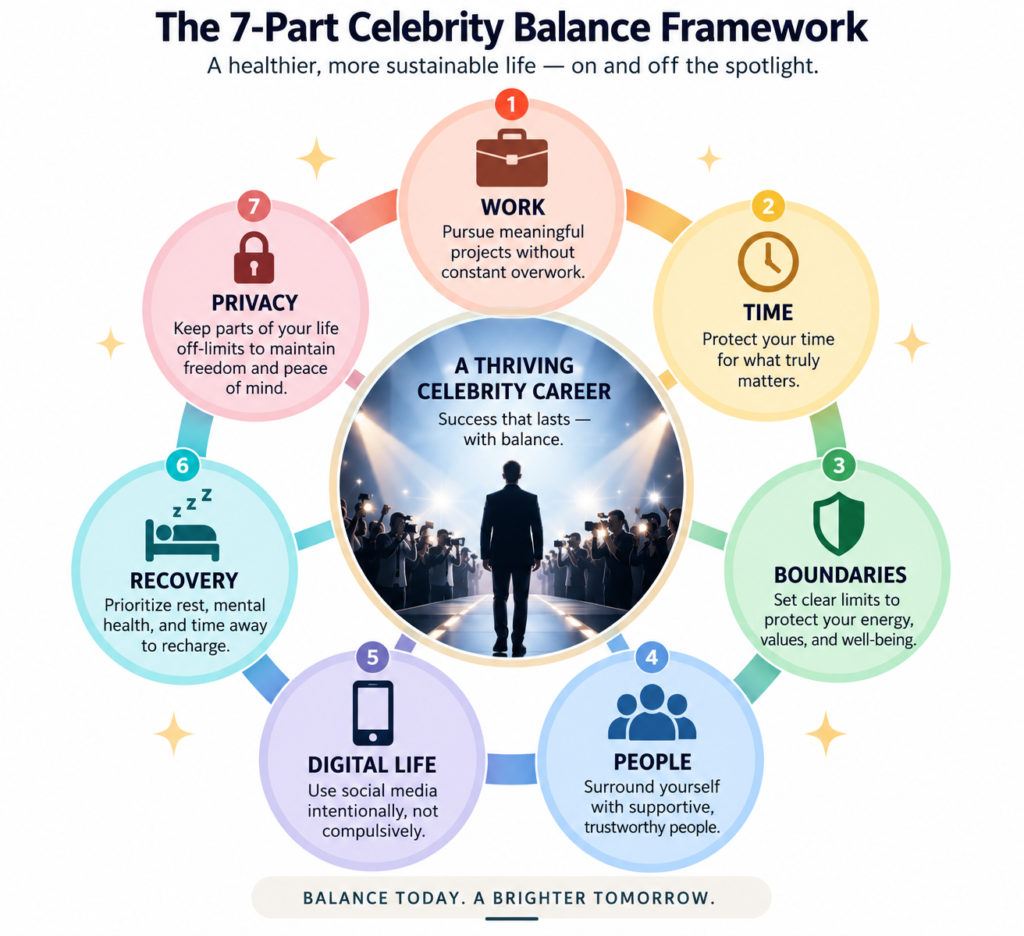
Why Balancing Fame, Work, and Personal Life Is More Complicated Than It Looks
The phrase “celebrity work-life balance” can make it sound as though celebrities have a special lifestyle completely separate from everyone else.
They do not.
The underlying questions are familiar:
- How much time should work take?
- How do you protect relationships?
- When should you disconnect?
- What should remain private?
- How do you recover after demanding periods?
- Which commitments are actually worth accepting?
What changes for celebrities is the scale of visibility and, in some careers, the commercial value of their public identity.
Research on celebrity culture has described this blurring of professional and personal boundaries as a defining feature of modern celebrity life. Recent academic research on celebrity visibility and public-private boundaries
That is why the best way to understand celebrity lifestyles is not through luxury possessions.
It is through time, boundaries, visibility, and control.
Frequently Asked Questions
How do celebrities balance work and personal life?
Celebrities may balance work and personal life through careful scheduling, project selection, professional support, privacy boundaries, and protected personal time. However, the approach varies considerably by profession and career stage.
Do celebrities have normal work schedules?
Some do, but many entertainment careers operate around projects, performances, filming periods, tours, or promotional commitments. A celebrity’s schedule can therefore change significantly from one period to another.
How does fame affect personal life?
Fame can make the boundary between public and private life more difficult to maintain. Public attention, media coverage, and social media audiences can create additional visibility that ordinary workers may not experience. Academic research has examined this ongoing negotiation between celebrity publicity and privacy. Academic research on celebrity privacy and public life
How do celebrities protect their privacy?
Different public figures use different boundaries. Some share very little personal information, while others selectively share family, travel, or lifestyle content. Research on celebrity social media behavior shows that public figures vary in how much private material they disclose. Research on celebrities and private social media content
Does social media make celebrity work-life balance harder?
It can. Social media can function simultaneously as a communication tool, marketing channel, and professional platform. That can make it harder to separate work from personal communication, although the effect varies by individual and how the platform is used. Research on social media and work-nonwork balance shows that the relationship is complex rather than universally positive or negative. Work-nonwork balance and social-media research
Is celebrity work-life balance different for actors and musicians?
Yes. Actors may experience concentrated filming and promotional periods, while musicians may deal with recording, rehearsals, performances, and touring. Their work-life challenges can therefore look quite different.
Does having money make celebrity life easier?
Financial resources can make some practical tasks easier, but they do not automatically create personal balance. Professional assistance can reduce administrative work while questions about relationships, privacy, priorities, and time remain.
What can ordinary people learn from celebrity work-life balance?
The most useful lessons are not about luxury. They include protecting personal time, setting digital boundaries, choosing commitments carefully, scheduling recovery, and deciding what parts of life should remain private.
Conclusion
Celebrity work-life balance is not simply a story about glamorous homes, expensive travel, or famous people having more freedom than everyone else.
The more useful question is how public figures manage the competing demands of professional commitments, personal relationships, public visibility, digital communication, privacy, and recovery.
There is no single celebrity routine. An actor preparing for a film, a musician on tour, an athlete competing throughout a season, and a digital creator working from a phone can have entirely different professional pressures.
Research also shows why the boundary between celebrity work and personal life deserves careful attention. Public figures may use personal disclosure as part of their public identity while simultaneously trying to maintain privacy and control over what audiences see. Journal of Business Research study of celebrity private-life presentation
The most valuable lesson for readers is therefore simple:
Work-life balance is not about having a perfect schedule. It is about deliberately protecting the time, relationships, privacy, and recovery that matter to you.
That principle applies whether someone is a movie star with millions of followers or a person managing an ordinary working week.
Disclaimer
This article is intended for general informational and educational purposes. It discusses celebrity culture, professional schedules, privacy, and work-life balance using publicly available research and sources. It does not provide private information about individuals, diagnose anyone’s mental or physical health, or claim that all celebrities experience the same working or personal circumstances.
References to research should be understood within the limitations of the studies themselves. Individual experiences can differ substantially by profession, country, career stage, employment arrangement, and personal circumstances.
Key Sources and Further Reading
- Google Search Central—Creating Helpful, Reliable, People-First Content: Google’s current guidance emphasizes original information, research, analysis, clear authorship, trustworthiness, and substantial value beyond competing pages. Google Search Central: People-first content guidance
- Google Search Central—Generative AI guidance: Google emphasizes accuracy, quality, relevance, and useful content rather than treating the production method alone as the quality standard. Google Search Central: AI-generated content guidance
- Work-life balance research review: A broad scholarly review examines how work, family responsibilities, conflict, and enrichment interact in work-life balance research. Work-life balance: A landscape mapping of two decades of scholarly research
- Journal of Business Research: Research examining 1,437 celebrities and hundreds of thousands of Instagram posts investigated private versus professional self-presentation. Presentation of celebrities’ private life through visual social media
- Celebrity Studies: Research examines how celebrity identity can become part of professional self-presentation in digital culture. Celebrity, Inc.: the self as work in the era of presentational culture online
- Journal of Family Psychology / NIH: Research involving actor-partner families examines work-family environments, work demands, and work-family interference. Family-friendly for her, longer hours for him: Actor-partner model linking work-family environment to work-family interference
- Social & Cultural Geography: Academic research examines how celebrities negotiate publicness, privacy, image control, and media attention. Publicizing private lives: celebrities, image control and the reconfiguration of public space
- International Journal of Human Resource Management: Research examines relationships between social media use and work-nonwork balance. Staying in touch while at work: social media use and work-nonwork balance
More Stories From This Blog