Film Industry Celebrity Interviews: How Actors and Filmmakers Tell Their Stories
Written by RVLNSV PRASAD
Independent Writer & Researcher
Published: September 5, 2026
Last Updated: September 5, 2026
Reading time: 12–15 minutes
.
Introduction
A film does not end when the credits begin.
Behind every performance, screenplay, camera movement, edit, sound design choice, and directorial decision is a person who made a series of creative choices. Film industry celebrity interviews can give audiences access to some of those decisions in a way that a conventional film review cannot.
An actor may explain how a character was developed. A director may discuss why a scene was shot in a particular way. A writer may reveal how an idea became a screenplay. A cinematographer can explain the visual language of a film.
This is why the strongest celebrity film interviews are more than publicity exercises.
Established film institutions have long used interviews and conversations to document cinema. The British Film Institute’s Screen Talks collection, for example, includes career and filmmaking discussions with major actors and directors, while the Festival de Cannes maintains an official archive of interviews with filmmakers, performers, and jury members.
For audiences, these conversations can provide something valuable: context.
A successful interview does not simply tell us what a celebrity is promoting. It helps us understand how a film was imagined, created, performed, marketed, and remembered.
Key Takeaways
- Film industry celebrity interviews can provide insight into acting, directing, writing, and filmmaking decisions.
- Actor interviews can reveal preparation, collaboration, and career choices beyond what audiences see on screen.
- Filmmaker interviews can explain creative decisions that are difficult to understand from the finished movie alone.
- Promotional interviews and long-form conversations have different purposes.
- Film festivals often create better conditions for deeper conversations about cinema.
- Indian cinema offers an especially broad interview landscape because of its many languages, industries, and filmmaking traditions.
- Good interviews require research, specific questions, active listening, and responsible editing.
- A celebrity’s statement should be treated as a source of perspective, not automatically as independent proof of every factual claim.
- Ethical reporting matters because edited clips and sensational headlines can distort what someone actually said.
What Are Film Industry Celebrity Interviews?
Film industry celebrity interviews are conversations with actors, directors, writers, producers, cinematographers, composers, editors, and other people involved in filmmaking.
They can appear in many formats:
- Newspaper and magazine interviews
- Digital entertainment interviews
- Television conversations
- Podcasts
- Film festival Q&As
- Press conferences
- Red-carpet interviews
- Video interviews
- Long-form career conversations
- Behind-the-scenes discussions
The format matters because it influences the type of information that can emerge.
A two-minute red-carpet interview may focus on a new release or fashion. A one-hour festival conversation can explore an actor’s career, a director’s creative philosophy or the making of a particular film.
The BFI’s Screen Talks collection illustrates this difference. Its programming includes extended conversations with actors and filmmakers about careers and filmmaking rather than relying only on short promotional answers.
That distinction is important when evaluating the quality of an interview.
The longer the conversation, however, the more important preparation and editing become.
Why Do Celebrity Film Interviews Matter?
Celebrity interviews are often associated with publicity, but their value can extend much further.
1. They reveal the person behind the performance.
A finished film shows the result.
An interview can reveal the process.
An actor might explain how they approached a difficult scene, worked with a director, or understood a character’s motivation. Such details can change the way audiences interpret a performance.
2. They explain creative decisions.
Cinema involves hundreds of decisions that viewers may never consciously notice.
- Why was a scene filmed at night?
- Why was a particular actor selected?
- Why was a sequence deliberately kept quiet?
- Why was a character given limited dialogue?
- Why did the filmmaker choose practical effects instead of digital effects?
Interviews can provide answers to questions like these.
3. They preserve film history.
Interviews can become historical documents.
A contemporary interview captures what an artist thought about their work at a particular moment. Years later, that conversation may help researchers, students, and audiences understand how a film was received and how its creators viewed it.
The continuing presence of archival interview collections from institutions such as the BFI demonstrates the long-term value of preserving conversations about cinema.
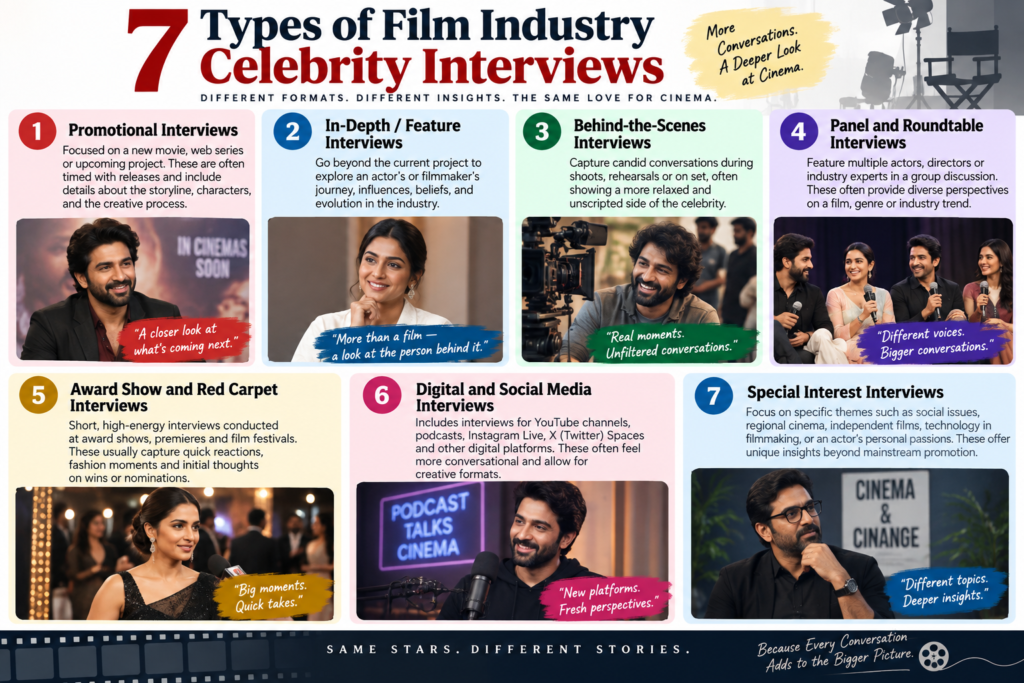
The Main Types of Film Industry Interviews
Not every interview serves the same purpose.
| Interview type | Main purpose | Typical questions |
|---|---|---|
| Promotional interview | Support a new release. | What attracted you to the film? |
| Career interview | Explore an artist’s journey. | How has your approach changed? |
| Actor interview | Examine performance. | How did you prepare for the role? |
| Director interview | Explain filmmaking. | Why did you choose this visual approach? |
| Technical interview | Explore film craft. | How were the visual effects created? |
| Festival Q&A | Discuss cinema with an audience. | What inspired the film? |
| Podcast interview | Allow longer conversation. | What experiences shaped your career? |
| Red-carpet interview | Capture immediate reactions. | What are you excited about tonight? |
| Documentary interview | Record deeper testimony. | How did the production evolve? |
The most useful format depends on what the audience wants to learn.
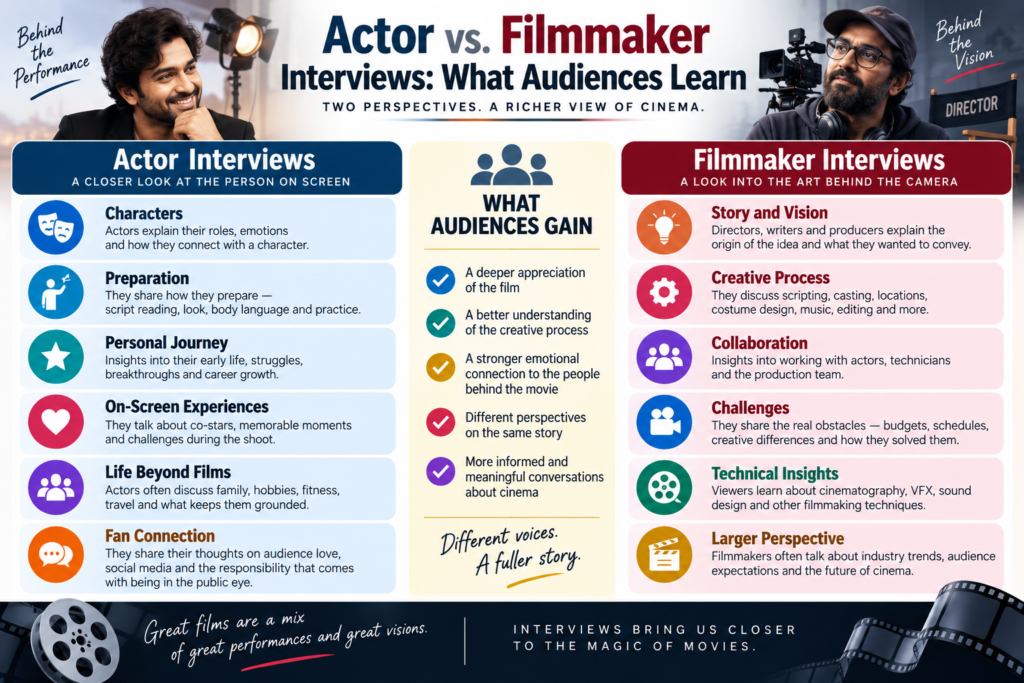
Actor Interviews: Looking Beyond the Performance
An actor interview can be much more revealing when it moves beyond questions about fame, fashion, and box-office expectations.
A thoughtful actor interview can explore four areas.
Character preparation
Audiences often see the final performance without seeing the preparation behind it.
Actors may discuss:
- Research
- Physical preparation
- Dialect or language training
- Movement
- Costume
- Character psychology
- Rehearsals
- Collaboration with the director
These details help audiences understand that acting is not simply memorizing dialogue.
Working with other performers
A performance exists within a relationship.
Actors work with directors, co-stars, cinematographers, editors, and other departments. A strong interview can explore how those relationships influenced the final result.
Career decisions
Career interviews can also reveal why performers accept or reject particular roles.
Indian entertainment publications regularly explore this side of celebrity careers. Filmfare’s interview archive, for instance, includes conversations with actors, directors, writers, and other creative professionals about projects, careers, and professional choices.
Personal interpretation of a role
The most interesting answers sometimes come when an actor explains something that audiences may not have noticed.
A small gesture, pause, expression, or change in physicality can have a deliberate purpose.
That is where an interview becomes a form of film analysis rather than simple promotion.
Filmmaker Interviews Reveal a Different Layer of Cinema
Actors are only one part of the filmmaking process.
Filmmaker interviews can reveal how a movie was constructed from the earliest idea to the finished screen.
A director may discuss:
- The original concept
- Screenplay development
- Casting
- Locations
- Cinematography
- Editing
- Music
- Production challenges
- Visual influences
- Collaboration with actors
- Decisions made during post-production
The BFI’s Screen Talks archive demonstrates how long-form filmmaker conversations can move from individual films into broader discussions of creative practice and careers.
This is particularly useful for readers who want to understand how movies are made, rather than only who stars in them.
What Makes a Good Film Celebrity Interview?
A celebrity’s popularity does not automatically make an interview valuable.
The quality of the questions and the preparation behind them matter.
1. Research comes first.
An interviewer should know the person’s work before asking questions.
Instead of:
“How was your experience working on the movie?”
A researched interviewer might ask about a specific scene, character decision, or collaboration.
Specific questions usually create more useful answers.
2. Ask questions that have somewhere to go.
Weak questions often produce predictable responses.
Strong questions create opportunities for explanation.
For example:
Weak:
“Was this role challenging?”
Stronger:
“What part of the character’s emotional journey was hardest to communicate without dialogue?”
The second question asks for an experience rather than a promotional adjective.
3. Listen to the answer.
An interview should not feel like a list of questions.
A good interviewer listens for something unexpected and follows up.
That is often where the most interesting material appears.
4. Avoid repeating the same question.
Celebrities frequently answer similar questions across multiple interviews.
Repeating the same publicity talking points provides little additional value.
5. Add context.
Readers should understand the film, role, or career moment being discussed.
Context prevents an isolated quote from becoming misleading.
Questions That Can Produce Meaningful Answers
Here are examples of questions that can generate stronger film interview content.
Actors
- What did you discover about the character during rehearsals?
- Did your understanding of the character change after filming began?
- Which scene required the most preparation?
- How did the director influence your performance?
- Was there a moment when your interpretation of the character changed?
- What did you learn from working with the rest of the cast?
Directors
- When did the central idea for the film first emerge?
- What changed between the screenplay and the finished film?
- Why did you choose this particular visual style?
- How did you approach casting?
- Which scene changed the most during production?
- What did you learn while making the film?
Writers
- What was the first image or idea behind the story?
- How did the characters evolve during writing?
- Which part of the screenplay was hardest to solve?
- Did production change the script?
For technical artists
- What technical limitation affected the creative decision?
- How did the team create a particular visual or sound?
- Which part of the process would audiences probably never notice?
These questions move the conversation from celebrity personality to creative substance.
Promotional Interviews vs. In-Depth Interviews
The two formats should not be confused.
| Promotional interview | In-depth interview |
|---|---|
| Usually connected to a release | May focus on career or creative process |
| Often shorter | Often longer |
| Marketing-oriented | Exploration-oriented |
| May repeat key talking points | Usually seeks original insight |
| Focuses on immediate project | Can examine several projects |
| Designed for broad audiences | Often rewards specialists or dedicated viewers |
Neither format is inherently bad.
A promotional interview can efficiently tell audiences why a new film matters.
An in-depth interview can provide context that survives beyond the release campaign.
The important question is whether the article accurately represents the purpose of the conversation.
Film Festivals Create Space for Deeper Conversations
Film festivals can be particularly valuable for interviews because cinema itself becomes the subject.
The Festival de Cannes maintains an official interview section containing conversations with actors, filmmakers, and jury members. Recent entries include interviews with figures such as Chloé Zhao, Javier Bardem, Demi Moore, and other festival participants.
The BFI London Film Festival also uses Screen Talks to place audiences directly in conversation with major cinema voices. Its 2026 program, announced in September 2026, includes figures such as Ava DuVernay, Brad Bird, Cynthia Erivo, Sofia Coppola, and Danny Boyle.
This illustrates an important point:
A film interview does not have to exist only as marketing content.
It can also become part of the cultural conversation surrounding cinema.
Why Indian Film Interviews Deserve Wider Attention
India’s film industry is not a single creative ecosystem.
It includes major industries and filmmaking communities working across languages, regions, and traditions.
That creates an unusually rich environment for Indian film industry interviews.
A useful interview can introduce audiences to:
- Regional filmmakers
- New actors
- Screenwriters
- Cinematographers
- Editors
- Musicians
- Production designers
- VFX artists
- Sound professionals
- Independent filmmakers
This broader perspective matters because audiences frequently associate cinema with actors while overlooking the many crafts involved in creating a film.
India’s International Film Festival of India has also highlighted the range of filmmaking disciplines through its Creative Minds of Tomorrow initiative, which spans areas including direction, acting, cinematography, editing, scriptwriting, music, sound, costume, art direction, and animation/VFX.
That wider craft ecosystem provides an important opportunity for entertainment journalism: interview the people audiences do not always see.
Interviews Can Make Invisible Film Crafts Visible
A great movie can make technical work almost invisible.
Good editing should feel natural.
Good sound design may be unnoticed.
Effective production design should feel like the world simply exists.
Visual effects should often disappear into the story.
That creates a paradox.
The better some technical work becomes, the less audiences may consciously notice it.
Interviews can correct that imbalance.
- A conversation with an editor can explain rhythm.
- A cinematographer can explain lighting.
- A sound designer can describe how the atmosphere was constructed.
- A costume designer can discuss how clothing communicates character.
- A production designer can explain how a fictional environment was built.
This is one reason I believe the future of film interviews should not belong exclusively to actors and directors.
The next generation of film interviews should give more space to the entire filmmaking team.
How Social Media Changed Celebrity Film Interviews
Social media has changed how interviews are consumed.
A traditional interview might have been read in full.
Today, one conversation can become:
- A full video
- Short clips
- Quotes
- Reels
- Shorts
- Headlines
- Memes
- Social posts
- Podcast excerpts
This creates both opportunity and risk.
An excellent answer can reach millions of people.
But a short clip can remove the context surrounding that answer.
For audiences, this means a 20-second clip should not automatically be treated as the complete interview.
For journalists and publishers, it means editing and headline writing require greater responsibility.
The question is no longer simply:
“Did the celebrity say this?”
It is also
“What did the celebrity mean in the full context?”
The Difference Between a Quote and Evidence
This distinction is essential for trustworthy entertainment journalism.
A celebrity saying something about their own experience is valuable evidence of what that person believes, remembers, or claims.
It is not automatically independent proof that every factual statement is objectively correct.
For example, if an actor says:
“This was the hardest role of my career.”
That tells us about the actor’s own assessment.
It does not establish an objective ranking of every role they have performed.
Likewise, if a filmmaker says a particular creative decision happened for a certain reason, the statement is valuable first-person testimony. But factual claims about budgets, dates, awards, box-office figures, or production history may require additional sources.
This is where good entertainment journalism separates itself from simple celebrity aggregation.
Quote the person for their perspective. Verify factual claims independently where verification is possible.
Ethical Questions in Celebrity Interviews
The popularity of a celebrity does not remove their right to fair treatment.
Responsible interviews should consider:
Privacy
Not every personal detail is relevant to a person’s professional work.
Sensationalism
A dramatic headline may generate clicks but damage the accuracy of the conversation.
Context
Short clips can change how an answer is understood.
Editing
Editing should improve clarity without deliberately changing meaning.
Sensitive subjects
Questions about grief, family problems, health, or other personal experiences should be handled with care and relevance.
Consent and attribution
Statements should be accurately attributed to the person who made them.
These principles matter particularly in an environment where interview clips can spread much faster than the full conversation.
How Audiences Can Evaluate a Celebrity Interview
Readers and viewers can also become better consumers of interview content.
Before accepting a dramatic quote, ask:
- Who conducted the interview?
- Where was it published?
- Was the complete interview available?
- Is the quote presented in context?
- Is the statement an opinion or a verifiable fact?
- Does another reliable source confirm important factual claims?
- Is the headline more dramatic than the actual answer?
These simple checks can help audiences distinguish journalism from click-driven content.
Why Long-Form Interviews Can Become Film History
Some interviews become more valuable with age.
At the time of publication, an interview may simply promote a film.
Years later, it can reveal:
- How the filmmaker thought about the project
- How an actor viewed a career stage
- How audiences responded to a film
- What production challenges existed
- How cinema culture changed
- Which creative ideas survived
BFI’s continuing preservation of screen conversations is a useful example of this archival value. Its collections include extensive career and filmmaking discussions rather than treating interviews as disposable promotional material.
This is why digital entertainment publishers should think beyond today’s traffic.
A well-researched interview article can potentially become a long-term reference page.
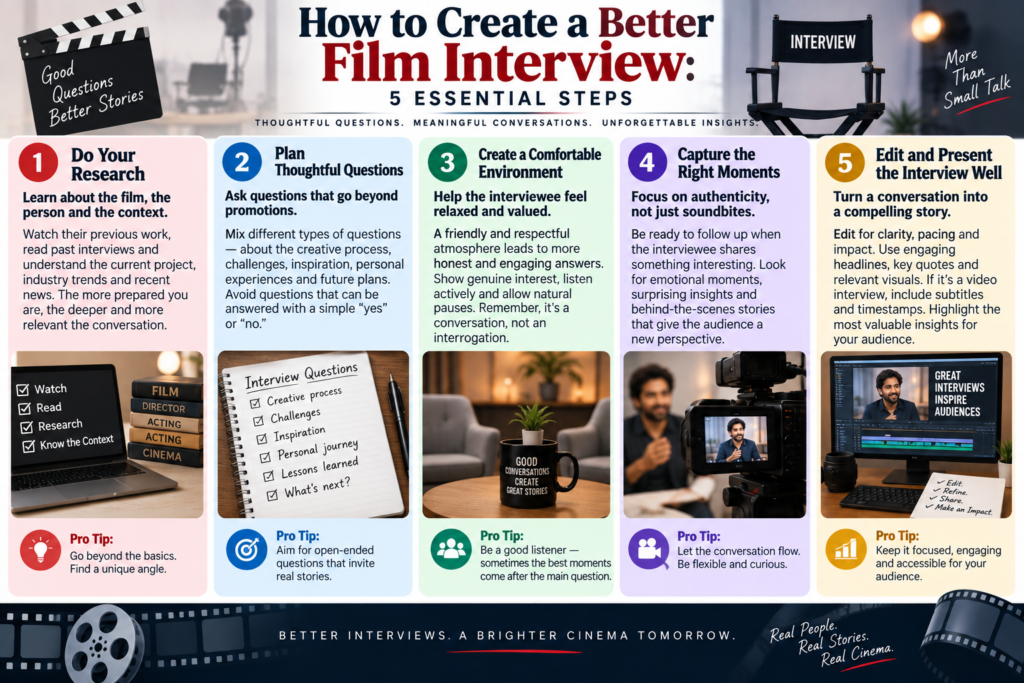
A Practical Framework for Creating a Better Film Interview
A useful interview can follow a simple five-stage process.
| Stage | What to do | Why it matters |
|---|---|---|
| Research | Study the person’s work. | Prevents generic questions |
| Prepare | Create focused questions. | Gives the conversation direction |
| Listen. | Follow unexpected answers. | Produces original material |
| Verify | Check factual claims. | Improves credibility |
| Edit | Remove repetition without changing meaning. | Makes the final interview useful |
This framework works for celebrity interviews, director Q&As, and technical filmmaking conversations.
The goal is not to ask the largest number of questions.
The goal is to discover the most meaningful answers.
What I Look For in Film Industry Celebrity Interviews
When I evaluate a film interview, I look beyond the celebrity’s name.
The first question I ask is
Did I learn something I could not easily have learned from a publicity poster or film trailer?
If the answer is yes, the interview has value.
I also look for specificity.
A useful interview contains details.
- It explains why something happened.
- It provides context.
- It connects an artist’s words to their work.
And most importantly, it respects the difference between a person’s opinion and an independently verifiable fact.
That distinction has become increasingly important as entertainment content moves rapidly between long-form journalism, short videos, and social media.
For readers, the best interviews are therefore not necessarily the loudest ones.
They are the ones that leave you understanding the film or the filmmaker better than you did before.
The Future of Film Celebrity Interviews
The future of celebrity interviews will probably become more fragmented.
Audiences will continue consuming short clips, podcasts, written interviews, festival conversations, and long-form videos.
But fragmentation does not have to mean shallowness.
There is room for both.
- A 30-second clip can introduce someone to a filmmaker.
- A 60-minute conversation can explain the filmmaker’s creative philosophy.
- A written article can connect those ideas with the film itself.
The strongest publishers will understand how these formats complement one another.
There is also a growing opportunity to interview people beyond traditional celebrity culture.
Actors will remain important, but audiences increasingly have reasons to hear from writers, editors, cinematographers, composers, production designers, sound artists, VFX teams, and emerging filmmakers.
That broader approach can make film industry celebrity interviews more useful, more diverse, and more durable.
Frequently Asked Questions
What are film industry celebrity interviews?
Film industry celebrity interviews are conversations with actors, directors, writers, producers, and other film professionals about their careers, projects, creative decisions, and experiences.
Why are celebrity film interviews important?
They can provide first-person insight into filmmaking, acting, career decisions, and creative processes that may not be visible in the finished film.
What questions are asked in actor interviews?
Questions may cover character preparation, rehearsals, collaboration, career choices, difficult scenes, and the actor’s interpretation of a role.
What is the difference between a promotional and an in-depth interview?
A promotional interview usually supports a current release, while an in-depth interview generally explores an artist’s career, creative process, or broader ideas about cinema.
Where can audiences find actor and filmmaker interviews?
Audiences can find them through film festivals, established entertainment publications, broadcasters, podcasts, and specialist film institutions. The BFI and Festival de Cannes both maintain substantial interview and conversation content.
How do film interviews help audiences understand movies?
They can explain decisions involving acting, writing, directing, cinematography, editing, sound, production design, and other areas that may not be obvious from the finished film.
Why are film festival interviews different?
Festival conversations often place filmmakers and performers in a cinema-focused environment where the discussion can extend beyond immediate promotion.
How should audiences evaluate celebrity interview quotes?
Readers should consider the original source, full context, and whether a statement is a personal opinion or a factual claim that can be independently verified.
Conclusion
Film industry celebrity interviews can be much more than publicity.
At their best, they create a bridge between the people who make films and the audiences who experience them.
An actor can explain the emotional work behind a performance.
- A director can reveal the thinking behind a scene.
- A writer can describe how an idea became a screenplay.
- A cinematographer can explain the visual language.
- An editor can reveal how rhythm was created.
- A sound professional can show how the atmosphere was built.
- These conversations help audiences see cinema not simply as a finished product, but as a collaborative creative process.
The strongest interviews also demand responsibility. Good research, precise questions, accurate attribution, contextual editing, and independent verification of factual claims all contribute to trustworthy entertainment journalism.
Ultimately, the most valuable celebrity interview is not necessarily the one that produces the biggest headline.
It is the one that gives the audience a better understanding of the person, the craft and the film.
Sources
- BFI Screen Talks — career discussions with actors and filmmakers
- Festival de Cannes — official interviews archive
- Filmfare — Interviews archive
- BFI London Film Festival — 2026 Screen Talks programme
- BFI — Daniel Day-Lewis LFF Screen Talk
Author’s Note
This article was developed as an editorial and research-based guide to understanding film industry interviews.
The examples and institutional references were selected to demonstrate how professional film organizations and entertainment publications use interviews to discuss acting, filmmaking, careers, and cinema culture.
The article does not claim that every celebrity statement is independently verified fact. Where an interview provides a first-person perspective, that perspective is treated as such. Where factual claims matter, readers should consult the original source or additional authoritative evidence.
The objective is to provide readers with a practical way to understand what makes a film interview informative, credible, and worth reading.
About the author: RVLNSV PRASAD is an independent writer and researcher covering cinema, entertainment, and film-industry topics.
More Stories From This Blog