Author: RVLNSV PRASAD—Independent Writer & Researcher
Published: Feb 9, 2025
Last Updated: September 2026
Reading time: 12–15 minutes
Author Note
Written by RVLNSV PRASAD, Independent Writer & Researcher, for Newstopup. This article examines how actors participate in charitable and advocacy work using publicly documented information from nonprofit organizations, official institutions, academic research, and other reputable sources. The article distinguishes between direct donations, fundraising, advocacy, ambassador roles, and other forms of public involvement rather than treating every celebrity appearance as philanthropy.
For more information about the author, see the Newstopup author profile and author bio.
Introduction
A famous actor can help a charitable cause without writing a cheque.
That distinction is easy to miss because celebrity involvement is often described with broad phrases such as “giving back,” “supporting a cause,” or “doing charity work.” In practice, those expressions can describe very different activities. An actor might donate personal money, appear at a fundraising event, become an ambassador for a nonprofit, visit communities, campaign for children’s rights, or use social media to direct millions of followers toward an established organization.
So how actors support charitable causes is a more complicated question than simply asking which stars are generous.
UNICEF provides a useful example. Its ambassador and celebrity-advocacy system involves public figures helping communicate issues, reach audiences, and support campaigns. UNICEF India’s current program includes film personalities such as Amitabh Bachchan, Kareena Kapoor Khan, Ayushmann Khurrana, and Keerthy Suresh in different ambassador or advocacy roles.
That does not mean every celebrity associated with a nonprofit personally finances its programs. It means celebrity involvement can operate as another part of an organization’s communication, advocacy, and fundraising strategy.
This article looks behind the publicity to explain what actors actually contribute, how different forms of celebrity philanthropy work, what can be verified, and where the limitations lie.
Quick Answer: How Do Actors Support Charitable Causes?
Actors support charitable causes in several ways:
- donating money or other resources;
- establishing or supporting charitable foundations;
- becoming ambassadors or advocates for nonprofit organizations;
- helping fundraising campaigns reach larger audiences;
- visiting communities and meeting people affected by an issue;
- promoting health, education, children’s rights, or environmental campaigns;
- using interviews and social media to increase awareness;
- participating in benefit events and public-service campaigns.
The important distinction is that visibility is not the same as financial contribution. An actor appearing at a charity event may be helping attract attention without personally funding the event. Similarly, becoming an ambassador does not automatically mean the person manages the nonprofit or finances its programs.
UNICEF‘s official ambassador information illustrates this broader model: celebrity representatives can help raise awareness, mobilize support, and advocate for issues affecting children.
Key Takeaways
- Celebrity philanthropy is broader than personal donations.
- Actors can contribute through advocacy, fundraising, foundations, public campaigns, and nonprofit partnerships.
- An ambassador role should not automatically be described as a personal charitable donation.
- Official nonprofit sources are usually the strongest evidence for current celebrity roles.
- Celebrity visibility can help organizations reach audiences, but visibility alone does not prove measurable social impact.
- A responsible article should distinguish what an actor did from what a charity achieved.
- Readers should check the organization behind a campaign rather than relying solely on celebrity publicity.
What Counts as an Actor’s Charitable Work?
The word “philanthropy” is often used loosely.
A personal donation is clearly different from appearing in a campaign video. A foundation is different from a one-day fundraising event. An ambassador role can involve advocacy without requiring the celebrity to provide the organization’s main financial resources.
A useful way to understand the landscape is to divide actor involvement into several categories.
Direct giving
The actor personally provides money, goods, services, or other resources to a charitable organization or cause.
Fundraising
The actor encourages other people to donate, hosts or participates in an event, or uses their public reach to help a campaign attract resources.
Advocacy
The actor speaks publicly about an issue and attempts to increase awareness or encourage action.
Ambassador or representative role
The actor formally works with an organization under a defined role.
Foundation or institutional involvement
The actor establishes, funds, or supports a structured organization or long-term charitable initiative.
Public-service communication
The actor participates in campaigns designed to communicate information about health, education, children’s rights, humanitarian issues, or other public concerns.
These categories can overlap.
Kareena Kapoor Khan’s relationship with UNICEF India is a good illustration. UNICEF says she has supported its work on education and, following her appointment as National Ambassador in 2024, has a role connected with children’s early development, health, education, and gender equality.
The lesson is important: charitable involvement should be described according to the documented activity, not according to the celebrity’s level of fame.
The 6 Ways Actors Support Charitable Causes
1. Direct Donations and Financial Support
The most straightforward form of philanthropy is financial giving.
An actor may donate personally to an organization, contribute to an emergency response, support a community project, or provide resources to a charitable initiative.
But financial claims require particular care.
Entertainment websites sometimes report that a celebrity “gave millions” without clearly identifying the recipient, date, source, or conditions attached to the contribution. A more trustworthy approach is to ask four basic questions:
- Who gave the money?
- Who received it?
- When was the contribution made?
- What reliable source documents it?
If an official nonprofit announcement confirms a donation, that is considerably stronger evidence than an unsourced celebrity article.
There is also an important difference between a celebrity’s personal donation and money raised through a campaign involving that celebrity.
Suppose an actor posts a fundraising link and followers collectively donate ₹1 crore. It would be inaccurate to describe that entire amount as the actor’s donation unless the actor personally contributed that sum.
The actor may have played an important fundraising role, but the financial contribution came from multiple donors.
That distinction protects both the celebrity and the charitable organization from misleading reporting.
2. Foundations and Long-Term Partnerships
Some actors move beyond individual campaigns and become involved in longer-term charitable organizations.
A foundation can provide a structure for continuing work in areas such as
- education;
- healthcare;
- children’s welfare;
- poverty reduction;
- environmental protection;
- disaster response;
- community development.
Long-term involvement can also make it easier to evaluate what an organization actually does.
Instead of asking only:
“Is this actor charitable?”
A better question is
“What does the organization associated with the actor actually do?”
That shift moves the discussion from celebrity image to measurable activity.
It is also why readers should distinguish between a foundation that runs ongoing programs and a celebrity who simply appears at an annual fundraising event.
The two can both be valuable, but they represent different forms of participation.
3. Public Advocacy and Awareness
An actor’s greatest contribution may sometimes be attention rather than money.
A recognizable film personality can introduce an issue to audiences who may never have encountered it through a conventional nonprofit communication campaign.
UNICEF explicitly uses celebrity ambassadors and advocates as part of its public-facing work. Its global Goodwill Ambassador program includes well-known public figures whose roles can involve communicating children’s issues and supporting advocacy.
UNICEF India similarly says its ambassadors and celebrity advocates have strong reach across India, the Indian diaspora, and global audiences, and can participate in campaigns alongside government and other partners.
This provides an important distinction:
Advocacy is a contribution even when it is not a donation.
An actor who explains a children’s rights issue in an interview may help the public understand the issue. An actor who encourages followers to support a vaccination campaign may help extend the campaign’s reach.
But neither action should automatically be described as proof that the underlying program succeeded.
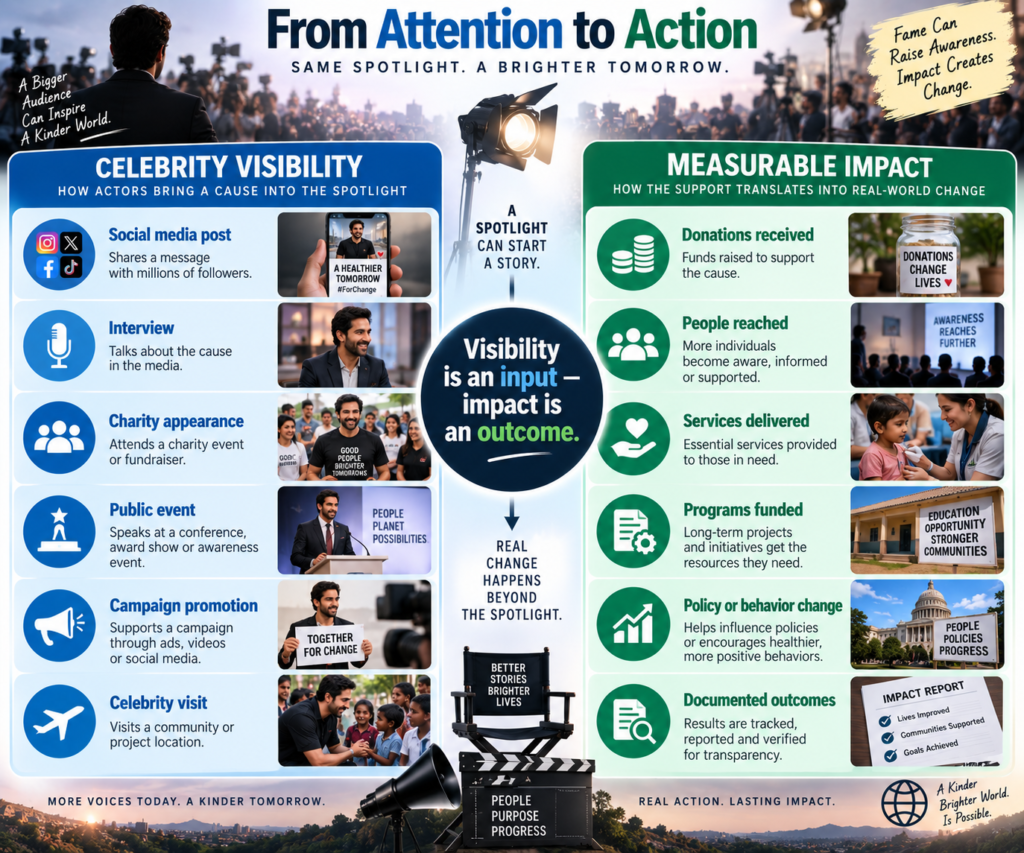
Awareness is an input.
Impact is an outcome.
They should not be treated as interchangeable.
4. Fundraising Campaigns and Charity Events
Actors can also act as fundraising multipliers.
They may:
- host a benefit event;
- appear at a fundraising dinner;
- encourage followers to donate;
- promote an official fundraising page;
- participate in a charity performance;
- recruit other celebrities;
- help attract corporate sponsors.
The value of celebrity involvement here comes partly from audience access.
A nonprofit may have strong expertise but limited public visibility. An actor can potentially open a communication channel to a much larger audience.
However, a good article should never assume that attention automatically becomes donations.
A campaign should be evaluated by what happened after the celebrity became involved.
For example:
| What the audience sees | What should be checked? |
|---|---|
| The actor promotes a fundraiser. | Is there an official fundraising page? |
| The actor attends a charity event | Was money actually raised? |
| The actor asks followers to donate. | Which organization receives the money? |
| A celebrity announces a campaign. | What is the campaign’s objective? |
| The actor shares a donation appeal. | Can the donation be independently verified? |
This is a more useful way to evaluate celebrity charity work than simply counting social media posts.
5. Field Visits and Direct Engagement
Some actors participate in visits to communities, schools, hospitals, or humanitarian programs.
These appearances can have a communication value that is difficult to reproduce through advertising alone.
A celebrity standing alongside local workers or meeting affected families can bring an issue into mainstream media coverage.
But the celebrity is rarely the entire operation.
A humanitarian or development program normally depends on local staff, technical specialists, administrators, healthcare professionals, teachers, community organizations, and government systems.
That is why coverage should avoid presenting the actor as the person who “solved” the underlying problem.
A more accurate description might be
The actor used their public platform to draw attention to an existing program.
That wording gives credit to both sides.
It recognizes the actor’s contribution without erasing the people who do the day-to-day work.
6. Social Media and Digital Mobilization
Social media has changed the scale and speed of celebrity advocacy.
An actor no longer needs a television interview or newspaper article to reach an audience.
A campaign can move through:
Actor → Social post → Followers → Nonprofit campaign → Donations / awareness / participation
That pathway can be useful, particularly when the celebrity provides a direct link to an official organization.
But it also creates risks.
A social media post can be:
- incomplete;
- outdated;
- taken out of context;
- linked to an unofficial fundraising page;
- exaggerated by reposts;
- confused with a personal donation.
For that reason, readers should look for the nonprofit’s official website before contributing money.
A celebrity post is often the beginning of verification, not the end.
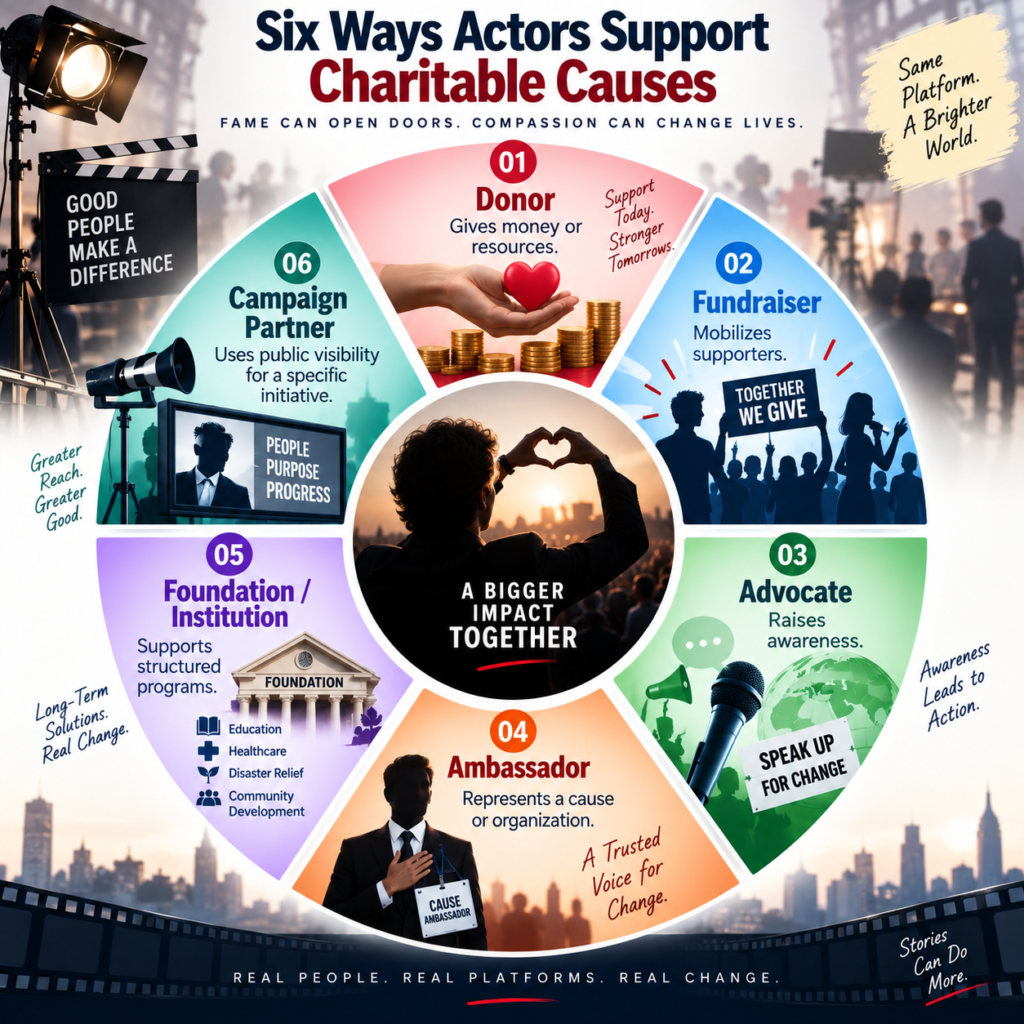
A Practical Comparison: Six Forms of Actor Involvement
| Model | Main contribution | What it can accomplish | What readers should verify |
|---|---|---|---|
| Donor | Money or resources | Provides direct financial support | Recipient and amount |
| Advocate | Public voice | Raises awareness | Organization and issue |
| Fundraiser | Audience mobilization | Encourages contributions | Amount actually raised |
| Ambassador | Formal representation | Extends organizational outreach | Official role and responsibilities |
| Foundation supporter | Long-term resources | Supports structured programs | Activities and governance |
| Campaign partner | Public participation | Gives visibility to an initiative | Campaign purpose and official sponsor |
This framework is more useful than simply ranking actors by how charitable they appear.
Documented Examples: What Actor Philanthropy Looks Like in Practice
Kareena Kapoor Khan: Advocacy as an Ongoing Role
Kareena Kapoor Khan provides a useful Indian example because her involvement with UNICEF is documented by the organization itself.
UNICEF says she was appointed a celebrity advocate in 2014 and supported work related to quality education. In May 2024, UNICEF India announced her appointment as National Ambassador, with responsibilities connected to children’s early childhood development, health, education, and gender equality.
Her example demonstrates why the phrase “charity work” can be too broad.
Her documented role is not simply a matter of writing a check. It includes public advocacy and representation of children’s issues.
UNICEF India has also documented her participation in public initiatives, including a 2025 event connected to the ICC Women’s Cricket World Cup.
The broader lesson is that a celebrity relationship with a nonprofit can develop over years rather than being limited to one campaign.
Ayushmann Khurrana: Using a Film Career to Support Advocacy
Ayushmann Khurrana is another example of the ambassador model in Indian cinema.
UNICEF India identifies him among its National Ambassadors. Its current ambassador information places him within a wider group of public figures whose reach can support children’s rights and advocacy work.
This is a useful example because it shows how an actor’s professional visibility can become an advocacy asset.
The value is not necessarily that the actor personally funds every program.
Instead, the actor can help make a public issue more visible.
That distinction is essential when reporting celebrity philanthropy.
Amitabh Bachchan: Public Health Advocacy
Amitabh Bachchan demonstrates another form of celebrity engagement.
UNICEF India identifies Bachchan as a Goodwill Ambassador and documents his involvement in public-health advocacy.
His example illustrates the potential longevity of celebrity advocacy.
A recognizable public figure can become associated with a public issue for years, giving the campaign continuity and repeated access to audiences.
This is different from a celebrity making a single social media post during a crisis.
The value lies partly in sustained public communication.
Keerthy Suresh: A Newer Generation of Celebrity Advocacy
In November 2025, UNICEF India announced that actor Keerthy Suresh had been appointed a Celebrity Advocate. The organization said she would champion children’s rights and highlighted children’s and adolescents’ mental health and well-being among the areas connected with her advocacy.
This example is particularly useful for understanding how the model is evolving.
Celebrity advocacy is not restricted to one language industry or one generation of performers. UNICEF India describes Keerthy’s reach across Tamil, Telugu, and Malayalam cinema, illustrating how regional film visibility can contribute to wider public campaigns.
In November 2025, UNICEF India also included her alongside Kareena Kapoor Khan and Ayushmann Khurrana in its “Child in Me” digital campaign around children’s rights.
That is a different model from direct charity: multiple public figures can collectively amplify one organizational campaign.
Why Celebrity Visibility Can Matter to a Charity
A celebrity’s contribution is often described as “influence,” but influence becomes more useful when we break it into specific mechanisms.
Reach
An actor can expose an issue to people who do not regularly follow nonprofit organizations.
Attention
A celebrity can make journalists and entertainment media more likely to cover a campaign.
Recognition
People may remember an issue more easily when it is connected to a familiar public figure.
Mobilization
An actor can give audiences a specific action, such as visiting an official website, donating, or sharing information.
Access
Celebrity involvement can sometimes help an organization enter conversations with businesses, media organizations, or policymakers.
UNICEF India explicitly describes its celebrity ambassadors and advocates as having substantial reach and notes their participation in national and international campaigns.
That provides a concrete institutional example of why nonprofits may choose to work with public figures.
But Celebrity Attention Is Not the Same as Social Impact
This is where celebrity philanthropy becomes more complicated.
An actor can attract millions of views without changing the outcome of a program.
A campaign can trend for one day and disappear the next.
A celebrity may also become the most recognizable part of a campaign even though the nonprofit’s local staff are responsible for delivering the actual service.
Academic research has examined this tension.
Oxford Academic’s research on media and celebrity engagement describes figures such as George Clooney and Ben Affleck as operating in forms of celebrity engagement that can involve mobilizing compassion, donations, and policy advocacy.
Other academic work has examined celebrity diplomacy and the complicated relationship between celebrity visibility, political communication, and advocacy.
This matters because a responsible article should avoid two extremes:
Extreme 1: “Celebrity philanthropy solves social problems.”
Extreme 2: “Celebrity philanthropy is just publicity.”
Neither statement is sufficiently precise.
The better question is
What did the celebrity contribute, and what evidence exists about the resulting activity?
Celebrity Visibility vs. Actual Impact
Celebrity activity What it may provide What it does not automatically prove Social-media post Audience reach Donations or policy change Charity appearance Public attention Personal financial contribution Ambassador appointment Formal advocacy Management of the organization Community visit Media visibility and engagement Successful program outcomes Fundraising appeal Potential donor mobilization Amount ultimately raised Foundation launch Institutional structure Long-term effectiveness This distinction is one of the most important ideas in understanding celebrity charity work.
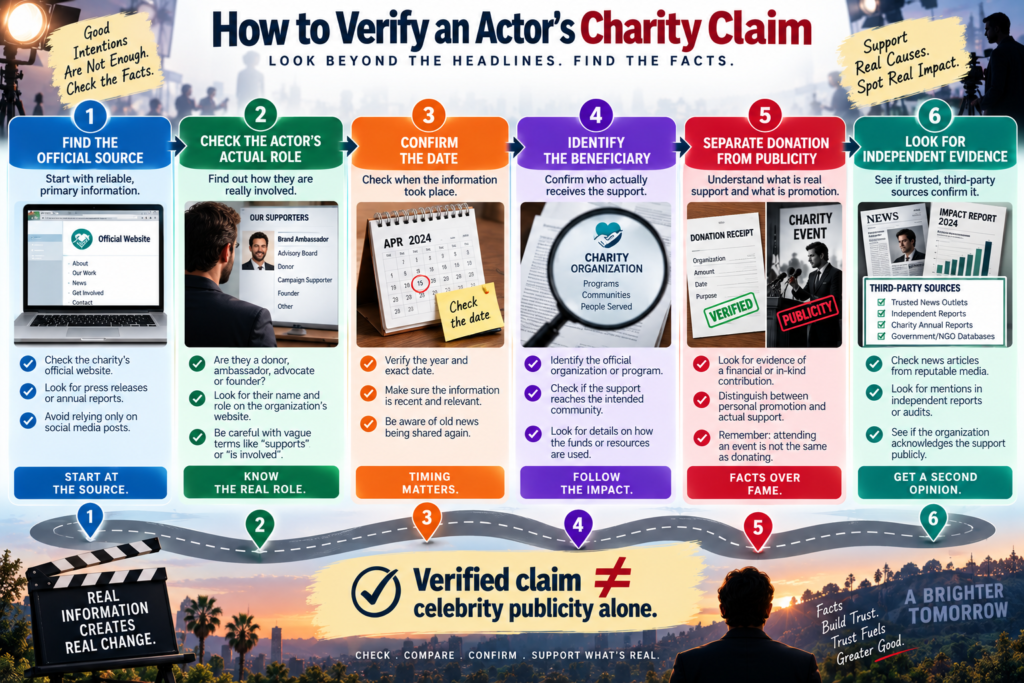
How to Verify an Actor’s Charitable Work
Readers do not need to be investigative journalists to check whether a celebrity charity claim is credible.
They can follow a simple process.
1. Start with the organization’s official website.
If an actor claims to support a nonprofit, look for the organization itself.
For example, UNICEF maintains dedicated pages documenting its celebrity ambassadors and advocates.
2. Find the actor’s actual role.
Is the person:
- an ambassador?
- a campaign supporter?
- a donor?
- a fundraiser?
- a spokesperson?
- a foundation founder?
Those terms describe different responsibilities.
3. Look for a date.
A celebrity may have supported an organization ten years ago but no longer have an active role.
Current claims should therefore be supported by current sources.
4. Identify the beneficiary
Ask which organization, community, or program received the support.
5. Separate money from publicity
An actor attending a charity dinner does not prove that the actor donated money.
6. Look for evidence beyond the celebrity’s own post.
The strongest confirmation may come from the nonprofit, a government agency, an academic institution, or reputable reporting.
Why Official Sources Are Particularly Valuable
Celebrity philanthropy is unusually vulnerable to repetition.
One entertainment website publishes a claim.
Another website copies it.
A third site repeats the second article.
Eventually, dozens of pages can appear to confirm the same information even though they all trace back to the same original claim.
That is why primary sources matter.
For example, UNICEF‘s page for Kareena Kapoor Khan directly documents her relationship with the organization rather than relying on a celebrity-news article.
Similarly, UNICEF India’s announcement regarding Keerthy Suresh provides a dated, official record of her appointment as Celebrity Advocate.
This is a stronger research method than collecting claims from “top 10 charitable celebrities” pages.
Indian Cinema and the Changing Shape of Celebrity Advocacy
India provides a particularly interesting environment for celebrity philanthropy because its film industries reach audiences across multiple languages and regions.
A single actor may have influence across:
- Hindi cinema;
- Telugu cinema;
- Tamil cinema;
- Malayalam cinema;
- Kannada cinema;
- streaming platforms;
- television;
- social media.
UNICEF India’s current celebrity-advocacy program reflects this breadth. Its official page identifies ambassadors and advocates with reach across India, the diaspora, and international audiences.
Keerthy Suresh’s appointment provides a contemporary example. UNICEF specifically describes her as an influential actor across Tamil, Telugu, and Malayalam cinema.
This creates an interesting advantage for nonprofit communication.
A cause does not necessarily have to rely on one nationally dominant celebrity.
It can work with different personalities whose audiences overlap in different ways.
That approach can potentially make a campaign more culturally and linguistically relevant.
Global Actors: From Film Fame to Public Advocacy
The model also exists internationally.
UNICEF‘s global Goodwill Ambassador program has included entertainers for decades. The organization’s current roster includes public figures such as Millie Bobby Brown and Lilly Singh, demonstrating that celebrity advocacy continues to evolve with newer generations of audiences.
The historical connection is even older.
UNICEF describes actor and entertainer Danny Kaye as its first Goodwill Ambassador, serving from 1954 until his death in 1987.
This history matters because celebrity advocacy is not simply a social-media-era phenomenon.
What has changed is the communication environment.
Earlier ambassadors depended heavily on television, newspapers, public appearances, and institutional campaigns.
Today’s celebrities can communicate directly with followers within seconds.
The underlying model—using public recognition to increase attention to a social issue—has been around much longer.
When Celebrity Philanthropy Works Best
Celebrity involvement is most useful when the celebrity role complements the nonprofit’s actual expertise.
A strong partnership may have several characteristics.
The cause is clearly defined.
Audiences understand what problem the campaign is addressing.
The organization is identifiable.
People know where their money, time, or attention should go.
The celebrity communicates accurately.
The actor does not exaggerate the problem or promise outcomes that the organization cannot guarantee.
The audience receives a clear action.
For example:
- learn more;
- donate through the official organization;
- attend an event;
- share verified information;
- Support a campaign.
The relationship is credible.
The celebrity’s public role should make sense for the cause.
The nonprofit remains visible.
The organization and its experts should not disappear behind the celebrity.
This final point is particularly important.
A successful campaign should increase awareness of the cause and the organization, not merely increase the celebrity’s visibility.
When Celebrity Philanthropy Can Fall Short
Celebrity involvement has limitations.
Short attention cycles
An issue may receive intense attention during a campaign and then disappear from public conversation.
Oversimplification
Complex humanitarian or social problems may be reduced to an emotionally powerful but incomplete message.
Celebrity-centered storytelling
The actor can become more visible than the people or communities the campaign is intended to support.
Unclear accountability
A social media post can make a claim without explaining who manages the money or program.
Confusion between publicity and outcomes
A successful campaign can generate millions of views without demonstrating a corresponding social result.
Academic research on celebrity philanthropy and humanitarian advocacy has examined precisely these tensions, including questions around representation, political influence, and the way celebrities become intermediaries between audiences and complex global issues.
The solution is not to dismiss celebrity philanthropy.
It is to evaluate it more carefully.
Celebrity Advocacy, Philanthropy, and Publicity Are Not the Same Thing
These terms are often mixed together.
| Term | Basic meaning | Example |
|---|---|---|
| Philanthropy | Giving resources for a charitable purpose | Personal donation |
| Advocacy | Publicly supporting an issue or policy goal | Speaking about children’s rights |
| Fundraising | Helping attract financial contributions | Promoting an official campaign |
| Ambassadorship | Formal public role with an organization | UNICEF ambassador |
| Publicity | Generating attention | Appearing at a charity event |
| Partnership | Working with an organization on a defined initiative | Campaign collaboration |
One actor can occupy several of these roles at the same time.
The mistake is assuming they are identical.
What Makes a Celebrity Charity Story Trustworthy?
For entertainment publishers, this question is particularly important.
A strong article should be able to answer:
Who?
Which actor is involved?
What?
What exactly did they do?
For whom?
Which organization or community was involved?
When?
When did the activity take place?
Evidence?
Which reliable source confirms it?
Impact?
Is there evidence of what changed?
This five-question framework can prevent many common errors in celebrity philanthropy reporting.
A Better Way to Read Celebrity Charity News
The next time you see a headline saying:
“Actor X is helping thousands of people.”
Don’t immediately accept or reject it.
Instead, ask:
What does “helping” mean here?
- Maybe the actor donated money.
- Maybe they appeared in a campaign.
- Maybe they are an ambassador.
- Maybe their foundation funded a program.
- Maybe they simply shared a nonprofit’s message.
Those actions can all have value, but they should not be reported as though they are identical.
That is especially important for readers deciding whether to donate.
If money is involved, follow the campaign to the official organization rather than relying solely on a celebrity’s social media post.
Frequently Asked Questions
How do actors support charitable causes?
Actors support charitable causes through direct donations, fundraising, public advocacy, ambassador roles, foundations, community engagement, public-service campaigns, and social media outreach. The exact role varies by actor and organization. UNICEF’s ambassador programs provide documented examples of celebrities supporting children’s rights awareness and advocacy.
What kinds of charities do actors commonly support?
Actors may become involved with organizations working in children’s rights, education, healthcare, humanitarian relief, environmental protection, poverty reduction, and disaster response. The causes vary considerably between individuals.
Do actors donate their money to charities?
Some do, but an actor’s participation in a charitable campaign does not by itself prove a personal financial donation. A reliable source should be used when reporting a specific contribution.
What is the difference between celebrity advocacy and philanthropy?
Philanthropy generally involves providing resources for a charitable purpose, while advocacy involves publicly supporting an issue or encouraging action. An actor can participate in both, but the terms should not be treated as interchangeable.
How do actors help charities raise awareness?
They can use interviews, public appearances, social media, campaigns, and formal ambassador roles to introduce causes to larger audiences. UNICEF explicitly describes its celebrity ambassadors and advocates as helping strengthen outreach and impact.
Do celebrity ambassadors actually work for charities?
An ambassador normally has a defined public or advocacy role rather than functioning as the organization’s entire workforce. Responsibilities differ between organizations. UNICEF’s official ambassador pages describe the roles of its current representatives and advocates.
How can readers verify an actor’s charitable work?
Start with the nonprofit’s official website, then check the actor’s documented role, the date of the activity, and any available evidence of donations, fundraising, or program participation. Primary sources are generally preferable to copied celebrity-list articles.
Can celebrity philanthropy have drawbacks?
Yes. Celebrity involvement can sometimes simplify complex issues, shift attention toward the celebrity, or create confusion between visibility and measurable impact. Academic research has examined these limitations alongside the potential benefits of celebrity advocacy.
Recommended Research and E-E-A-T Sources
- UNICEF — Goodwill Ambassadors — Official information on UNICEF’s global celebrity ambassador program and current representatives.
- UNICEF India—Ambassadors & Celebrity Advocates—Useful primary source for current Indian celebrity advocacy roles and their stated purpose.
- UNICEF India — Kareena Kapoor Khan — Documents Kareena Kapoor Khan’s UNICEF involvement and advocacy work.
- UNICEF India—Kareena Kapoor Khan appointed National Ambassador—Official 2024 appointment announcement.
- UNICEF India—Keerthy Suresh—Official documentation of her 2025 Celebrity Advocate appointment.
- Oxford Academic—Media and Celebrities—Academic perspective on celebrity engagement, advocacy, and humanitarian activity.
- Oxford Academic—Celebrity Diplomacy—Research examining celebrity activism, public communication, and diplomacy.
- University of Manchester—George Clooney research—Academic research examining the relationship between celebrity status, philanthropy, and advocacy
Disclaimer
This article is intended for general informational and educational purposes. An actor’s association with a charity, nonprofit, or campaign does not by itself establish the effectiveness of that organization or program. Celebrity roles, nonprofit partnerships, campaigns, and donations can change over time. Readers should consult the relevant organization’s official information for current details before donating or relying on a specific claim. This article does not provide financial, legal, or charitable-giving advice.
Conclusion
How actors support charitable causes cannot be reduced to a list of celebrities who have donated money.
Some actors provide direct financial support. Others raise funds, advocate for children’s rights, represent nonprofit organizations, establish foundations, or use their public reach to bring attention to issues that might otherwise receive less coverage.
The most useful distinction is between visibility and verified action.
An actor’s social media post may create awareness. An ambassador appointment may give an organization access to a wider audience. A fundraiser may encourage thousands of people to contribute. A personal donation may provide direct financial support. These are different contributions, and each should be reported accurately.
Official sources make that distinction easier to see. UNICEF‘s documentation of Indian and international celebrity advocates demonstrates that public figures can have defined advocacy roles within larger institutional programs.
For readers, the best approach is simple: look past the celebrity headline and ask what was actually done, which organization was involved, when it happened, and what evidence exists.
That approach produces a more honest picture of celebrity philanthropy—and gives charitable causes the attention they deserve without confusing publicity with impact.
More Stories From This Blog