


Introduction to Celebrity Collaborations Across Film Industries
Written by RVLNSV PRASAD
Independent Writer & Researcher
Published:
Last Updated: September 2026
Reading time: 12–15 minutes

Introduction
A movie may have a familiar language, a local cast, or a story rooted in one country, yet the work behind it can involve producers, financiers, actors, technicians, post-production companies, and distributors from several parts of the world.
That is where the international film collaboration process becomes important.
International filmmaking is not simply a matter of bringing a foreign actor into a movie or shooting a few scenes overseas. A genuine cross-border production can involve financing arrangements, formal co-production agreements, creative partnerships, location services, international crews, post-production specialists, and distribution plans.
Government and industry institutions demonstrate how structured these relationships can be. For example, the Government of Canada describes audiovisual treaty co-productions as productions that pool creative, technical and financial resources between Canadian and foreign producers. Government of Canada: Audiovisual treaty coproduction
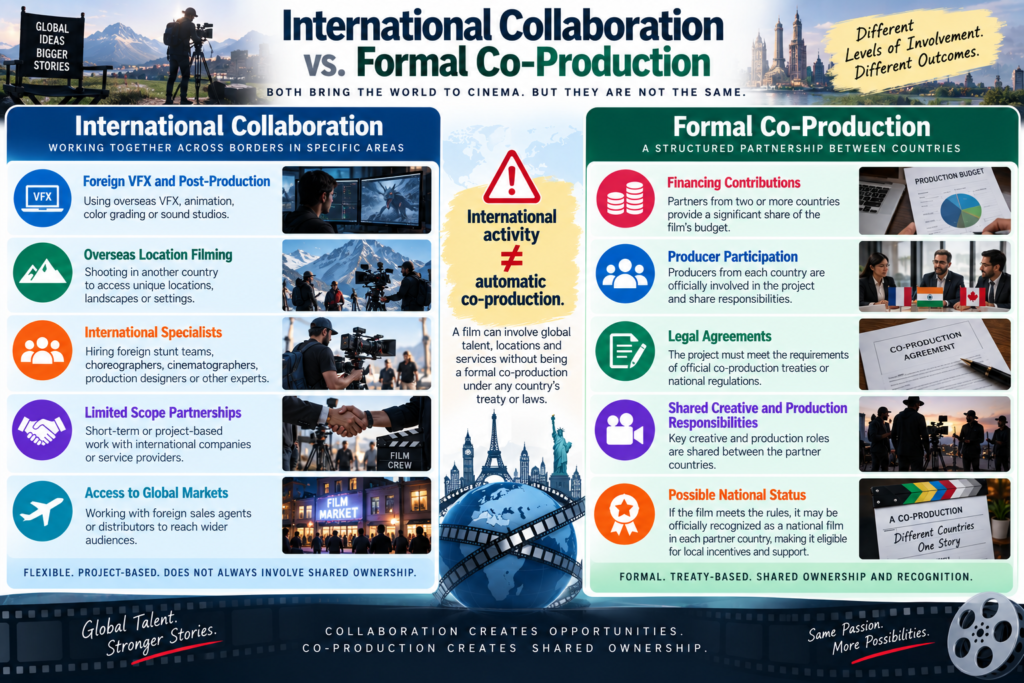
At the same time, not every film made in another country is a co-production. A production might simply hire an overseas crew, use a foreign location, or sell distribution rights abroad.
This distinction matters to audiences because the words “international film,” “international collaboration,” and “co-production” are often used interchangeably even though they can describe very different arrangements.
This guide breaks down what actually happens when film projects cross national borders, why producers pursue these partnerships, where the difficulties arise, and how the finished movie reaches audiences.
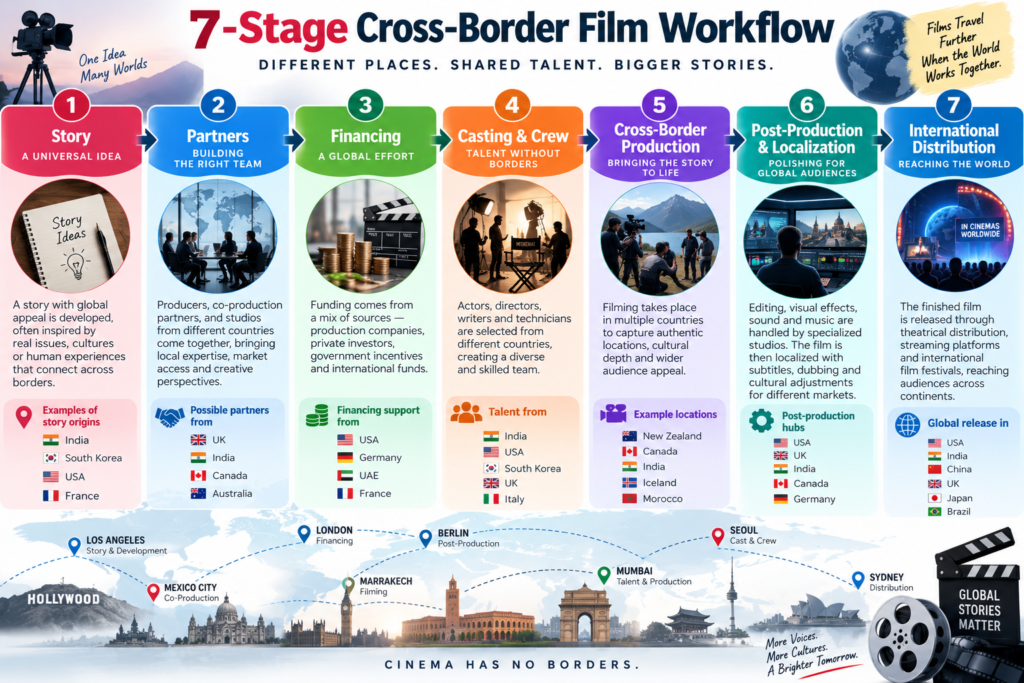
Quick Answer: What Is the International Film Collaboration Process?
The international film collaboration process is the series of creative, financial, legal, production, and distribution steps through which filmmakers or companies from different countries work together on a screen project.
A typical project can move through seven broad stages:
- Developing the story and deciding whether international partners are useful.
- Finding producers, financiers, and other partners.
- Structuring financing and, where applicable, a formal co-production.
- Building an international creative and production team.
- Managing filming across countries or with international crews.
- Completing editing, sound, visual effects, subtitles, and dubbing.
- Distributing and marketing the finished film to audiences in different territories.
The exact route varies considerably. A small independent movie may have only two production partners, while a larger project can involve several countries and multiple financing and distribution arrangements.
What Is an International Film Collaboration?
An international film collaboration occurs when important parts of a film project involve people, companies, institutions, or resources from more than one country.
That definition is intentionally broad.
Consider three different situations:
- An Indian production hires a British visual effects company.
- An American movie films several sequences in Italy using local production services.
- Producers from Canada and another country formally combine creative, technical, and financial resources under a co-production agreement.
All three involve international activity, but they are not necessarily the same type of production.
A formal treaty co-production can carry specific legal and financial consequences. Canada’s official guidance explains that productions made under qualifying co-production treaties can receive national status in each participating country, subject to applicable requirements.
The British Film Institute similarly explains that UK international co-productions can qualify through cultural tests or official co-production agreements.
That distinction gives readers a useful rule:
International production activity does not automatically mean international co-production.
The legal definition depends on the countries involved, the agreement being used, and the requirements of the relevant authorities.
Why Are Film Industries Collaborating Across Borders?
International partnerships are usually created because a production needs something that another market can provide.
The motivation may be financial, creative, technical, or commercial.
| Reason | What the partnership can provide | Potential benefit |
|---|---|---|
| Financing | Additional investors or public support | Makes projects possible at a larger scale |
| Talent | Actors, directors, and specialists | Adds creative expertise |
| Locations | Access to distinctive settings | Supports story and visual design |
| Production services | Local crews and facilities | Makes overseas filming practical |
| Technology | VFX, animation, or post-production expertise | Expands technical capabilities |
| Distribution | Access to foreign markets | Gives the film a wider release opportunity |
| Cultural knowledge | Local creative input | Helps represent settings and communities more accurately |
Formal funding programs show that international collaboration is not merely a marketing idea.
In May 2026, the British Film Institute announced almost £1 million in new support for six international co-productions involving partners across 13 territories. The projects included partnerships involving countries such as Thailand, Canada, France, Germany, Ireland, Italy, Mexico, the Netherlands, Poland, Switzerland, and the United States.
That example illustrates an important point: international collaboration can be built into the financial and production structure of a project from the beginning.
UNESCO’s latest Global Report on Cultural Policies also emphasizes the importance of cooperation, investment, and digital transformation across cultural and creative industries.
The International Film Collaboration Process: 7 Stages
The easiest way to understand cross-border filmmaking is to follow the project from the initial idea to the audience.
1. Creative Idea and Story Development
The first question is not “Which foreign actor should we hire?”
It is:
Does this story actually benefit from international collaboration?
Some stories are naturally suited to multiple locations, languages, or cultures. A historical drama might require several countries. A story about migration might have characters connected to different societies. A science-fiction project might require international visual-effects expertise.
Other stories may gain little from crossing borders.
At the development stage, producers may therefore consider:
- the story’s geographical setting
- language requirements
- target audiences
- intellectual property rights
- potential financing
- cultural representation
- production locations
- distribution opportunities
This is also when writers and producers can determine whether the story should remain culturally specific or be adapted for audiences in multiple territories.
An international partnership should serve the film rather than exist simply to make the project appear more global.
2. Finding International Partners
Once the creative concept is developed, producers can look for partners capable of filling specific needs.
Potential partners include:
- production companies
- independent producers
- studios
- broadcasters
- streaming companies
- distributors
- film funds
- government-supported programs
- location-production companies
- post-production specialists
The partner does not necessarily need to contribute the same thing as everyone else.
One company may provide financing. Another may contribute production experience. A third may handle distribution in its territory.
The British Film Institute’s international co-production program provides a current example. Its UK Global Screen Fund supports UK producers working with international partners and requires projects to meet specific financial and eligibility conditions.
This shows why international film partnerships are better understood as structured business relationships rather than informal celebrity connections.
3. Financing and Co-Production Structure
Money is often where an international project becomes complicated.
A production may combine:
- private investment
- studio financing
- government support
- tax incentives
- film funds
- broadcaster contributions
- distributor commitments
- production-company investment
Formal co-productions can provide a framework for sharing these responsibilities.
The Government of Canada describes audiovisual treaty co-productions as projects that pool creative, technical, and financial resources.
However, financial arrangements differ from project to project.
A useful way to think about the financing stage is
- Who contributes money?
- What does each partner contribute?
- How are rights divided?
- How is revenue shared?
- Which laws govern the agreement?
Those questions can influence everything from casting to distribution.
The current BFI Global Screen Fund provides another practical example. Its international co-production strand supports qualifying feature projects and can provide grants of up to £300,000 for eligible UK independent producers acting as minority co-producers.
This does not mean every international film receives public funding. It demonstrates instead that some countries actively build funding mechanisms to encourage cross-border screen partnerships.
4. Casting and Building the Creative Team
Casting is one of the most visible aspects of international filmmaking, but it is only one component.
A production might bring together:
- actors from different countries
- an international director
- writers working across languages
- cinematographers
- production designers
- composers
- editors
- stunt specialists
- visual-effects teams
- sound professionals
The choice should ideally be connected to the story.
A foreign performer can bring language ability, cultural knowledge, audience recognition, or a specific performance style. But adding a recognizable name does not automatically make a production genuinely international.
The same applies behind the camera.
A specialist visual-effects company may contribute more to an international project than a famous actor because its technical expertise directly affects the finished movie.
This broader view also makes international collaboration easier to understand: talent moves across borders because productions need particular skills, perspectives, or market connections.
5. Managing Cross-Border Production
Once filming begins, the theoretical partnership becomes a practical challenge.
A production working across countries may have to coordinate:
- locations
- permits
- transportation
- visas
- accommodation
- local crews
- equipment
- insurance
- schedules
- language
- local regulations
- weather
- safety requirements
A foreign production company can therefore become extremely important.
Local crews understand locations, regulations, suppliers, and working practices. International producers can bring their own creative and technical requirements.
The result is a production environment in which communication becomes as important as filmmaking skill.
| Production challenge | Why it matters |
|---|---|
| Language | Miscommunication can affect creative and technical decisions. |
| Time zones | Remote production teams may work different hours. |
| Local regulations | Filming permissions and employment rules vary |
| Scheduling | International travel can complicate production days. |
| Cultural expectations | Creative assumptions may differ. |
| Equipment | Importing and hiring requirements can vary. |
| Weather | Overseas locations can introduce unfamiliar risks. |
The practical lesson is simple: international production requires more coordination than simply booking a flight and taking a camera abroad.

6. Post-Production and Localization
The collaboration does not end when filming finishes.
Editors, sound designers, composers, VFX artists and other specialists may continue working from different countries.
A film intended for multiple markets may also require:
- subtitles
- dubbing
- localized marketing
- translated promotional material
- adapted titles
- regional artwork
- different release strategies
Localization is particularly important because translation does not always preserve cultural meaning.
A joke, idiom, or social reference may work perfectly in one language and make little sense in another.
That means localization can influence how audiences experience the finished movie.
A production might therefore complete one creative version while distributors and localization teams prepare different audience-facing versions for specific markets.
7. International Distribution and Audience Strategy
The final stage is getting the film to viewers.
Possible routes include:
- theatrical distribution
- film festivals
- streaming platforms
- television
- digital rental
- regional distributors
- international sales agents
Distribution decisions may begin much earlier than audiences realize.
A producer who knows that a film will target several territories may consider language, subtitles, festival strategy, and sales requirements during development.
Recent European market data illustrates why international circulation matters. The European Audiovisual Observatory reported that European films accounted for an estimated 32.8% of cinema admissions in Europe in 2024, while several of the most successful films were UK productions or co-productions involving international partners.
That does not mean co-production guarantees commercial success.
It does show that films can operate within a network of national and international markets rather than a single domestic system.
International Film Collaboration vs. International Co-Production
These terms are related, but they should not be treated as synonyms.
| Feature | International collaboration | Formal international co-production |
|---|---|---|
| Meaning | Broad term covering cross-border creative or production activity | Structured production relationship between producers from different territories |
| Financing | May remain mostly domestic | Often involves defined contributions |
| Legal framework | Can vary widely | May operate under treaties or official agreements |
| Creative participation | Can involve selected specialists | Usually involves agreed producer/creative participation |
| National status | Not necessarily affected | May provide qualifying national status under applicable rules |
| Requirements | Project-specific | Can involve formal eligibility requirements |
Canada’s official co-production guidance is a good example of why the distinction matters: treaty co-productions can receive national status when they satisfy the applicable rules.
The exact requirements should always be checked with the relevant national authority because international production law is not identical everywhere.
What Makes International Film Collaborations Difficult?
International projects offer opportunities, but they also introduce additional points of failure.
Language barriers
A production may have several working languages. Translation can solve some problems, but creative discussions still require precise communication.
Cultural differences
A gesture, joke, costume, storyline, or character may be interpreted differently by audiences and collaborators from different cultures.
Financing complexity
Multiple investors can mean more complicated agreements around budgets, rights, revenue, and responsibilities.
Scheduling
Actors and technical teams may be working across different countries, making dates harder to coordinate.
Legal requirements
Film permits, employment rules, tax arrangements, intellectual property rights, and co-production eligibility vary between jurisdictions.
Distribution disagreements
Partners may have different ideas about where and when the film should be released.
Creative disagreements
An international partnership does not remove artistic differences. It can sometimes make them more complicated because collaborators bring different expectations.
The European Audiovisual Observatory has long examined the economic, legal, and policy dimensions of international co-production, showing that these arrangements involve much more than creative exchange.
How Streaming Has Changed International Filmmaking
Streaming has made international audiences easier to reach, but its influence should not be exaggerated.
A film made in one country can now potentially be discovered by viewers in many others without requiring a traditional theatrical release in every territory.
That changes the commercial logic of some projects.
Subtitles and dubbing can make regional productions accessible to audiences who would previously have had fewer opportunities to encounter them.
Streaming can also encourage platforms and producers to develop stories specifically for audiences beyond their home markets.
But global availability does not automatically mean global popularity.
A movie still needs:
- a compelling story
- strong performances
- effective promotion
- suitable localization
- audience interest
- an appropriate distribution strategy
The broader cultural environment is changing as well. UNESCO’s current global cultural-policy research highlights digital transformation and international cooperation as important issues for cultural and creative industries.
So the strongest effect of streaming may not simply be that “every movie can become global.” It is that the path between local production and international discovery has become more flexible.
Real-World Examples of International Film Collaboration
Looking at documented projects makes the process easier to understand.
UK Global Screen Fund: Multiple Territories, Multiple Partnerships
The BFI’s 2026 funding announcement provides a particularly useful current example.
Six supported feature projects involved collaboration with 13 territories. The projects included partnerships involving Thailand, Canada, France, Germany, Ireland, Italy, Mexico, the Netherlands, Poland, Switzerland, and the United States.
The important lesson is not the number of countries alone.
Each project can involve different combinations of producers, financing sources, creative teams, and locations.
That demonstrates why “international film collaboration” is better understood as a flexible production structure than as one standardized formula.
The President
The BFI describes The President as a Georgia-France-UK-Germany international co-production directed by Iranian filmmaker Mohsen Makhmalbaf and shot in Georgia.
This example illustrates how a project can connect creative leadership, production partners, and filming locations across multiple countries.
Only Lovers Left Alive
The BFI identifies Jim Jarmusch’s Only Lovers Left Alive as an international co-production shot in Germany, Detroit, and Tangier.
The example demonstrates that international collaboration can operate through both financing and production geography.
A Longstanding Model
International co-production is not exclusively a modern streaming-era phenomenon.
The BFI’s archive identifies Rainer Werner Fassbinder’s Chinese Roulette as a 1976 Federal Republic of Germany-France international co-production.
That historical example matters because it prevents a common misunderstanding: cross-border filmmaking did not begin with streaming platforms.
What Audiences Often Misunderstand
| Common assumption | What is actually true |
|---|---|
| A foreign actor makes an international movie. | International production can involve financing, crews, rights, locations, and distribution as well. |
| Shooting overseas means co-production. | A foreign shoot can simply be location production. |
| More countries always mean a bigger production. | More partners can also mean more coordination. |
| Subtitles are just translated dialogue. | Localization can require cultural and technical adaptation. |
| Streaming guarantees worldwide success. | Global availability does not guarantee audience attention. |
| Co-production means everyone owns an equal share. | Financial and creative contributions can be structured differently. |
| International movies must use English | Productions can remain multilingual. |
These distinctions are useful because entertainment coverage often compresses complicated production arrangements into a single label.
How International Collaboration Can Change the Final Movie
Cross-border cooperation can affect the creative result in subtle ways.
Storytelling
Writers may develop characters whose lives naturally cross cultures or locations.
Casting
Performers can bring different languages, acting traditions, and audience connections.
Cinematography
Filming in another country can change the visual character of a movie through architecture, landscape, and light.
Music
International composers or musicians can introduce different musical traditions.
Visual effects
Specialist teams can work remotely across continents.
Distribution
The final version may be adapted for different languages and audiences.
The strongest collaborations are therefore not necessarily those with the largest number of countries attached to them. A smaller partnership can be more creatively effective if every participant contributes something necessary.
What the Future of International Film Collaboration May Look Like
Several developments are likely to influence cross-border filmmaking.
Remote post-production will continue making it easier for editors, VFX artists, sound specialists, and other professionals to work from different countries.
Virtual production can reduce the need for some physical travel while creating new opportunities for international technical teams.
Multilingual releases are likely to remain important as platforms and distributors attempt to reach audiences beyond a film’s country of origin.
Regional cinema may travel further. The growth of international distribution means films do not necessarily have to originate in Hollywood to find audiences elsewhere.
Formal co-production programs may remain important. Current funding initiatives demonstrate that governments and cultural institutions continue to support international partnerships. The BFI’s 2026 program, for example, expanded support for international co-productions and planned a larger UK Global Screen Fund budget for 2026–2029.
These are trends rather than guarantees. Technology can make collaboration easier, but it cannot solve every creative, financial, or cultural problem.
Why International Film Collaboration Matters to Viewers
Audiences often notice the result without seeing the production system behind it.
A viewer may notice:
- a foreign location
- a multilingual cast
- unfamiliar cultural references
- distinctive music
- international visual effects
- subtitles or dubbing
But those visible elements may represent only a small part of the collaboration.
Behind them can be years of development, negotiations, financing, production planning, and distribution work.
Understanding this process changes the way viewers can look at international cinema.
Instead of asking only, “Which country made this movie?” it can be more useful to ask:
Who financed it?
Who produced it?
Where was it filmed?
Which countries contributed talent or technical expertise?
How was it localized?
How did it reach audiences?
Those questions reveal the actual network behind the screen.
Recommended Research and Industry Sources
For readers who want to investigate international film production further, these are stronger starting points than generic entertainment blogs:
- British Film Institute (BFI)—useful for current UK co-production funding, production examples, and international screen-sector initiatives. British Film Institute—International Co-productions
- European Audiovisual Observatory—useful for European film production, co-production, and cinema-market research. European Audiovisual Observatory
- Government of Canada—Canadian Heritage—useful for official audiovisual treaty co-production information and certification requirements. Government of Canada—Audiovisual Treaty Coproduction
- UNESCO—useful for broader research on cultural and creative industries, international cooperation, and digital transformation. UNESCO Global Report on Cultural Policies
- Google Search Central—useful for understanding people-first content, authorship, originality, and search-quality principles. Google Search Central — Creating Helpful, Reliable, People-First Content
Frequently Asked Questions
What is the international film collaboration process?
The international film collaboration process is the sequence through which filmmakers or production companies from different countries develop, finance, produce, complete, and distribute a film. It can include creative development, co-production agreements, international financing, casting, filming, post-production, localization, and distribution.
What is an international film co-production?
An international co-production generally involves producers from different countries combining resources under an agreed production structure. Some co-productions operate under formal treaties or official agreements with specific eligibility requirements. Canada’s official guidance provides one example of how treaty co-productions are recognized and certified.
How do filmmakers from different countries work together?
They can divide responsibilities among producers, writers, actors, technicians, financiers, post-production companies, and distributors. Digital communication also allows some creative and technical work to continue remotely.
Does filming in another country make a movie an international co-production?
No. A production can film overseas while remaining primarily financed and produced by companies from its home country. A formal co-production can involve additional legal and financial requirements.
What are the biggest challenges of international film production?
Common challenges include language differences, financing, legal requirements, schedules, cultural expectations, location logistics, rights management, and distribution.
How has streaming affected international filmmaking?
Streaming has expanded the potential reach of films made outside traditional major markets. Subtitles, dubbing, and international platform distribution can help regional productions reach viewers elsewhere, although global availability does not guarantee success.
Why do filmmakers collaborate across countries?
They may seek financing, specialist talent, locations, production expertise, cultural knowledge, distribution opportunities, or access to larger audiences.
Disclaimer
This article is intended for general informational and educational purposes. Film financing, co-production eligibility, tax incentives, intellectual property rights, production regulations, and distribution agreements vary by country and project. Specific legal, financial, or contractual questions should be checked with the relevant government authority or qualified professional.
Conclusion
The international film collaboration process is much more than putting performers from different countries into the same movie.
A successful cross-border production can require an interconnected chain of creative development, financing, partner selection, casting, production management, post-production, localization, and distribution. Formal co-productions can add another layer of legal and financial requirements, while ordinary international collaborations may involve only particular parts of the filmmaking process.
The most useful way to understand these projects is to look beyond the celebrity names attached to them. Ask who developed the story, who financed the production, which partners contributed technical or creative expertise, where the movie was made, how it was localized, and how it reached audiences.
That perspective reveals something easy to miss: modern cinema is increasingly built through networks rather than within a single national boundary.
International collaboration does not automatically make a movie better. What it can do is give filmmakers access to resources, talent, perspectives, and audiences that may not be available within one market. When those contributions genuinely serve the story, the result can be more than an international production label—it can become a meaningful creative partnership.
More Stories From This Blog