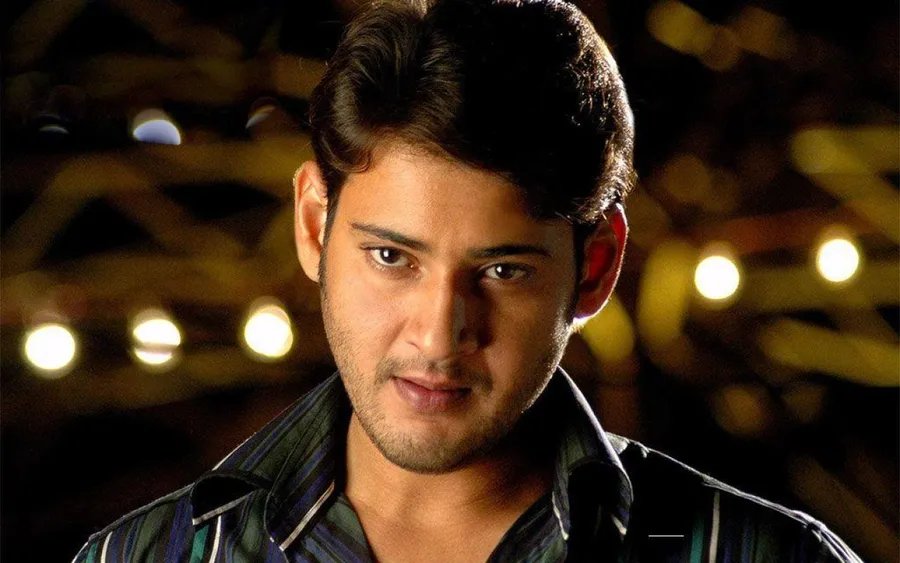

Mahesh Babu Career Journey: From Child Actor to Telugu Cinema Star
Written by RVLNSV PRASAD
Independent Writer & Researcher
Published: August 30, 2026
Last Updated: August 30, 2026
Reading time: 12–15 minutes
Introduction
The Mahesh Babu career journey is unusual because his relationship with cinema began long before he became a leading man.
He appeared in films as a child, stepped away from acting to concentrate on education, and returned almost a decade later as an adult actor. His subsequent career was not simply a sequence of successful films. It was a process of developing, testing, and sometimes reshaping a recognizable screen identity.
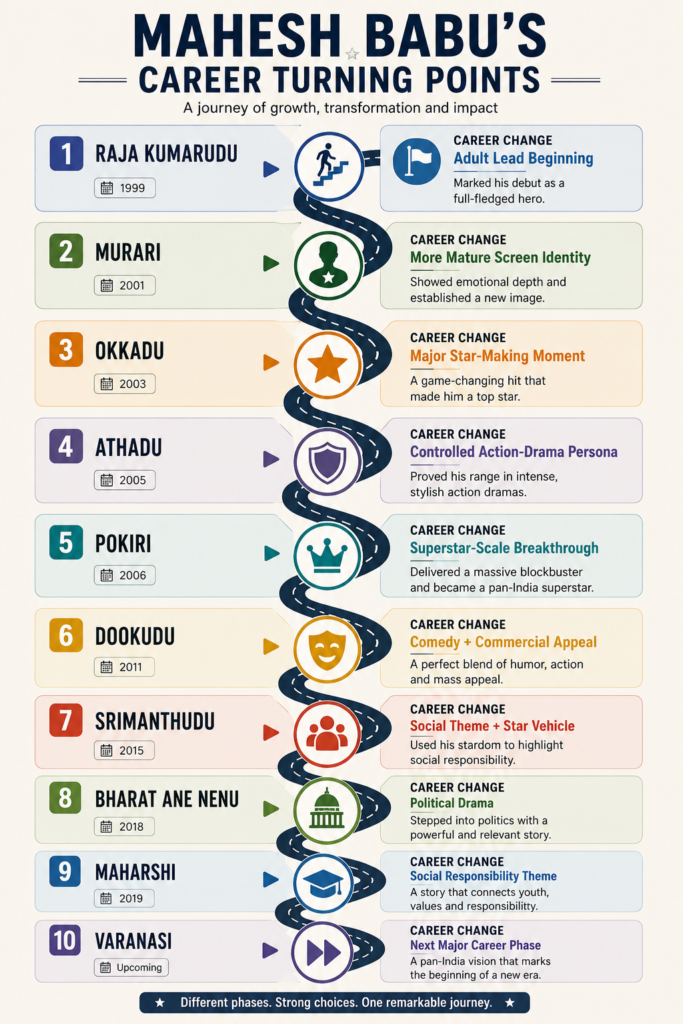
That evolution can be seen through several important stages: the early adult roles that helped him establish himself, Okkadu and Pokiri as major career turning points, the commercial success of Dookudu, later socially themed films such as Srimanthudu, Bharat Ane Nenu, and Maharshi, and the increasingly ambitious scale of his upcoming work.
Rather than treating Mahesh Babu’s life as a list of dates and film titles, this article looks at how his career changed and why particular films mattered.
Key Takeaways
- Mahesh Babu’s career began in childhood, giving him an unusually early connection with Telugu cinema before he later returned as an adult leading actor.
- Raja Kumarudu (1999) marked the beginning of his adult career as a lead actor and established the foundation for his independent screen identity.
- Murari and Okkadu were important developmental stages, with Okkadu becoming a major turning point in his rise as a leading Telugu star.
- Pokiri changed the scale of his stardom, strengthening his action-hero image and creating much greater expectations around his subsequent films.
- His screen identity has continued to evolve, moving through action, comedy, family drama, psychological storytelling, and socially themed commercial cinema.
- Films such as Srimanthudu, Bharat Ane Nenu, and Maharshi connected his established star persona with stories built around broader social themes.
- His public work extends beyond acting, with the Mahesh Babu Foundation documenting initiatives involving children’s healthcare, education, and village development.
- Varanasi represents a new stage in his career, bringing him into a large-scale collaboration with director S. S. Rajamouli and a wider national and international filmmaking context.
- The most useful way to understand his career is through its turning points, rather than simply counting successful films or listing his complete filmography
Mahesh Babu Career at a Glance
- Born: August 9, 1975
- Profession: Actor and producer
- Film industry: Telugu cinema
- Father: Actor Krishna Ghattamaneni
- Child-artist career: Began during childhood
- Adult lead debut: Raja Kumarudu (1999)
- Major early turning point: Okkadu (2003)
- Major commercial breakthrough: Pokiri (2006)
- Later career landmarks: Dookudu, Srimanthudu, Bharat Ane Nenu, Maharshi
- Current major project: Varanasi, directed by S. S. Rajamouli
The dates are only the framework. The more interesting story is what happened between them.
Mahesh Babu Had Two Beginnings in Cinema
Mahesh Babu’s first connection with cinema came during childhood. His father, Krishna, was already an important figure in Telugu cinema, and Mahesh appeared in several films as a child artist.
Recent retrospective reporting by The Indian Express notes that Mahesh Babu had appeared in nine films before finishing school. The same report explains that he subsequently stepped away from films to concentrate on education and later earned a Bachelor of Commerce degree from Loyola College in Chennai.
That creates an unusual structure for his career.
His childhood work was effectively a first introduction to filmmaking. His adult career was a second beginning in which he had to establish himself under his own name and identity.
That distinction is important when discussing a star who came from a prominent film family.
His family background opened the door to cinema, but it did not automatically determine the trajectory of his adult career.
Returning to Cinema as an Adult Lead
Mahesh Babu returned as an adult leading actor with Raja Kumarudu in 1999.
The film, directed by K. Raghavendra Rao and featuring Preity Zinta, introduced him to audiences in a completely different role from his childhood appearances. He received the Nandi Award for Best Male Debut.
The significance of Raja Kumarudu was therefore not simply that it was his first lead film.
It established the starting point from which his adult career could develop.
The years immediately following it were a period of experimentation. Films such as Yuvaraju, Vamsi, Murari, Takkari Donga, and Bobby placed him in different genres and performance situations.
That period matters because he had not yet been reduced to a single “Mahesh Babu formula.”
Finding His Identity Before Stardom
One useful way to look at the early stage of his acting career is as a period of discovery.
Murari, directed by Krishna Vamsi, gave him a more mature dramatic environment. Takkari Donga moved him into a stylized action setting.
These films were different in tone, but together they contributed to a gradual process of establishing his own screen identity.
This is where a career timeline can be misleading.
A film can matter to an actor even when it is not his biggest commercial success.
Mahesh Babu himself later described Murari as a crucial film because it proved that he could act, while identifying Okkadu as the film that made him a star and Pokiri as the film that made him a superstar. In a The Indian Express interview, he specifically distinguished these films according to what each contributed to his career.
That is useful first-hand evidence for understanding his own view of his career.
Okkadu: The First Major Career Transformation
Okkadu, directed by Gunasekhar and released in 2003, is one of the clearest turning points in the Mahesh Babu career journey.
He played Ajay, a young kabaddi player who becomes involved in protecting Swapna, played by Bhumika Chawla.
The film combined romance, action, and emotional drama, but its importance for Mahesh Babu was larger than its genre mixture.
It demonstrated that he could carry a commercially ambitious film through physical performance, emotional stakes and screen charisma.
The News Minute’s analysis of his action-hero image identifies Okkadu as an early milestone in the development of that identity and discusses the physical intensity of his performance.
Mahesh Babu himself later summarized the distinction even more directly: he considered Okkadu the film that made him a star.
That makes Okkadu an important example of a career turning point supported by both retrospective analysis and the actor’s own account.
Pokiri: When the Actor Became a Superstar
If Okkadu established Mahesh Babu as a major star, Pokiri dramatically expanded that position.
Directed by Puri Jagannadh and released in 2006, the film presented Mahesh Babu as Pandu, an action-oriented character whose real identity becomes an important part of the narrative.
The performance was notable for its restraint.
Instead of relying entirely on exaggerated physicality, Mahesh Babu used posture, timing, facial expression, and controlled dialogue delivery to create a character who appeared confident without constantly announcing his power.
A 2026 retrospective by The Indian Express on 20 years of Pokiri argues that the film changed perceptions of what a Telugu mass hero could look like and describes the shift in Mahesh Babu’s screen image.
There is also a remarkable piece of first-person evidence.
In a more recent Indian Express interview about Pokiri and Varanasi, Mahesh Babu discussed the pressure that followed Pokiri and explained how the film changed expectations around his subsequent choices.
This is an important part of the story that a simple filmography misses.
Success did not merely make his career easier.
It also made the expectations surrounding every later film much higher.
What Makes Mahesh Babu’s Acting Style Distinctive?
There is no single formula that explains Mahesh Babu’s performances, but restraint is one recurring characteristic discussed by critics and observers.
His performances often rely on controlled expressions, pauses, dialogue timing, and physical stillness rather than constant exaggerated movement.
That style can work particularly well in commercial cinema because a leading actor may have to communicate confidence, humor, vulnerability, and intensity without changing his basic screen personality.
The News Minute’s analysis of his action-hero image also discusses the contrast between his earlier action-oriented performances and the more restrained style visible in later films.
There is another important piece of evidence: Mahesh Babu has spoken about the importance of understanding the director’s vision and approaching a character according to what the role requires.
In a The Indian Express interview about Sarileru Neekevvaru, he explained that being in sync with his director was important to him and that he was willing to surrender to the director’s vision once he understood the approach.
That provides a more useful explanation of his acting process than simply describing him as “natural” or “versatile.”
The Star Image and the Actor
This creates one of the most interesting tensions in the Mahesh Babu career journey.
Once an actor becomes a major star, audiences do not approach every film as a blank slate.
They already have expectations.
They may expect a certain confidence, appearance, dialogue style, humor, or action persona.
That can help a film succeed.
But it can also make experimentation more difficult.
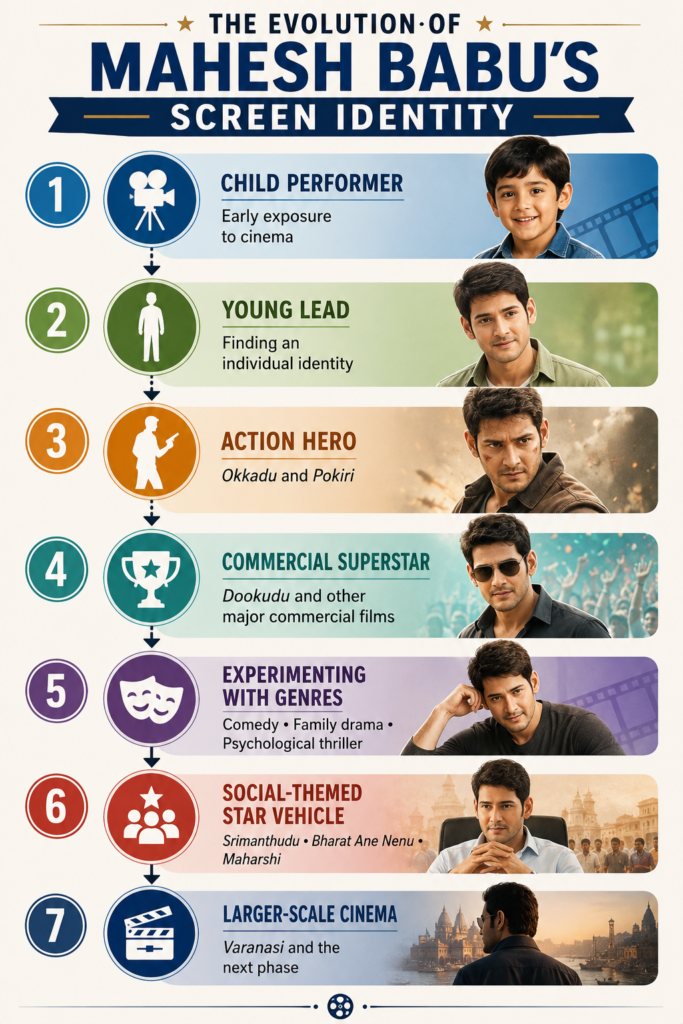
Mahesh Babu’s filmography shows both sides.
Pokiri strengthened his action identity.
Athadu demonstrated a quieter combination of action and drama.
Dookudu added comedy to the commercial formula.
1: Nenokkadine moved into a more psychologically unusual space.
Later films such as Srimanthudu, Bharat Ane Nenu, and Maharshi incorporated explicit social themes.
The career therefore contains an ongoing negotiation between the actor audiences want to see and the actor a particular director wants to use.
That tension is more revealing than simply counting hits.
Dookudu and the Expansion of the Commercial Formula
Released in 2011 and directed by Srinu Vaitla, Dookudu showed another side of Mahesh Babu’s commercial appeal.
The film combined action with comedy and family-oriented entertainment.
This mattered because it demonstrated that his popularity did not depend solely on the intense action persona established by Pokiri.
Comedy requires timing.
It also requires an actor to allow other performers and situations to generate humor without losing control of the central character.
The success of Dookudu therefore expanded the range of the established star image.
Films That Tested Different Versions of Mahesh Babu
The years that followed included films that approached his image in different ways.
The businessman returned to an intense commercial style.
Seethamma Vakitlo Sirimalle Chettu placed him within an ensemble family drama.
1: Nenokkadine attempted a psychologically more complex thriller.
Not every experiment produced the same commercial result.
But that is precisely why they belong in a serious discussion of his career.
A career is not only the collection of its biggest successes.
It also includes the films through which an actor and director test what audiences will accept from an established star.
When Social Themes Became Part of His Cinema
Another important phase emerged with films that combined the established Mahesh Babu star image with social themes.
Srimanthudu connected wealth and privilege with responsibility toward rural communities.
Bharat Ane Nenu placed him in a political setting, while Maharshi explored themes involving agriculture, rural life, and social responsibility.
The significance of these films is not simply that they contain messages.
Their more interesting feature is the combination:
major commercial star, accessible entertainment, and explicit social ideas.
That combination became an identifiable part of Mahesh Babu’s later screen identity.
His own comments support the importance of these films in his career. In the Indian Express interview about Maharshi, he described Murari, Okkadu, Athadu, and Pokiri according to the different stages they represented in his development as an actor.
Mahesh Babu Beyond Acting
Mahesh Babu’s public career extends beyond film performances.
One area that can be documented through primary evidence is philanthropy.
The Mahesh Babu Foundation’s official About Us page describes the organization as supporting children with heart ailments, education for children from disadvantaged families, and village development. The Foundation also states that it has supported more than 2,000 heart surgeries in collaboration with hospitals.
The Foundation’s own homepage further identifies its work in medical assistance, education, and development activities in Burripalem and Siddhapuram.
These primary sources are more useful than repeating generic claims that Mahesh Babu “helps poor people.”
Philanthropy and Public Responsibility
The Foundation’s published work provides concrete examples.
Its Children’s Cardiac Surgical Camp records a February 2024 camp during which four children underwent heart surgery through an initiative involving Andhra Hospitals and Healing Little Hearts.
The Foundation has also published details of health camps in Burripalem. Its 2025 records include a multispecialty camp where 132 adults and children received free check-ups, investigations, and medicines.
Its Our Work archive documents other initiatives, including scholarships, health camps, and an HPV vaccination drive.
This distinction matters for EEAT.
The article should report what the Foundation documents rather than turning philanthropy into promotional language.
How His Career Changed in the 2020s
Mahesh Babu’s 2020s filmography includes Sarkaru Vaari Paata and Guntur Kaaram.
But the larger context is changing around him.
Telugu cinema has become increasingly visible to audiences outside its traditional market, while large-scale Indian productions increasingly aim for simultaneous national and international attention.
For Mahesh Babu, that creates a different career question.
The challenge is no longer simply maintaining his position within Telugu cinema.
It is how his established screen identity can function within productions built for a much broader audience.
Varanasi: The Next Chapter
That makes Varanasi particularly significant.
Directed by S. S. Rajamouli, the film features Mahesh Babu alongside Priyanka Chopra Jonas and Prithviraj Sukumaran.
Current reporting has placed the theatrical release on April 7, 2027.
The project is important to the Mahesh Babu career journey because it represents a different scale of filmmaking and a collaboration with a director whose work has reached audiences far beyond the traditional Telugu market.
A recent Indian Express reporting on Mahesh Babu, Rajamouli and Varanasi also connects the project with Mahesh Babu’s own reflections on the career pressure that followed Pokiri.
That creates an interesting career parallel.
Pokiri changed what audiences expected from Mahesh Babu.
Varanasi could potentially create another major shift.
But that is a possibility, not a fact.
Until the film is released, claims about records or guaranteed global success should remain speculation.
What Makes Mahesh Babu’s Career Journey Different?
1. Two distinct beginnings
His childhood film appearances and adult lead career were separated by a substantial period away from acting.
2. A gradual adult identity
His adult career was built through several films rather than a single overnight transformation.
3. Okkadu changed his position.
Mahesh Babu himself has described Okkadu as the film that made him a star.
4. Pokiri changed the scale.
He has described Pokiri as the film that made him a superstar, while later reflecting on the enormous expectations it created.
5. The screen persona continued to evolve.
His filmography has moved through action, comedy, family drama, psychological material, and social themes.
6. His public identity extends beyond cinema.
The Mahesh Babu Foundation documents work in children’s healthcare, education, and village development.
7. Varanasi represents a new scale.
The Rajamouli collaboration provides a new context in which his established Telugu star image can be presented to wider audiences.
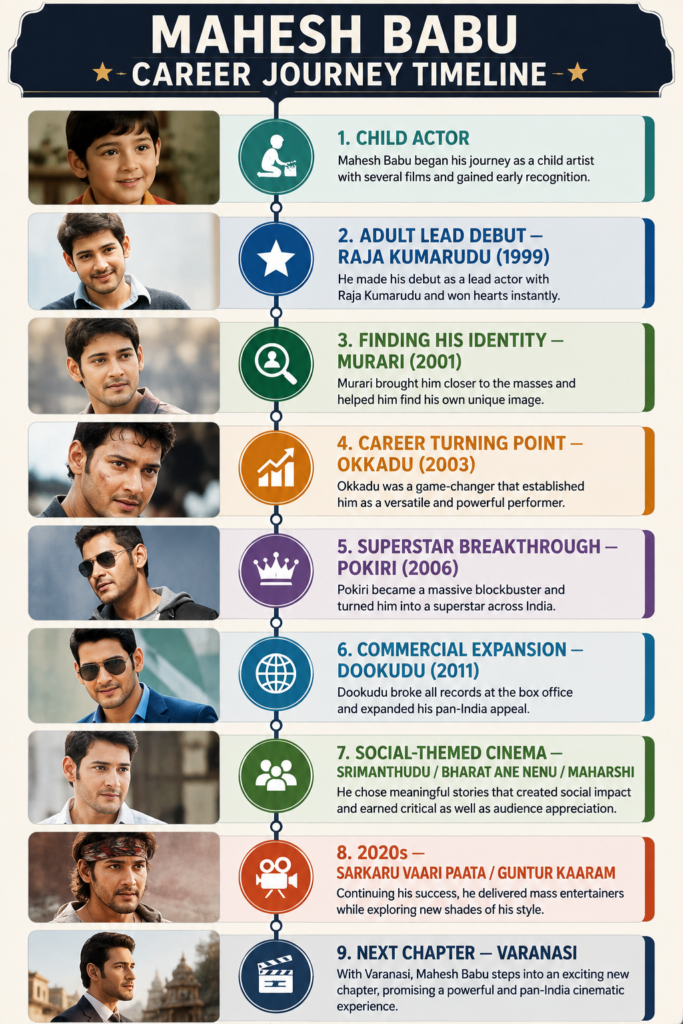
Mahesh Babu Career Timeline
1975 — Born on August 9 in Madras, now Chennai.
Childhood—Begins appearing in Telugu films as a child artist.
1999 — Makes his adult lead debut with Raja Kumarudu.
2001—Murari becomes an important stage in his development as an actor.
2003 — Okkadu becomes a major career turning point.
2005 — Athadu further develops his screen identity.
2006 — Pokiri dramatically expands his commercial stature.
2011 — Dookudu combines his established star appeal with comedy and family entertainment.
2015 — Srimanthudu combines commercial cinema with a social theme.
2018 — Bharat Ane Nenu explores political drama.
2019 — Maharshi continues the socially themed strand of his filmography.
2022—Sarkaru Vaari Paata releases.
2024—Guntur Kaaram releases.
2026 — Attention turns toward Varanasi, his major collaboration with S. S. Rajamouli.
2027 — Varanasi is currently scheduled for theatrical release on April 7.
Frequently Asked Questions
When did Mahesh Babu start acting?
Mahesh Babu began appearing in Telugu films as a child before stepping away from cinema to concentrate on education. He later returned as an adult lead actor.
What was Mahesh Babu’s first adult lead film?
Raja Kumarudu, released in 1999, marked his adult lead debut.
Which film changed Mahesh Babu’s career?
Okkadu was a major early turning point. Mahesh Babu himself has described it as the film that made him a star.
Why was Pokiri important to Mahesh Babu?
Pokiri significantly expanded his commercial stature and helped establish a distinctive mass-hero image. Mahesh Babu has also spoken about the pressure and expectations that followed the film’s success.
How has Mahesh Babu’s acting style changed?
His performances have moved between action, comedy, family drama, psychological material, and socially themed roles. Critics have also discussed a more restrained performance style in parts of his later filmography.
What is Mahesh Babu’s next major film?
His major upcoming project is Varanasi, directed by S. S. Rajamouli. Current reporting places its theatrical release on April 7, 2027.
Conclusion
The Mahesh Babu career journey is more interesting when viewed as an evolution of screen identity rather than a simple collection of successful films.
He began as a child performer, returned as an adult lead, developed through films such as Murari and Okkadu, and reached a dramatically different level of stardom with Pokiri.
Later films showed an established star moving between comedy, family drama, psychological storytelling, action, and social themes.
His philanthropic work also created a public identity beyond cinema, while Varanasi presents another potentially important stage in his professional journey.
The future of that journey will ultimately be determined by the films themselves.
For now, the clearest conclusion is that Mahesh Babu has remained relevant not because his screen image never changes, but because filmmakers have repeatedly found new ways to use it.
Sources and Further Reading
Primary sources
- Mahesh Babu Foundation—About Us—Foundation background, healthcare, education, and village-development information.
- Mahesh Babu Foundation—Current overview of medical, education, and village initiatives.
- Mahesh Babu Foundation — Our Work — Documented initiatives and recent activities.
Reputable secondary sources
- The Indian Express—Mahesh Babu’s child-artist years—Early film career and education.
- The Indian Express—Mahesh Babu on important career films—First-person comments on Murari, Okkadu, Athadu, and Pokiri.
- The Indian Express—20 years of Pokiri—Career and screen-image analysis.
- The Indian Express—Pokiri, career pressure, and Varanasi—Mahesh Babu’s reflections on the post-Pokiri period and Varanasi.
- The News Minute—Mahesh Babu’s action-hero image—Analysis of his action performances and evolving screen persona.
- The Indian Express—Mahesh Babu on working with directors—First-person comments about his approach to roles and directors.
Author’s Note
Written by RVLNSV PRASAD
Independent Writer & Researcher
This article focuses on the evolution of Mahesh Babu’s screen career rather than presenting a conventional celebrity biography. It was researched and updated in August 2026 using publicly available primary and reputable secondary sources.
More Stories From This Blog
- Athiya Shetty: The Rising Bollywood Actress Making Waves in the Industry
- Hollywood Actors and Their Philanthropic Activities: Spotlight on Heroism Beyond the Screen
- Exciting Upcoming Telugu Movies in 2025: A Comprehensive Guide
- Home