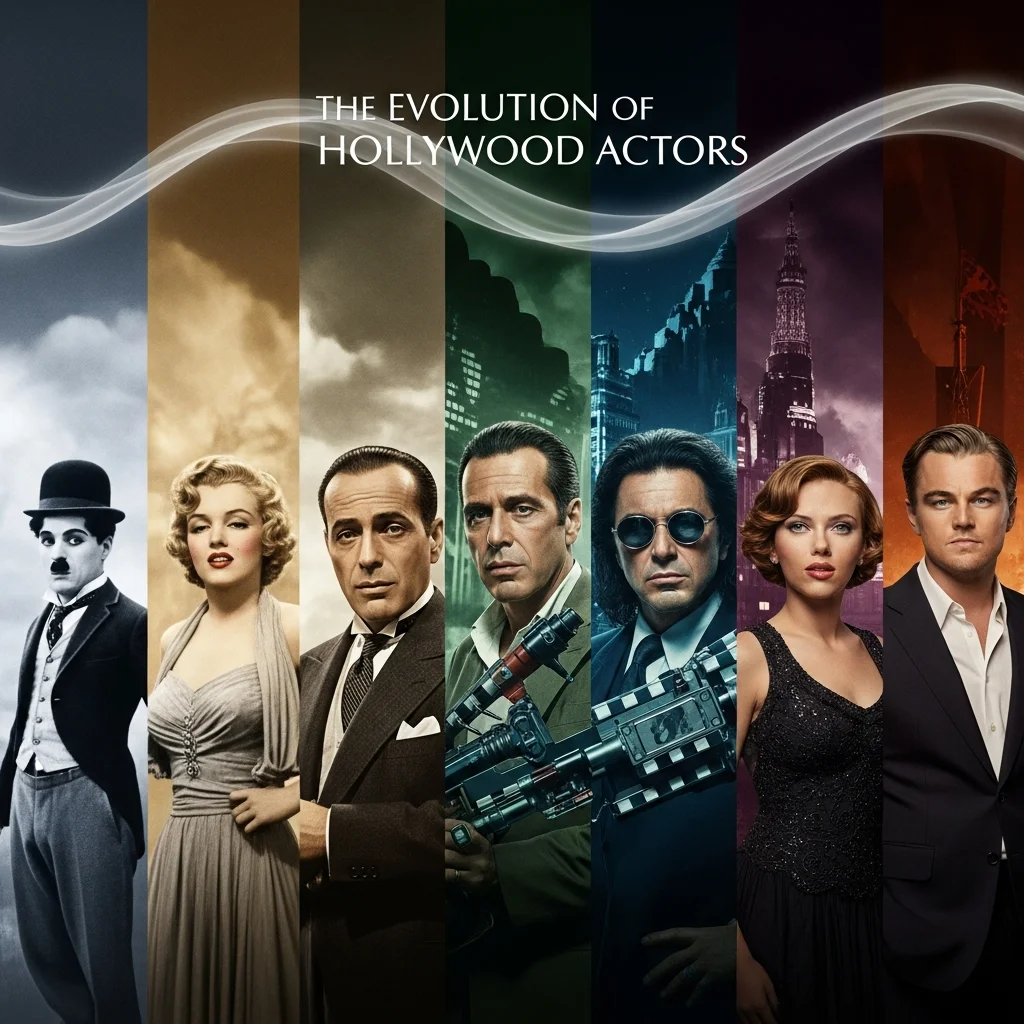
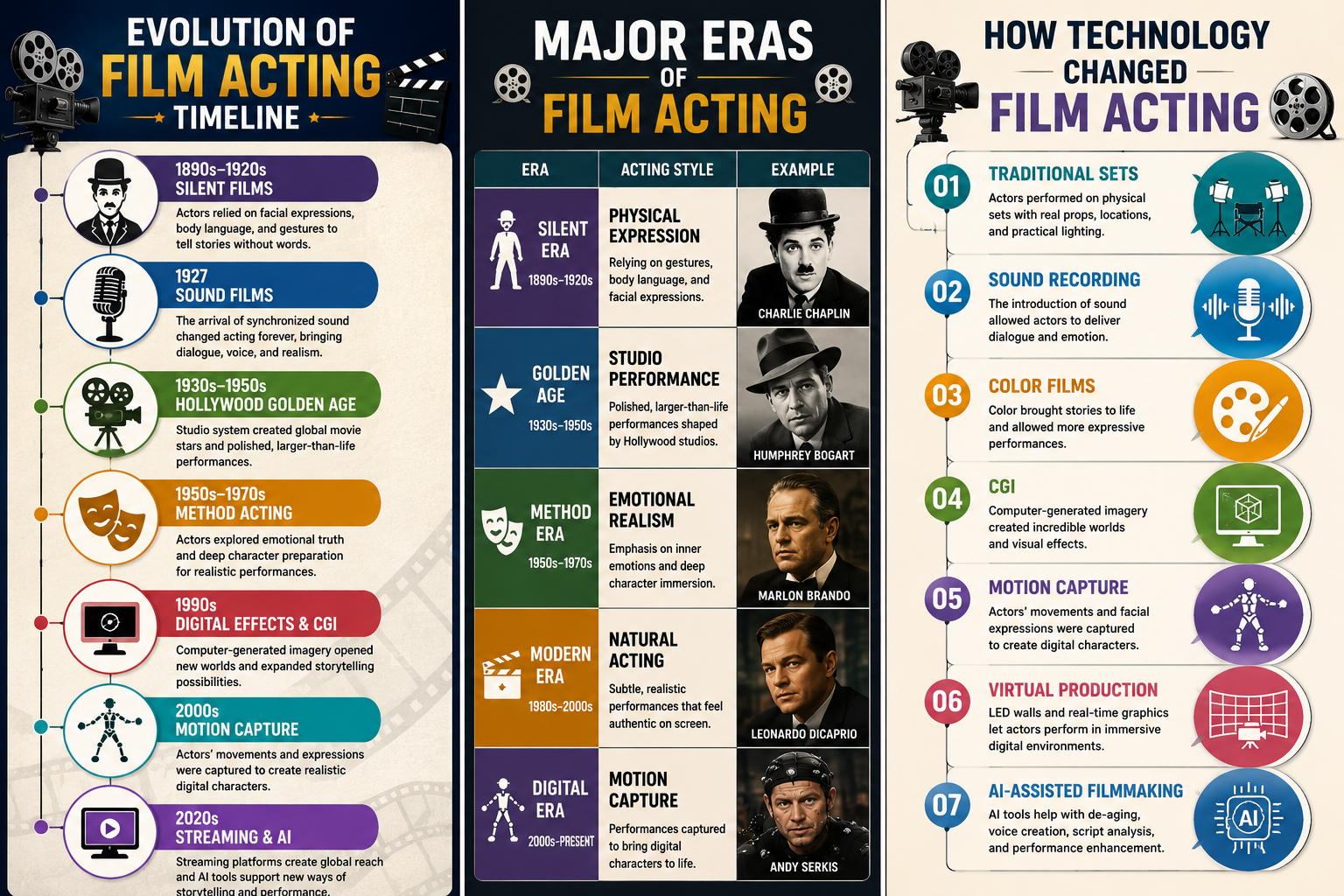

The Evolution of Film Acting: From Silent Movies to the Digital Age
Written by RVLNSV Prasad
Updated August 2026
Author Bio
RVLNSV Prasad is a content writer and entertainment researcher who covers cinema history, film industry trends, and popular culture.
Key Takeaways From the Evolution of Film Acting
Example:
- Technology changes acting tools.
- Human emotion remains central.
- Audiences increasingly value authenticity.
- AI may assist actors but is unlikely to replace human performance entirely.
Introduction
The evolution of film acting is one of the more fascinating stories in the history of the movies. Over the last century, acting has changed drastically as technology, storytelling, and audience expectations have developed.
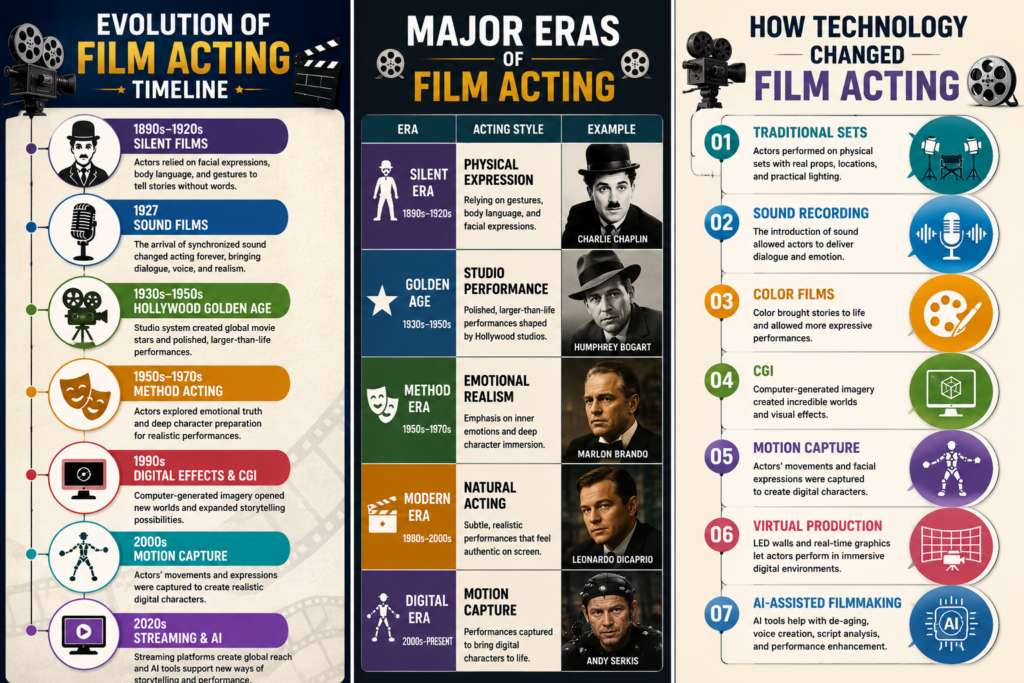
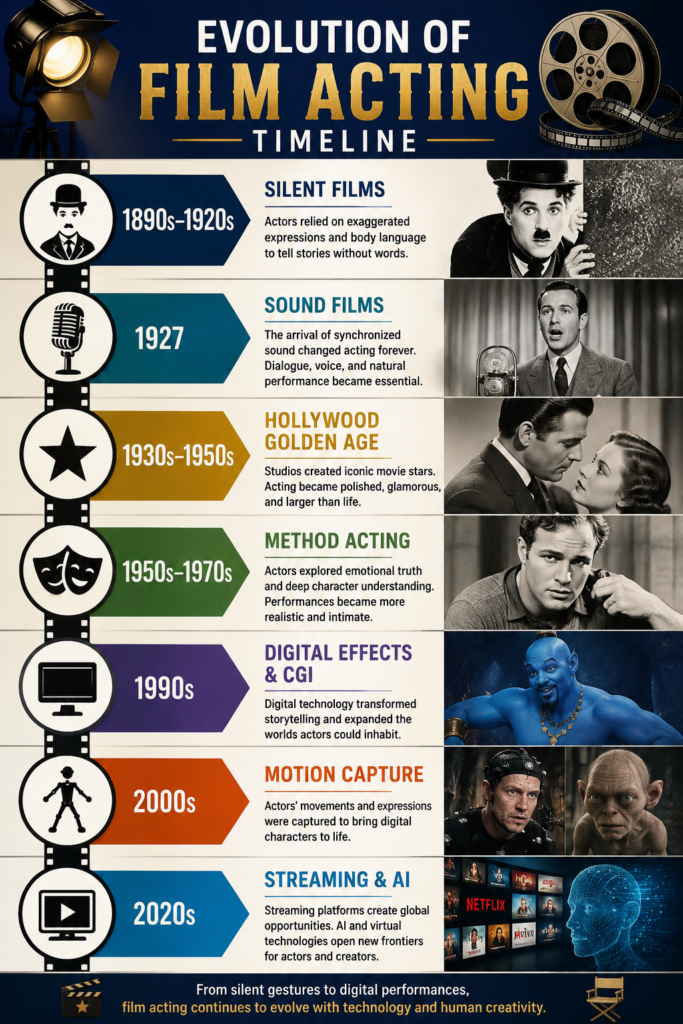
In the early days of filmmaking, there was no sound in films, so actors had to use only their facial expressions and body language. Later, the coming of sound to motion pictures changed the nature of performance, leading to a more natural style of acting. The Golden Age of Hollywood gave us movie stars known around the world, while method acting introduced a greater emotional reality to the screen. Today’s actors are working with sophisticated technologies such as CGI, motion capture, and virtual production.
Audiences still expect real performances and compelling stories; thus, film acting is still changing. And at the same time, filmmakers are always exploring new techniques to make characters come alive.
This essay explores the evolution of film acting, from the silent era to today’s streaming services and AI-generated films. We will also look at the significant developments that defined the industry and the actors who defined each era.
- Encyclopaedia Britannica – History of Motion Pictures
- British Film Institute (BFI)
What Is Film Acting, and Why Does It Matter?
Film acting is the art of portraying characters in movies. Film acting is designed for the camera, unlike theatrical acting. Subtle facial expressions, small movements, and natural dialogue can portray great emotions.
Great acting connects audiences to the characters and makes them care about a story. A memorable performance turns an excellent movie into a classic.
Since then, film acting has never been the same. The constant evolution of technology, culture, and filmmaking techniques has impacted the ways actors perform on screen. So over the decades each generation has developed its own particular style of acting.
The Birth of Film Acting (1890s-1920s)
Acting in film has a history dating back to the late nineteenth century, beginning with the introduction of the first motion pictures.
Many of the early actors had come from the theater. Many early film actors came from theater backgrounds, where performers were trained to project their voices and use large gestures. and to employ large gestures because the audiences often sat far away from the stage. When these performers transitioned to film, they initially employed the same approaches.
Silent films have their own obstacles. There was no spoken dialogue; thus, the actors had to show emotions with facial expressions, posture, and movement. Performances were often exaggerated, as opposed to modern acting approaches.
- BFI Silent Film Archive
- BFI Silent Film
- Silent Film History
The era was defined by a few pioneers.
Charlie Chaplin
Charlie Chaplin is one of the most recognized individuals in the history of cinema. The Tramp, his character, blended comedy, emotion, and physical performance that made sense to audiences all around the world.
Buster Keaton
Buster Keaton, with his stone face and incredible athletic acrobatics, proved that a story told visually could hold an audience spellbound without any words being spoken.
Lilian Gish
Lillian Gish is often regarded as one of the first true film actors. She helped make screen acting more realistic and demonstrated that delicate acting could work on camera.
Filmmakers began to adapt to camera techniques like close-ups. Acting became less theatrical and more realistic. This change paved the way for the screen performances we see today.
- Encyclopaedia Britannica – History of Motion Pictures
- Academy Museum of Motion Pictures
How Sound Films Changed the Evolution of Film Acting
The arrival of synchronized sound was one of the key turning points in the history of movies.
The era of the talking picture began with The Jazz Singer (1927), the first “talkie.” Actors could suddenly speak directly to audiences. This technological breakthrough forever transformed the trade.
- Encyclopaedia Britannica – The Jazz Singer
- Academy of Motion Picture Arts and Sciences
New performance skills were required
- Clear speech
- Good voice control
- Natural flow of dialogue
- Timing improved
Many stars of the silent film era had a difficult time adjusting. Some had voices that audiences did not expect. Some had difficulty adjusting their performance style.
Simultaneously, it opened new possibilities for actors who could not only deliver screen presence but also vocal performances.
Sound technology got better, and acting became more realistic. Subtle emotions replaced the over-the-top gestures, and audiences came to expect convincing dialog and real characters.
The Rise of the Movie Star in Hollywood’s Golden Age
People commonly refer to the 1930s through the 1950s as the Golden Age of Hollywood.
The major studios—MGM, Warner Bros., Paramount, and 20th Century Fox—controlled much of the industry. They signed performers to long-term contracts and took care of their careers.
- BFI Film History
- Encyclopaedia Britannica – Hollywood Studio System
During this period, studios spent money training actors. What performers learned:
- Speaking in public
- Dancing
- Voice training
- Motion
- Screen Presence
This period gave birth to many legendary stars.
Humphrey Bogart
Bogart became known for his gritty, captivating performances in movies like Casablanca.
Cary Grant
Grant was noted for his charisma, refinement, and ease before the camera.
Audrey Hepburn
Hepburn was elegant, intelligent, and warm and one of cinema’s most popular actresses.
Marilyn Monroe
Monroe became an international superstar, and her impact still echoes decades after her career ended.
The Golden Age gave birth to the cinema star and helped set acting standards that affected generations of artists.
The Revolution of Method Acting
The emergence of method acting was one of the most important advances in modern acting.
Method acting originated from Russian theater director Konstantin Stanislavski. His method required actors to explore their characters from within and to generate genuine emotional experiences. (Method Acting History)
As Stanislavski famously said:
“There are no small parts, only small actors.”
His theories were influential for a number of American acting teachers, including Lee Strasberg, Stella Adler, and Sanford Meisner. (BFI Method Acting History)
Method acting urged actors to:
- Lean on personal experiences
- Get inside the psychology of the character
- Respond naturally
- Create emotional reality
The style was closely associated with several actors.
Marlon Brando
Brando revolutionized movie acting with strong, seemingly spontaneous, genuine performances. Many film historians consider him one of the most influential actors in the history of film.
James Dean
Dean’s emotionally honest performances really connected with younger audiences.
Al Pacino
Pacino contributed a remarkable intensity and authenticity to films such as The Godfather.
Robert De Niro
De Niro gained renown for his total immersion in performances, helping to create modern character acting.
Method acting altered the expectations of the viewer and helped create psychological realism as the foundation of modern cinema. (BFI Method Acting History)
Global Influences on Film Acting
Film acting has always developed in response to outside influences.
With foreign filmmaking becoming more accessible, filmmakers and actors learned from each other. This cross-pollination of ideas enriched acting techniques around the world.
European Cinema
European filmmakers often focused on authenticity, emotional depth, and artistic storytelling. Their influence encouraged more natural performances.
Japanese Movies
Akira Kurosawa and other directors helped make a style of acting popular that combined emotional control with great dramatic moments.
Indian Film Industry
Indian cinema offered audiences a combination of realism, music, dance, and larger-than-life storytelling. Bollywood stars earned international fame.
Latin American Cinema
Latin American films offered new viewpoints, with performances grounded in indigenous cultures and experiences that were emotionally powerful.
Today actors operate in many countries and languages. International collaboration continues to extend the scope of film performance.
- BFI World Cinema
- Criterion Collection
- UNESCO Cultural Diversity resources
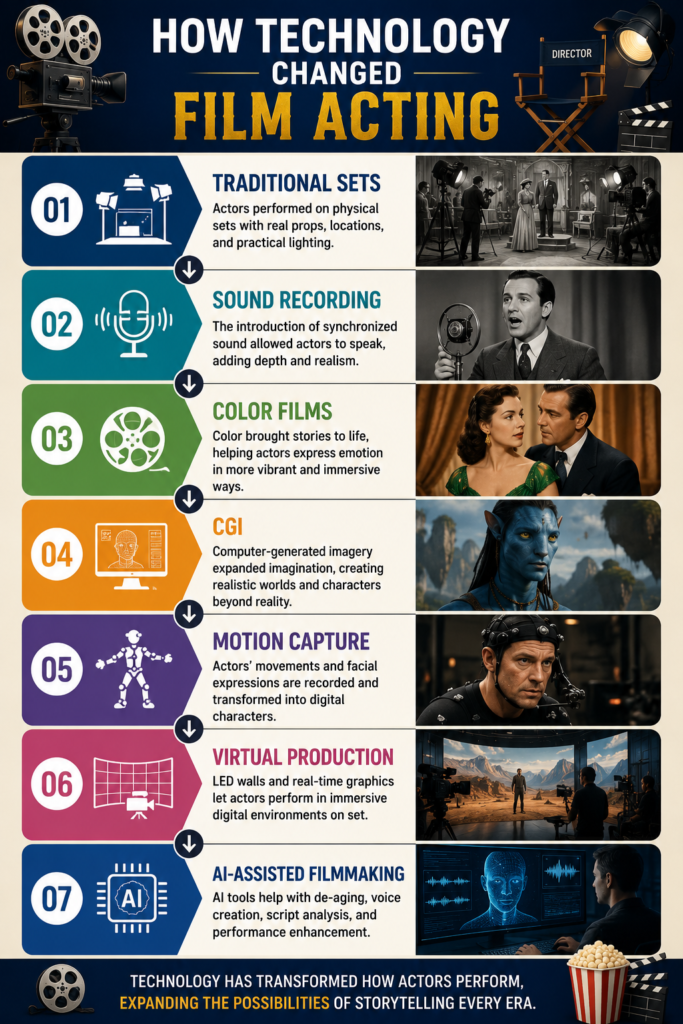
Technology and Modern Film Performance
Technology has changed almost everything about making movies, including the acting.
But today’s performers operate in conditions that would have been unimaginable decades ago.
CGI & Green Screens
Actors often act in front of green screens and imagine places, creatures, and visual effects that will be added later.
Motion Capture
Motion capture technology records the movements of an actor’s body and face and translates them into digital characters with realistic appearances.
Andy Serkis is one of the most notable examples.
His portrayal as Gollum in The Lord of the Rings and Caesar in Planet of the Apes showed that computer characters can be emotionally impactful.
Virtual Productions
Modern productions are increasingly using LED walls and virtual environments. These technologies allow performers to interact with realistic digital surroundings during the filming process.
With the development of technology, performers need to learn new technical skills, but they still need to deliver real emotional performances.
- Academy Awards
- Weta Workshop
- Britannica Motion Capture
Independent Films and Realistic Acting
These independent cinemas have had an immense influence on acting styles.
Independent films tend to focus on realistic characters and personal stories, rather than the big studio blockbusters.
These movies usually have:
- Smaller budgets
- Real-world locations
- Character-driven narratives
- Intimate performances
Independent directors tend to encourage actors to be natural, rather than use dramatic techniques.
This made audiences appreciate nuanced and authentic performances more.
Many talented actors develop their skills in independent films before they become well-known.
How Acting Styles Have Changed According to Audience Expectations
One thing that many articles on film history tend to forget is the role of audiences.
Viewer habits change; thus, the acting techniques change.
Audiences supported exaggerated acting during the silent film period because it was required to tell a story visually.
During the golden age of Hollywood, dazzling cinema stars entertained viewers by representing aspiration and imagination.
The Method acting era was a time of increasing interest in realism and emotional honesty.
Today’s viewers tend to enjoy people who are believable and relatable. Social media and “behind-the-scenes content” have made the viewers more aware of performers as real people.
Because of this trend, modern performances generally emphasize authenticity rather than the theatrical.
Audience expectations, technology, and training methods have all played a part in shaping acting.
Streaming Platforms and New Opportunities for Actors
Streaming services have revolutionized the entertainment industry.
Netflix, Disney+, Prime Video, and others have created a greater desire for entertainment than ever before.
This expansion has created new opportunities for actors around the world.
The benefits include:
- More acting opportunities
- Global exposure
- Diverse storytelling
- International collaborations
Today, a streaming series watched by millions of fans in different countries may make an actor a star throughout the world.
The rise of streaming services has also created demand for authentic acting—people tend to watch shows on their phones, where more nuanced acting can be appreciated.
AI, Digital Avatars, and the Future of Acting
Artificial intelligence is an emerging topic in the entertainment business.
Artificial intelligence technology can:
- Design digital characters
- Upgrade visual effects
- Generate voices
- Recreate appearances
Some filmmakers are experimenting with digital avatars that can perform alongside human performers.
These changes raise significant questions.
Will AI replace actors?
Most industry professionals believe that human performers will continue to be important. Technology can replicate appearances and voices, but real human creativity, emotion, and connection are harder to mimic.
The future will probably be a combination of performers and technology rather than replacement.
Core Skills for Successful Actors Today
Today’s actors need a broad skill set.
Emotional Intelligence
Actors must grasp human behavior and emotions.
Adaptability
This is an ever-evolving industry. The successful performers learn new approaches and technologies.
Voice Control
You still need a strong voice for movies, TV, animation, and streaming platforms.
Physical Performance
Many jobs involve movement training, stunt work, or dancing.
Motion Capture Knowledge
Experience in motion capture is becoming increasingly valuable as digital productions are more widespread.
Business Communication
Actors often collaborate with directors, writers, producers, and big creative teams.
Social Media Awareness
The management of a public image has become a significant aspect of many acting careers.
Actors need to continue learning to stay competitive in a continually changing field.
- SAG-AFTRA
- World Economic Forum
- MIT Technology Review
- Stanford HAI
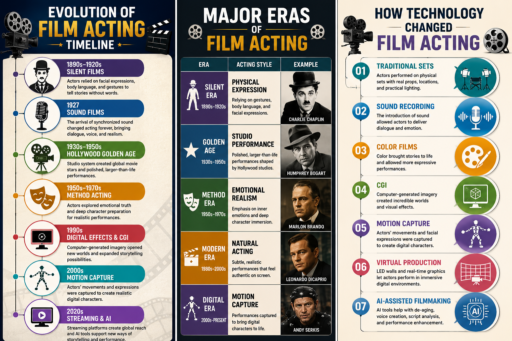
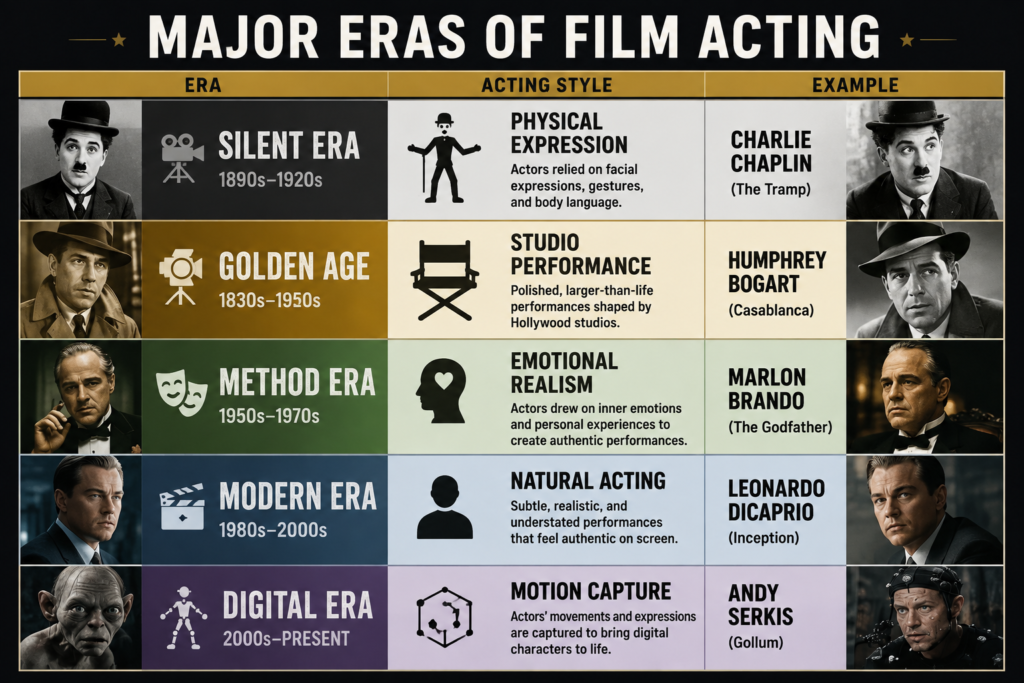
Evolution of Film Acting: A Quick Comparison
| Era | Acting Style | Famous Examples |
|---|---|---|
| Silent Era | Physical Expression | Charlie Chaplin |
| Golden Age | Theatrical Realism | Humphrey Bogart |
| Method Era | Emotional Realism | Marlon Brando |
| Modern Era | Naturalistic Acting | Leonardo DiCaprio |
| Digital Era | Motion Capture | Andy Serkis |
Conclusion
The evolution of film acting is a record of more than a century of artistic invention, technological development, and cultural shift.
From the emotive performances of silent cinema to the emotional reality of method acting, every age has added something to the craft. Unforgettable icons of Hollywood’s Golden Age and the expanding storytelling possibilities of international cinema have shaped the craft. CGI, motion capture, and virtual production came with advances in technology, providing actors entirely new performing tools.
At the same time, changing audience expectations have continued to influence acting styles. Today’s audience craves authenticity, emotional depth, and believable people.
Looking forward, artificial intelligence and digital technologies will continue to affect filmmaking. But the basic goal of acting is not likely to change. And audiences will always respond to performances that make real emotional connections.
The future of cinema may be very different from its history, but the human ability to bring stories and characters to life will remain at the heart of film acting for generations to come.
Frequently Asked Question
1. What is film acting?
The art of acting in films is portraying characters through dialogue, facial expressions, body language, and emotional performance.
2. Why did silent-film actors utilize over-the-top movements?
There was no dialogue in silent films, and hence the actors had to portray emotions and parts of the plot through their bodily reactions.
3. What were some of the most famous silent film actors?
Some of the most significant silent-film actors were Buster Keaton, Charlie Chaplin, and Lillian Gish.
4. What is method acting?
Method acting is a technique designed to produce authentic performances through emotional truth and profound character knowledge.
5. How did sound change film acting?
With the debut of sound movies, performers could talk, act more naturally, and emphasize their vocal ability.
6. What is the function of technology in acting today?
Technology has made CGI, motion capture, virtual production, and digital filmmaking possible and requires new abilities from actors when performing.
7. Could artificial intelligence replace human actors?
Artificial intelligence can be a tool for filmmakers, but the human spark of creativity, emotion, and personal expression is still difficult to fully replicate.
8. What is the future of film acting?
We will certainly see a mix of conventional acting skills with new technologies, but the focus will remain on authentic storytelling.
.
Sources
- Britannica Film History
- British Film Institute (BFI)
- Academy of Motion Picture Arts and Sciences
- Library of Congress National Film Registry
- Actors Studio History
More Stories From This Blog
- Home
- Rising Stars: Upcoming Bollywood Actors You Should Keep an Eye On
- Emerging Actors in Global Cinema 2025
- Breakthrough Performances by New Actors: A New Era in Cinema